
West Asia Crisis : Geopolitical Shifts and India’s Security Concerns
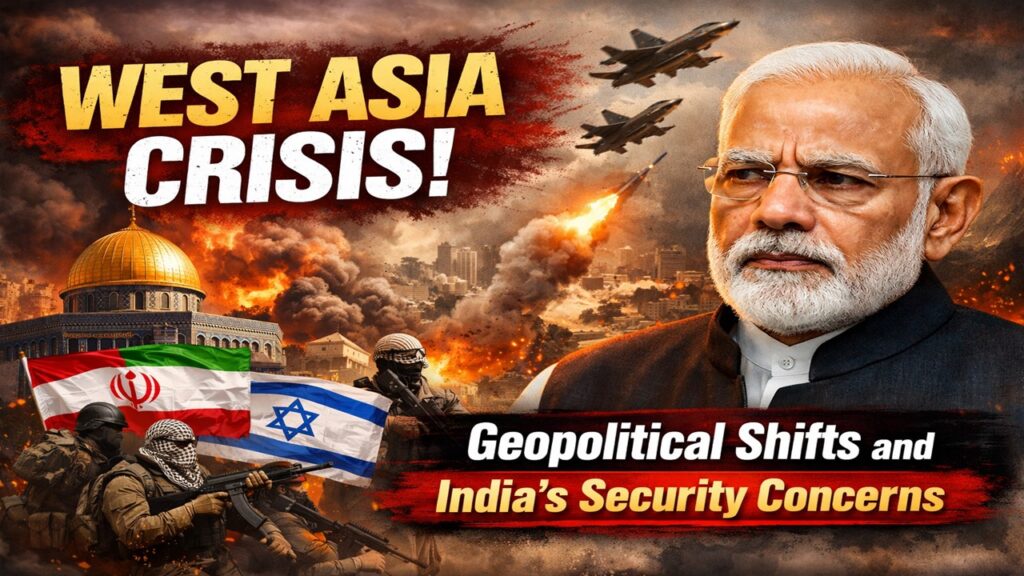
Context
The ongoing conflict involving Iran, Israel, and the United States, which began with strikes on February 28, has intensified geopolitical tensions in West Asia. The war has expanded beyond a limited military confrontation and is now reshaping the region’s strategic, security, and economic dynamics. The developments have serious implications for global energy security, regional alliances, and India’s strategic interests in the Gulf region.
Introduction
The Iran war has evolved into a major geopolitical conflict aimed at altering the balance of power in West Asia. While the United States and Israel seek to weaken Iran’s ideological and strategic influence, the conflict has exposed the vulnerabilities of regional security arrangements and created wider global repercussions. For India, which has deep economic and strategic stakes in the region, the conflict presents significant diplomatic and security challenges.
Nature of the Conflict
Ideological and Strategic Objectives
The conflict is not merely aimed at eliminating an immediate military threat. Instead, it seeks to weaken the ideological foundations of the Iranian regime that drive its regional policies and support for militant groups.
Regime Change as a Strategic Goal
Israel and the United States believe that regime change in Iran could reduce regional instability and end Tehran’s ideological influence in West Asia.
Targeting Iran’s Strategic Capabilities
The military campaign has focused on weakening Iran’s military infrastructure, missile capabilities, and strategic installations, including oil and energy infrastructure.
Iran’s Regional Influence through Proxy Actors
Support to Non-State Actors
Iran has historically supported several militant organizations across West Asia, using them as tools of proxy warfare.
Hezbollah in Lebanon
The Iran-backed Hezbollah has significant influence in Lebanon and has even affected the formation of governments in the country.
Houthis in Yemen
The Houthi movement in Yemen, supported by Iran, controls significant territory and has carried out missile strikes against regional targets.
Shia Militias in Iraq
Iran also maintains strong influence over Shia militia groups in Iraq, which play an important role in regional power politics.
Hamas and the October 7, 2023 Attack
Iran’s alleged support to Hamas during the October 7, 2023 attack on Israel intensified Israeli military retaliation and exposed Iran’s proxy network.
Changing Regional Strategic Dynamics
Normalization Between Arab States and Israel
Concern over Iran’s regional ambitions pushed several Gulf states toward diplomatic normalization with Israel under the Abraham Accords.
Expansion of the War Beyond Iran
Following heavy bombardment in June 2025, Iran widened the conflict by targeting U.S. military bases and regional strategic assets.
Threat to Global Energy Infrastructure
Strikes on oil depots, oil fields, and gas installations have raised concerns over disruptions to global energy supply.
Strategic Importance of the Strait of Hormuz
Iran has threatened to disrupt shipping through the Strait of Hormuz, through which nearly one fifth of the world’s oil supply passes.
Limitations of the U.S. Strategy
Difficulty of Achieving Regime Change
Historical experience suggests that regime change through aerial bombardment alone is difficult, especially without deployment of ground forces.
Differences Between U.S. and Israeli Approaches
Israel appears willing to pursue a prolonged military campaign, whereas the United States seeks to avoid a long conflict due to economic and political costs.
Mixed Strategic Signals
The United States has sent mixed signals about continuing or ending the war, reflecting internal political and strategic debates.
Crisis of Gulf Security Arrangements
Origins of the U.S. Security Guarantee
After the 1979 Iranian Revolution, the United States assured Gulf states that it would defend the Persian Gulf region against external threats.
Dependence of Gulf States on U.S. Protection
For decades, Gulf monarchies relied heavily on the U.S. military presence and security guarantees for their defence.
Exposure of Security Vulnerabilities
Iran’s strikes on U.S. military bases and energy infrastructure in Saudi Arabia, UAE, Qatar, Bahrain, Jordan, Iraq, Syria, and Oman have exposed weaknesses in the existing security framework.
Possible Transformation of Regional Security Architecture
Some Gulf states are reportedly exploring reducing dependence on U.S. military bases and security arrangements, which could fundamentally reshape regional security dynamics.
Implications for Global Geopolitics
Opportunity for China and Russia
A prolonged U.S. engagement in West Asia may reduce Washington’s strategic attention toward China and Russia, giving them greater geopolitical space.
Impact on Global Energy Markets
Rising oil prices benefit energy-exporting countries like Russia, while creating economic pressures for major importers such as India and China.
Implications for India
Energy Security Concerns
India imports a significant share of its oil from West Asian countries, making regional stability crucial for India’s economy.
Protection of Indian Diaspora
Millions of Indian expatriates live and work in Gulf countries, making their safety a major concern during regional conflicts.
Need for Balanced Diplomacy
India maintains strong relations with Iran, Israel, and Gulf states, requiring a careful and balanced diplomatic approach.
Need for a Comprehensive Regional Policy
India’s approach to West Asia should move beyond individual bilateral relations and develop a coherent regional strategy to manage competing interests.
Lessons for India’s National Security
Importance of Strategic Autonomy
The war demonstrates that national security cannot depend entirely on external powers.
Need for Defence Self-Reliance
India has increasingly focused on self-reliance in defence manufacturing, especially after the lessons of the 1999 Kargil War.
Growth of Indigenous Defence Production
India’s defence exports reached ₹23,622 crore in FY 2024–25, while defence imports have declined to about 25 to 30 percent.
Development of Indigenous Weapon Systems
Platforms such as BrahMos missiles, Tejas fighter aircraft, artillery systems, and ammunition are now being produced domestically and exported globally.
Conclusion
The Iran war is reshaping the strategic architecture of West Asia and exposing the limitations of existing security arrangements in the region. The conflict has wider implications for global geopolitics, energy security, and regional alliances. For India, the developments highlight the importance of balanced diplomacy, strategic autonomy, and defence self-reliance. In an increasingly uncertain geopolitical environment, strengthening indigenous capabilities and maintaining flexible foreign policy will be essential to safeguard India’s long-term interests.