
PM Matsya Sampada Yojana
Context
The Union Government has earmarked ₹2,500 crore for the fisheries sector under the Pradhan Mantri Matsya Sampada Yojana (PMMSY) in the Union Budget 2026–27, highlighting continued focus on strengthening India’s blue economy and fisheries infrastructure.
Overview of the Scheme
Nature of the Programme:
PMMSY is a flagship umbrella initiative aimed at the holistic, sustainable, and responsible development of India’s fisheries sector, with emphasis on modernizing the fisheries value chain and improving the livelihoods of fishers and aquaculture farmers.
Year of Launch:
The programme was formally launched on 10 September 2020.
Nodal Ministry:
The scheme is implemented by the Department of Fisheries under the Ministry of Fisheries, Animal Husbandry and Dairying, Government of India.
Core Objectives
Boosting Fish Production:
To significantly increase fish production and productivity through sustainable and scientific practices.
Strengthening Supply Chains:
To upgrade fisheries infrastructure, post-harvest facilities, and marketing networks for efficient value-chain management.
Improving Livelihoods:
To generate higher income and employment opportunities for fishers, fish farmers, and coastal communities while maintaining ecological balance.
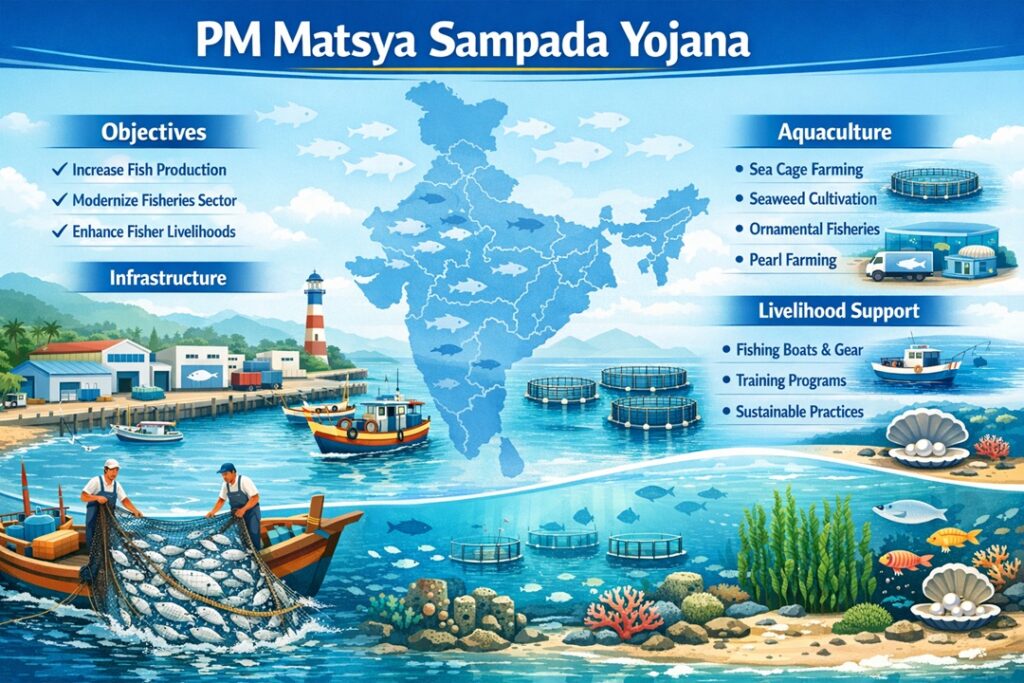
Major Components
Comprehensive Financial Outlay:
The scheme was approved with an overall investment of approximately ₹20,050 crore to accelerate fisheries sector growth.
Dual Implementation Model:
It operates through Central Sector (CS) and Centrally Sponsored Scheme (CSS) components involving both Union and State governments.
Infrastructure Expansion:
Focus on developing modern fishing harbours, fish landing centres, cold storage networks, and seafood processing facilities.
Aquaculture Development:
Encouragement for advanced aquaculture practices such as biofloc technology, sea cage culture, seaweed farming, ornamental fish breeding, and pearl culture.
Support for Fishers:
Financial assistance for modern boats, fishing gear modernization, and livelihood support during seasonal fishing bans.
Resource Sustainability:
Promotion of artificial reefs, mariculture practices, and ecosystem restoration measures to ensure long-term fish stock sustainability.
Skill Development:
Training programmes and capacity-building initiatives for fishers, entrepreneurs, and fisheries cooperatives.
Importance for India
Global Fisheries Leadership:
India is the second-largest fish producer globally, contributing nearly 8% of total global fish production, and the scheme strengthens this position.
Economic and Social Impact:
The programme supports millions of fishers, fish farmers, and coastal populations by enhancing employment, income stability, and rural economic development.
Source : DD News