
Office of the Speaker: Constitutional Safeguards and Challenges
Context
A no-confidence motion recently initiated by the Opposition against Om Birla has once again brought attention to the constitutional status, powers, and accountability of the Speaker of the Lok Sabha within India’s parliamentary framework.
Constitutional Basis of the Speaker’s Office
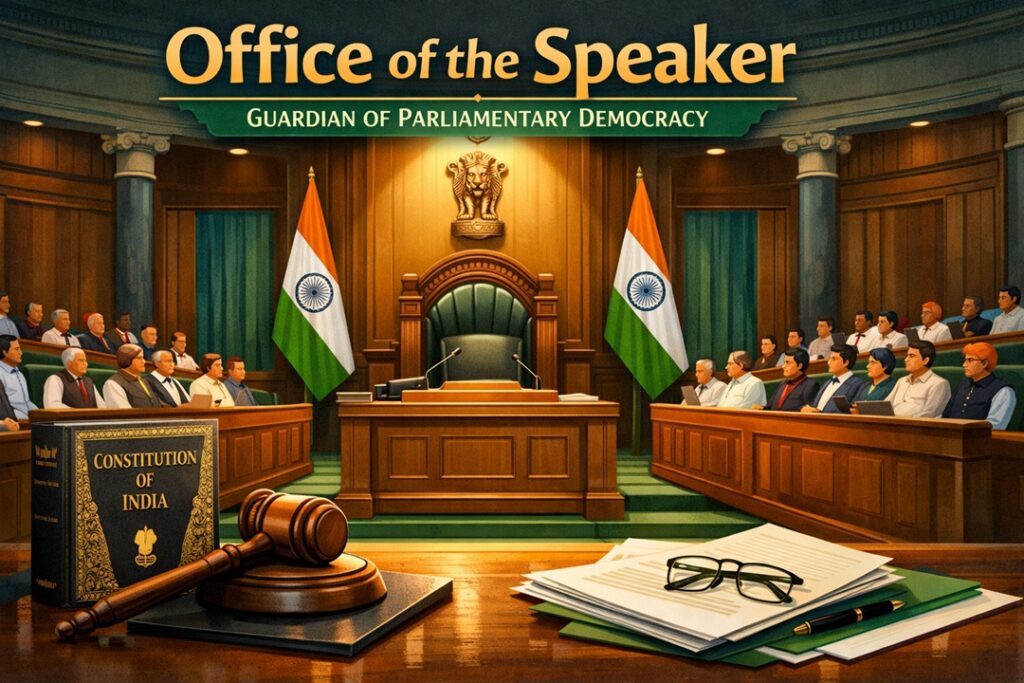
Democratic Significance: The office of the Speaker occupies a central position in India’s parliamentary system, ensuring orderly functioning of legislative proceedings.
Constitutional Provision: Article 93 of the Constitution of India mandates that the Lok Sabha must elect a Speaker and Deputy Speaker soon after its constitution.
Evolution of the Office:
- The Government of India Act 1919 introduced the posts of presiding officers in the central legislature in 1921. Initially, they were referred to as President and Deputy President.
- Later, the Government of India Act 1935 replaced these titles with Speaker and Deputy Speaker, which continues in the present parliamentary system.
Election Process: After newly elected members take oath under a pro-tem Speaker, the Lok Sabha elects the Speaker from among its members through a simple majority vote. Traditionally, the ruling party nominates the candidate.
Term of Office: The Speaker normally serves for the entire five-year duration of the Lok Sabha, unless resignation, disqualification, or removal occurs earlier.
Continuation after Dissolution: Even if the Lok Sabha is dissolved, the Speaker remains in office until the first sitting of the next Lok Sabha.
Resignation: The Speaker may submit resignation to the Deputy Speaker. Historically, Neelam Sanjiva Reddy is the only Speaker who voluntarily stepped down from the position.
Disqualification: If the Speaker ceases to be a member of Parliament under the Representation of the People Act 1951, the office automatically becomes vacant.
Financial Independence: The salary and allowances of the Speaker are charged to the Consolidated Fund of India, ensuring institutional autonomy.
Powers and Responsibilities of the Speaker
Foundations of Authority: The powers of the Speaker arise from three main sources:
- The Constitution of India
- Rules of Procedure and Conduct of Business in Lok Sabha
- Established parliamentary conventions
Presiding Role: The Speaker presides over sessions of the House, regulates debates, and ensures that discussions proceed in accordance with established rules.
Procedural Authority: The Speaker decides the order of speaking, interprets procedural provisions, and exercises disciplinary control when members violate rules.
Legislative Influence: Important responsibilities include certifying Money Bills, recognising party leaders, and deciding procedural questions raised during debates.
Guardian of Parliamentary Balance: The Speaker safeguards the rights of members while maintaining equilibrium between the government’s legislative agenda and the Opposition’s oversight role.
Mechanism for Removal of the Speaker
Constitutional Provision: According to Article 94(c) of the Constitution of India, the Speaker may be removed through a resolution passed by an effective majority of the Lok Sabha (majority of the total membership).
Procedural Framework: The detailed process is specified under Rules 200–203 of the Rules of Procedure and Conduct of Business in Lok Sabha.
Steps Involved:
Initiation: A member submits a written notice to the Secretary-General of the Lok Sabha requesting the Speaker’s removal.
Notice Period: The motion must be submitted at least 14 days in advance.
Minimum Support: The motion requires the backing of 50 members before it can be admitted for discussion.
Specification of Charges: The resolution must clearly outline the grounds for seeking removal.
Voting Requirement: Adoption of the motion requires an effective majority of the total strength of the House.
Role of the Speaker During the Motion:
- The Speaker continues to hold office until the resolution is adopted.
- During discussions, the Speaker may participate as a member.
- The Speaker can vote initially but cannot exercise a casting vote in case of a tie.
Past Instances of Removal Motions
Attempts to remove a Speaker have been extremely uncommon in India’s parliamentary history.
Three notable attempts include:
- 1954: Motion against G. V. Mavalankar
- 1966: Motion against Hukam Singh
- 1987: Motion against Balram Jakhar
In each case, the motions did not succeed, reflecting the difficulty of removing a Speaker due to the constitutional safeguards.
Broader Significance of the Current Motion
Institutional Reminder: Even if the motion does not succeed, it highlights that the authority of the Speaker ultimately flows from the confidence of the House.
Neutrality Debate: The credibility of the office is closely linked to the perception of impartiality in decision-making.
Impact on Democratic Legitimacy: Allegations of bias can weaken public trust in parliamentary functioning.
Checks and Balances: While the removal procedure is intentionally demanding, it provides a constitutional safeguard for accountability.
Concerns Surrounding the Office
Perceived Political Bias: Decisions regarding anti-defection law cases and Money Bill certification have sometimes triggered allegations of partiality.
Rising Political Polarisation: Increasing friction between ruling and opposition parties has occasionally led to disruptions in parliamentary proceedings.
Weakening of Parliamentary Traditions: Long-standing conventions guiding neutral conduct of the Speaker have gradually diminished.
Trust Deficit: Questioning the neutrality of the presiding officer can undermine consensus-building within Parliament.
Reform Imperatives
Strengthening Parliamentary Norms: Political stakeholders must reinforce the convention that the Speaker operates above partisan considerations.
Greater Procedural Transparency: Providing detailed explanations for major procedural rulings could enhance institutional credibility.
Constructive Engagement: Regular dialogue between the government and Opposition on parliamentary functioning may reduce confrontations.
Clarifying Discretionary Powers: Formulating clearer guidelines regarding the Speaker’s powers could reduce procedural disputes while preserving flexibility.
Source : The Hindu