
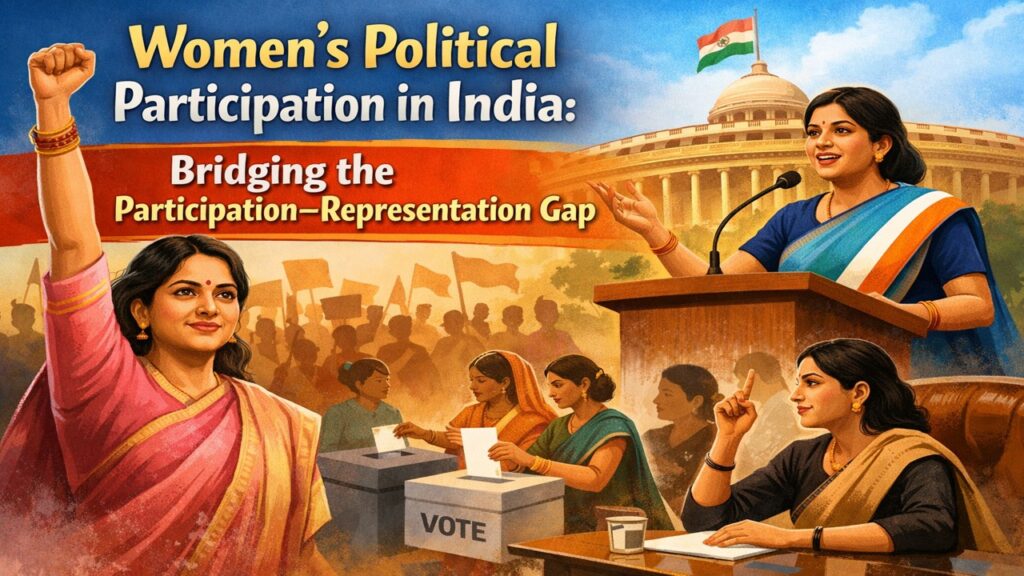
Women’s Political Participation in India: Bridging the Participation–Representation Gap
Context
Women’s voter participation in India has increased significantly in recent elections. While women’s turnout reached near parity with men in the 2019 and 2024 Lok Sabha elections, their representation in legislatures remains low. This highlights a clear participation–representation gap in Indian democracy.
Introduction
Women’s political participation refers to the involvement of women in the political process through voting, campaigning, decision making, and holding public office. Although women are increasingly active voters and grassroots leaders, their presence in higher political institutions remains limited.
Body
Meaning of Women’s Political Participation
It refers to women’s engagement in politics at different levels, including voting in elections, participating in campaigns, influencing public debates, and holding positions in the Lok Sabha, Rajya Sabha, State Assemblies, and local governments.
Key Data and Trends
Voter Turnout
The gender gap in voter turnout declined from 11.2 percent in 1967 to almost zero in the 2019 and 2024 Lok Sabha elections, showing rising political awareness among women.
Legislative Representation
Despite high voter turnout, women remain underrepresented. In the 2024 Lok Sabha, women hold only 74 seats, about 13.6 percent, slightly lower than 78 seats in 2019.
Candidature and Success Rate
Around 800 women contested the 2024 elections, but they remain a small share of candidates. However, women have a higher success rate with about 9 percent winning compared to 6 percent of men.
State Election Trends
In many state elections since 2011, women’s turnout has exceeded men’s turnout by nearly 2 percent, reflecting stronger political participation.
Dimensions of Participation
Electoral Participation
Women have moved from passive voters to active political participants. In 2024, female turnout was almost equal to male turnout across many regions.
Grassroots Leadership
Due to the 73rd and 74th Constitutional Amendments, India has over 1.4 million elected women representatives in Panchayati Raj Institutions, strengthening grassroots democracy.
Independent Voting
Nearly 50 percent of women in 2024 reported voting independently, indicating increasing political autonomy.
Issue Based Voting
Women voters increasingly support policies related to welfare and social security. For example, schemes such as the Ladli Behna Yojana in Madhya Pradesh significantly mobilized women voters.
Government Initiatives
Women’s Reservation
The Nari Shakti Vandan Adhiniyam (128th Constitutional Amendment Act) provides 33 percent reservation for women in the Lok Sabha and State Assemblies.
Reservation in Local Bodies
The 73rd and 74th Amendments mandate 33 percent reservation for women in Panchayats and Urban Local Bodies, with some states increasing it to 50 percent.
SVEEP Programme
The Election Commission’s SVEEP initiative promotes voter awareness and aims to reduce the gender gap in voter participation.
Challenges
Electability Myth
Political parties often hesitate to give tickets to women. In 2024, women formed only about 10 percent of candidates, despite higher winnability.
Patriarchal Norms
Traditional social attitudes often discourage women from entering politics.
Domestic and Economic Barriers
Household responsibilities, high campaign costs, and the criminalization of politics limit women’s participation.
Way Forward
Implementation of Reservation
Early implementation of 33 percent reservation in Parliament and State Assemblies will improve representation.
Political Party Reforms
Political parties should increase ticket allocation and leadership opportunities for women.
Capacity Building
Training and leadership development for women in Panchayati Raj Institutions can help them move to higher political roles.
Conclusion
India has nearly achieved gender parity in voter turnout, reflecting growing political awareness among women. However, representation remains limited. Ensuring institutional reforms, greater political support, and social change is essential to make women equal participants in democratic governance.
Source : The Hindu