
India’s Informal Economy: Growth Without Transformation
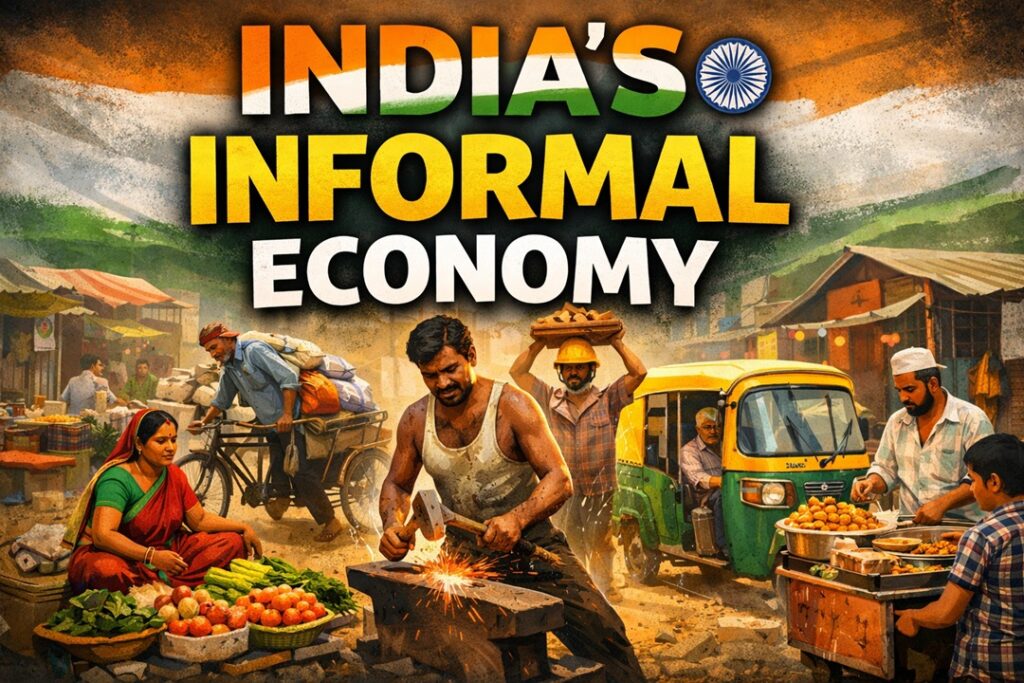
Context
The latest Annual Survey of Unincorporated Sector Enterprises (ASUSE) 2025 highlights a paradox—India’s informal sector is expanding in size but lacking qualitative transformation, raising concerns about sustainability and productivity.
Magnitude and Economic Role
Enterprise Base – Around 7.92 crore units, rising from 7.34 crore (2023–24).
Workforce Dependence – Supports 12.81 crore workers, making it a key employment backbone.
Functional Significance
- Acts as a shock absorber for surplus labour, especially rural migrants.
- Sustains grassroots demand via local production and services.
Concern – Reflects limited capacity of the formal sector to generate jobs.
Enterprise Expansion vs Structural Stagnation
Increase in Units – Nearly 8% rise, indicating steady entry of small businesses.
Sectoral Distribution (unchanged pattern)
- Manufacturing – 27%
- Trade – 31%
- Services – 42%
Inference – Growth remains numerical rather than structural.
Nature of Employment Generation
Employment Growth – Expanded by 6.18%.
Workforce Composition
- Owner-led enterprises – 62%
- Wage-employed workers – 24%
Implication – Growth driven by self-employment, not formal job creation.
Output Growth and Sectoral Shift
GVA Growth – Increased by 10.9% (2023–25).
Sector-wise Contribution
- Services – 42%
- Trade – 37%
- Manufacturing – 21%
Trend – Increasing reliance on consumption-driven sectors.
Core Structural Constraints
Weak Industrial Base
- Low capital investment
- Limited technology adoption
- Dominance of micro-units
Outcome – Lack of manufacturing-led transformation.
Productivity Dynamics
Per Worker GVA – Rose from ₹1.49 lakh to ₹1.56 lakh (~4.5%).
Interpretation
- Incremental gains
- Continued reliance on traditional methods
- Limited technological progress
Income Trends and Inequality Concerns
Average Wage Growth – Increased by 3.88%.
Issue
- Slower than output growth
- Indicates unequal benefit distribution
Causes
- Weak labour bargaining power
- Absence of formal safeguards
Gender Dimensions in Informality
Women-led Enterprises – Increased slightly from 26% to 27%.
Challenges
- Limited credit access
- Weak market linkages
- Concentration in low-value work
Outcome – Restricted economic mobility for women.
Exposure to External Vulnerabilities
Fuel Price Sensitivity
- High dependence on imported crude oil
- Rising fuel costs increase input and transport expenses
Remittance Dependency
- Decline reduces consumption demand
Impact – Sector remains highly shock-sensitive.
Institutional Structure of Informality
Ownership Pattern – Nearly 95% proprietary/partnership units.
Advantages
- Ease of entry
- Operational flexibility
Limitations
- Limited credit access
- Poor scalability
- Lack of social security
Policy Priorities for Reform
Quality-Oriented Growth
- Promote technology adoption and skilling
- Improve access to formal finance
Labour Welfare
- Extend social security
- Enhance wage conditions
Women Empowerment
- Targeted credit support
- Better market access
Resilience Building
- Diversify energy sources
- Strengthen supply chains
- Improve infrastructure
Way Forward
The ASUSE 2025 findings show that India’s informal sector is expanding without adequate transformation.
It continues to provide livelihoods but largely in low-productivity, survival-oriented forms.
Key Challenge – Shift toward productivity, formalisation, and equitable growth to avoid long-term stagnation.
Source : The Indian Express