
West Asia Conflict and the Emerging Global Energy Shock
Context
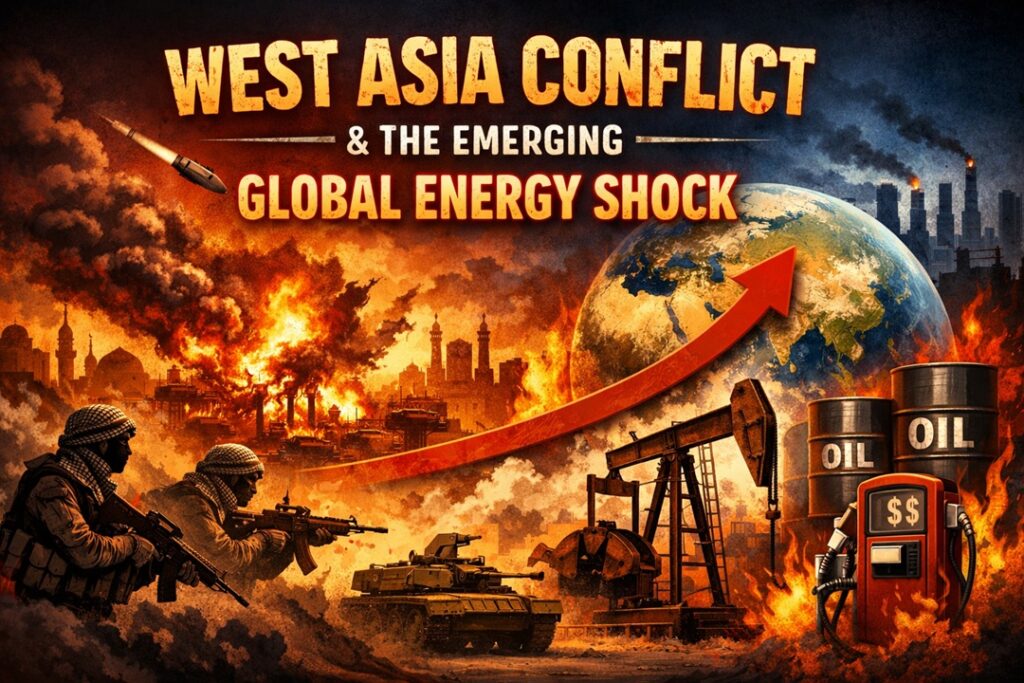
The ongoing conflict in West Asia has precipitated a severe global energy disruption, as the closure of the Strait of Hormuz has halted nearly 20 million barrels per day (bpd) of crude oil supply.
This unprecedented disruption has revived comparisons with the 1973 Oil Crisis, which reshaped global economic structures and strengthened the petrodollar system.
Understanding the 1973 Energy Disruption
Nature of the Crisis:
The 1973 oil shock emerged when Arab members of OPEC enforced an oil embargo against nations backing Israel.
Strategic Significance:
It marked the first large-scale use of oil as a geopolitical instrument, leading to a fourfold increase in prices and long-term restructuring of global financial systems.
Preconditions Behind the 1973 Shock
Economic Expansion Phase:
Post-war industrial economies, particularly the US, were witnessing high production and commodity demand.
Growing Producer Control:
OPEC nations had consolidated their dominance over global oil supply by the early 1970s.
Rising Inflation Trends:
Industrial commodity prices were already increasing at double-digit rates prior to the crisis.
Supply Rigidity:
The US lacked sufficient domestic spare capacity to offset disruptions in imports.
Triggers and Strategic Motives
Geopolitical Alignment:
The embargo followed US military and financial support to Israel during the Yom Kippur War.
Territorial Objectives:
Arab nations aimed to regain territories lost in the Six-Day War.
Currency Discontent:
The 1971 decision by Richard Nixon to end dollar convertibility into gold reduced real oil earnings.
Production Strategy:
Sharp output cuts were used to gain pricing power rather than merely coordinating supply.
Assertion of Power:
Oil-exporting nations sought to challenge Western economic dominance.
Crisis Dynamics and Immediate Fallout
Embargo Enforcement:
Oil exports to the US and allies were halted, with simultaneous production cuts.
Price Escalation:
Global oil prices surged nearly four times within months.
Energy Conservation Measures:
The US introduced fuel rationing and nationwide speed limits.
Industrial Disruptions:
Rising energy costs led to shortages in key industrial inputs.
War Outcome:
Despite economic pressure, Israel retained military advantage.
Repercussions for India
Surging Import Costs:
India’s oil import bill rose sharply within a year.
Inflationary Pressures:
A steep rise in fuel prices triggered widespread inflation and declining real incomes.
Labour Mobilisation:
The 1974 railway strike became one of the largest industrial actions in India.
Political Turbulence:
Mass protests under Jayaprakash Narayan contributed to the declaration of the Emergency in 1975.
External Dependence:
India sought assistance from global financial institutions, accompanied by reform conditions.
Global Economic Realignments Post-Crisis
Rise of the Petrodollar System:
The US–Saudi agreement institutionalised dollar-denominated oil trade.
Strengthening of Dollar Hegemony:
Global demand for the US dollar increased significantly.
Remittance Flows:
India benefited from higher remittances from workers in West Asia.
Policy Reorientation:
India faced pressure to liberalise trade and devalue its currency.
Contemporary Crisis vs 1973: A Comparative View
Nature of Disruption:
1973 was policy-driven (embargo), whereas 2026 stems from active military conflict.
Scale of Impact:
Current disruption (~20 million bpd) far exceeds the 1970s shock in volume terms.
Systemic Risk:
Modern supply chains face deeper vulnerabilities due to higher global integration.
Strategic Imperatives Ahead
Energy Transition:
Accelerate renewable adoption to reduce dependence on volatile regions.
Strategic Stockpiling:
Expand Strategic Petroleum Reserves (SPR) to withstand prolonged disruptions.
Diplomatic Engagement:
Global mediation is essential to reopen key chokepoints like Hormuz.
Macroeconomic Preparedness:
Central banks must brace for prolonged high crude prices and inflationary cycles.
Final Insight
The 1973 crisis demonstrated that control over energy resources translates into geopolitical power, giving rise to a dollar-centric global order. However, the present West Asian conflict represents a far more severe structural threat, with physical supply blockades on an unprecedented scale. Without swift resolution, the global economy risks entering a phase of sustained inflation and systemic instability surpassing the shocks of the 1970s.
Source : The Indian Express