
Womaniya Initiative: Driving Women-Led Public Procurement in India
Context
The Womaniya programme on the Government e-Marketplace has gained attention for empowering more than 2.1 lakh women entrepreneurs, enabling them to secure contracts exceeding ₹28,000 crore.
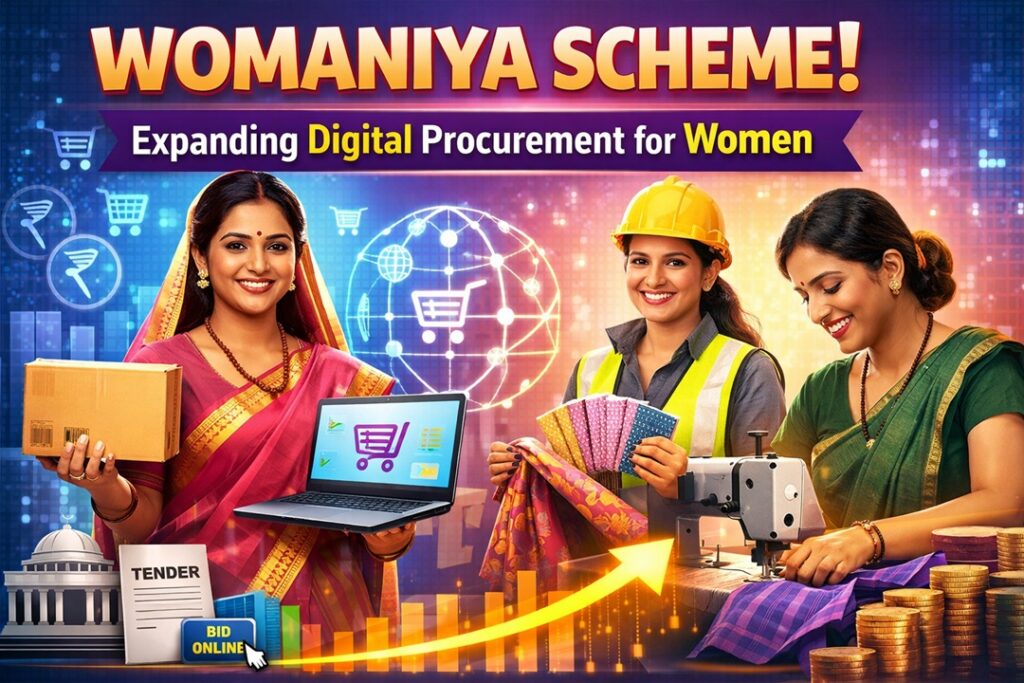
Womaniya Scheme: Expanding Digital Procurement for Women
Nature of the Initiative:
Introduced in 2019 under the Ministry of Commerce and Industry, Womaniya is a gender-inclusive initiative hosted on GeM. It offers a specialized online marketplace where women-led micro and small enterprises (MSEs) and Self-Help Groups (SHGs) can directly sell products such as handicrafts, textiles, and office supplies to government buyers.
Performance Highlights
Participation Expansion:
More than 2.1 lakh women-led MSEs have been onboarded onto the GeM platform.
Procurement Scale:
Women entrepreneurs fulfilled approximately 13.7 lakh orders during FY 2025–26.
Monetary Value:
The total value of contracts awarded exceeded ₹28,000 crore, reflecting a 27.6% annual increase.
Beyond Mandated Targets:
While the procurement requirement stands at 3%, women-led enterprises contributed 5.6% of total transactions.
Core Design Elements
Seamless Registration:
Integration with Udyam registration and targeted training ensures simplified onboarding.
Uniform Product Listing:
Standard templates enhance product visibility and ease comparison for buyers.
End-to-End Digitisation:
Processes like bidding, invoicing, and payments are fully online, eliminating middlemen.
Prompt Payment Mechanism:
Automated workflows ensure timely payments, critical for small-scale suppliers.
Capacity Development:
Training in local languages and buyer-seller interactions strengthen participation.
Socio-Economic Outcomes
Collective Mobilisation:
As of February 2026, over 10 crore women are part of nearly 90 lakh SHGs, fostering economic collectivisation.
Reduced Intermediation:
Direct access to government buyers eliminates exploitative middle layers.
Inclusive Supply Chains:
Enhances diversity by integrating women entrepreneurs into public procurement.
Enterprise Formalisation:
Facilitates transition from informal production to structured business participation.
Enhanced Financial Footprint:
Digital transaction records improve creditworthiness and growth prospects.
Structural Constraints
Digital Skill Gaps:
Limited digital literacy affects efficient use of online procurement systems.
Time Constraints:
Household and caregiving responsibilities restrict active business engagement.
Awareness Deficit:
Information gaps about schemes and procedures persist, especially in rural areas.
Limited Autonomy:
Socio-cultural factors may constrain independent business decision-making.
Credit Barriers:
Lack of collateral limits access to formal finance for scaling operations.
Strategic Directions
Data-Driven Credit Models:
Utilising digital transaction histories (GeM, UPI) for better credit assessment.
Localised Digital Interfaces:
Promoting vernacular and voice-enabled platforms to enhance usability.
Community-Based Adoption:
Leveraging SHG networks to build trust and digital confidence.
Growth-Oriented Financing:
Tracking progression from micro-loans to larger working capital funding.
Strengthening Entrepreneurial Agency:
Providing mentorship, market linkages, and non-financial support systems.
Conclusion
Womaniya has evolved into a significant pillar of inclusive public procurement in India. By linking women producers directly with institutional buyers, it not only enhances economic participation but also strengthens financial independence and representation. It marks a crucial step toward ensuring that governance frameworks reflect gender-inclusive growth.
Source : PIB