
Voting as a Symbol of Democratic Belonging
Context
The Supreme Court of India criticized the Election Commission of India for large-scale voter deletions during electoral roll revision. The issue emerged from the Special Intensive Revision (SIR) exercise, which introduced the concept of “logical discrepancies” as a basis for exclusion. This led to the removal of nearly 34 lakh names from electoral rolls, raising serious concerns regarding fairness, transparency, and the risk of disenfranchisement of genuine voters.
Judicial Observations on Voting Rights
- Voting was described as the core instrument of democratic participation, beyond a mere legal entitlement.
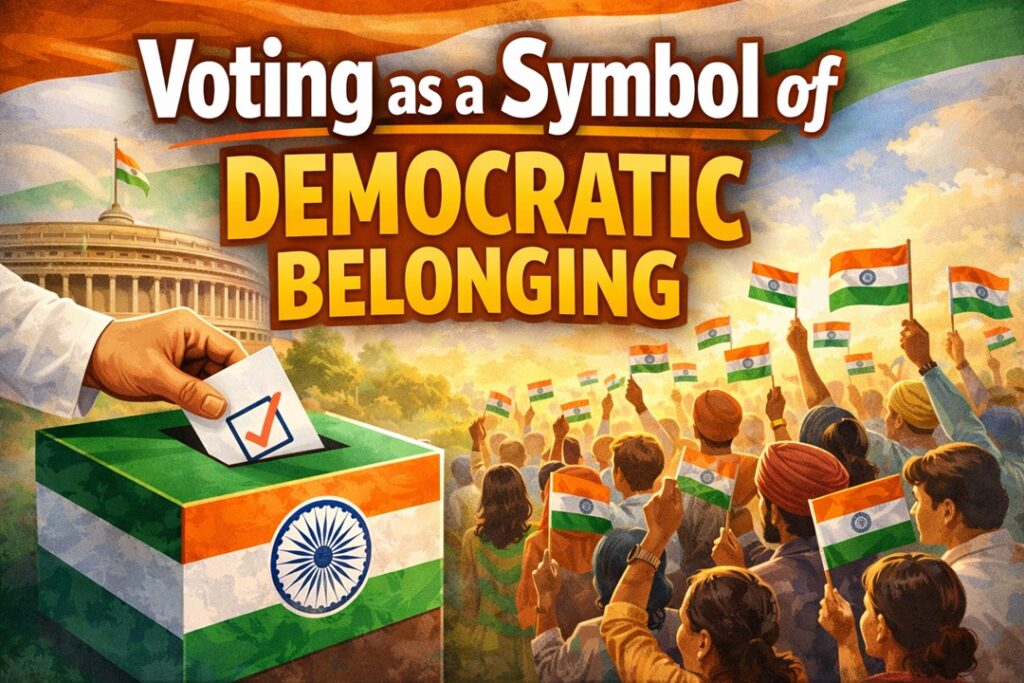
- The Court emphasized that being on the electoral roll reflects emotional belonging to the nation and civic identity.
- It cautioned that technical filters cannot override the principle of inclusiveness.
- Mass deletions may distort electoral outcomes, especially in closely contested constituencies.
Core Constitutional Safeguards
- Article 324: Empowers the Election Commission to supervise elections and electoral rolls.
- Article 325: Ensures a single electoral roll without discrimination based on religion, race, caste, or sex.
- Article 326: Provides for universal adult franchise for citizens above 18 years.
Statutory Framework Governing Elections
- Representation of the People Act, 1950: Covers voter eligibility, delimitation, and electoral roll preparation.
- Representation of the People Act, 1951: Deals with election conduct, qualifications, and dispute resolution.
- Registration of Electors Rules, 1960: Defines procedures for revision and objections.
- Conduct of Election Rules, 1961: Specifies voting and counting mechanisms including EVMs/VVPATs.
Structural Issues in Electoral Roll Management
- Unilateral Exclusions: Removal of voters without adequate hearing undermines procedural fairness.
- Algorithmic Errors: Use of data-based filters risks excluding genuine voters due to minor inconsistencies.
- Institutional Overload: Large number of appeals overwhelms limited tribunals.
- Timing Concerns: Revisions near elections create administrative instability.
- Verification Challenges: Changing benchmarks complicate identity validation for citizens.
Reform Imperatives
- Strengthened Grievance Redressal: Permanent and adequately staffed tribunals for timely justice.
- Uniform Standards: Harmonised criteria for identifying discrepancies across states.
- Judicial Facilitation: Deployment of judicial officers in sensitive cases.
- Continuous Updating Model: Moving towards year-round electoral roll maintenance.
- Digital Accountability: Transparent platforms for citizens to track voter status and corrections.
Conclusion
The Supreme Court has underscored that electoral rolls are not merely administrative records but represent the essence of democratic participation and national identity. By cautioning against arbitrary exclusions and emphasizing inclusivity, the Court has reinforced the need to protect voting rights as both a constitutional guarantee and a reflection of citizens’ emotional connection to the nation.
Source : TOI