
Indian Railways: Transitioning Towards a High-Speed, Integrated Future
Context
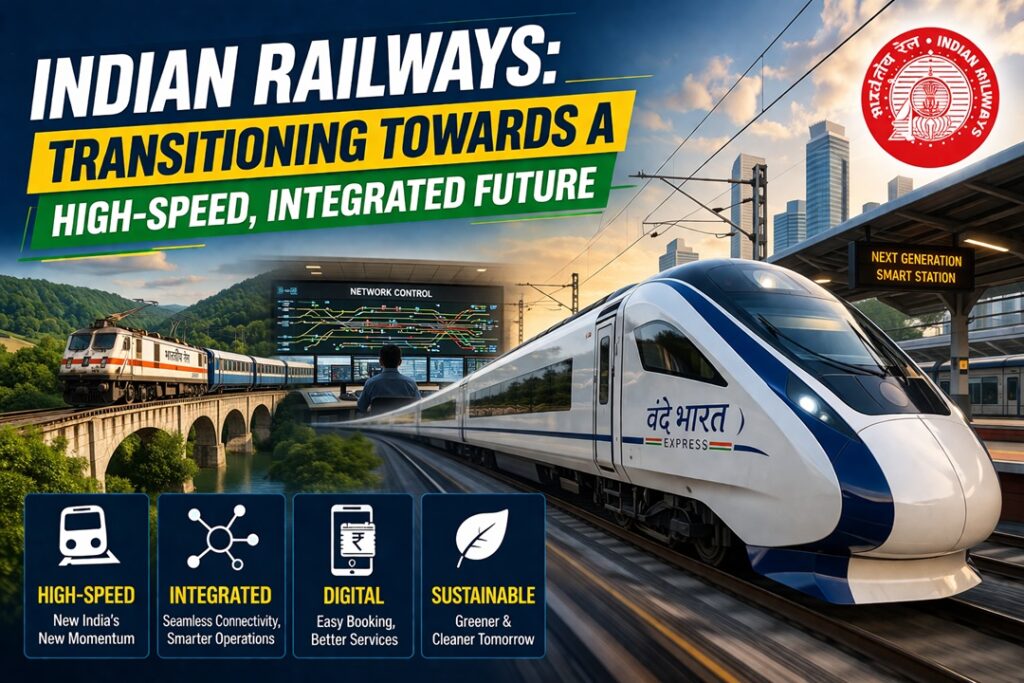
As India progresses toward its Vision 2047 objectives, the railway sector is undergoing a structural transformation—from a mass mobility system to a modern network focused on speed, efficiency, safety, and multimodal integration.
Tracing the Journey of Railways in India
Early Foundations (1853–1947)
The railway era commenced in 1853 with the first train between Mumbai and Thane. During colonial rule, railways largely served extractive economic interests, yet they inadvertently strengthened national unity and aided mass political mobilisation during the freedom struggle, especially through leaders like Mahatma Gandhi.
Expansion & Nation-Building (1947–2014)
Post-independence, railways became an instrument of inclusive growth, focusing on affordability and regional connectivity. However, systemic issues like overcrowding, outdated infrastructure, and limited capacity gradually surfaced.
Modernisation Phase (2014–Present)
The current phase is marked by rapid technological upgrades, improved service delivery, and alignment with global benchmarks. Emphasis is on speed, safety, efficiency, and passenger-centric reforms.
Key Transformational Initiatives
Integrated Infrastructure Strategy
The PM Gati Shakti National Master Plan has emerged as a cornerstone of railway development. It promotes seamless coordination across transport modes. In FY 2025–26, about 100 railway projects worth ₹1.53 lakh crore have been approved, targeting expansion of over 6,000 km of tracks. The approach reflects a shift toward holistic and logistics-efficient planning.
Next-Gen Train Ecosystem
The Vande Bharat Express represents a leap in indigenous innovation. With speeds up to 160 km/h, enhanced safety systems, and modern amenities, it is redefining passenger experience. The introduction of sleeper variants signals a move to compete with aviation in long-distance travel.
Complementing this is the Amrit Bharat Station Scheme, aimed at upgrading over 1,300 stations into modern transit hubs, especially in smaller cities. Features include improved infrastructure, urban integration, and passenger-centric amenities.
High-Speed Rail Vision
Bullet Train Network Expansion
India’s high-speed rail ambitions are exemplified by the Mumbai Ahmedabad High Speed Rail, developed with Japanese collaboration. It introduces advanced technologies such as seismic monitoring and slab track systems.
The broader “Diamond Quadrilateral” plan envisions ~4,000 km of high-speed corridors linking major economic centres like Delhi, Mumbai, Chennai, and Kolkata, significantly reducing travel time and boosting economic productivity.
Bridging Regional Gaps
Northeast Connectivity Push
Projects like the Bairabi Sairang railway line aim to connect Aizawl with the national network. Similar efforts are underway for Imphal and Kohima. These projects involve advanced tunnelling and bridge construction, ensuring integration of remote regions into the national economy.
Engineering Feats & Strategic Assets
Innovative Infrastructure Projects
The Pamban Bridge in Tamil Nadu exemplifies India’s engineering prowess. As the country’s first vertical lift sea bridge, it enhances connectivity to Rameswaram while showcasing cutting-edge design capabilities.
Freight–Passenger Balance
Dedicated Freight Corridors (DFCs)
Congestion remains a persistent issue due to shared tracks. The development of DFCs aims to segregate cargo and passenger traffic, improving speed, reliability, and overall efficiency of the railway network.
Constraints & Policy Directions
Key Bottlenecks
- High capital intensity of projects
- Land acquisition delays
- Environmental sustainability concerns
- Continuous need for technological upgrades
Strategic Responses
- Expanding public-private partnerships (PPPs)
- Promoting green and sustainable infrastructure
- Deploying advanced safety systems like Kavach
- Strengthening multimodal integration
Way Forward
India’s railway modernisation marks a paradigm shift in infrastructure development. With initiatives like Gati Shakti, Vande Bharat, and high-speed corridors, the sector is evolving into a globally competitive transport system.
A balanced approach—combining speed with inclusivity and innovation with accessibility—will ensure that Indian Railways continues to remain the backbone of economic growth and national integration in the journey toward 2047.
Source : The Indian Express