
India’s Vanishing Lakes: A Silent Ecological Crisis
Context
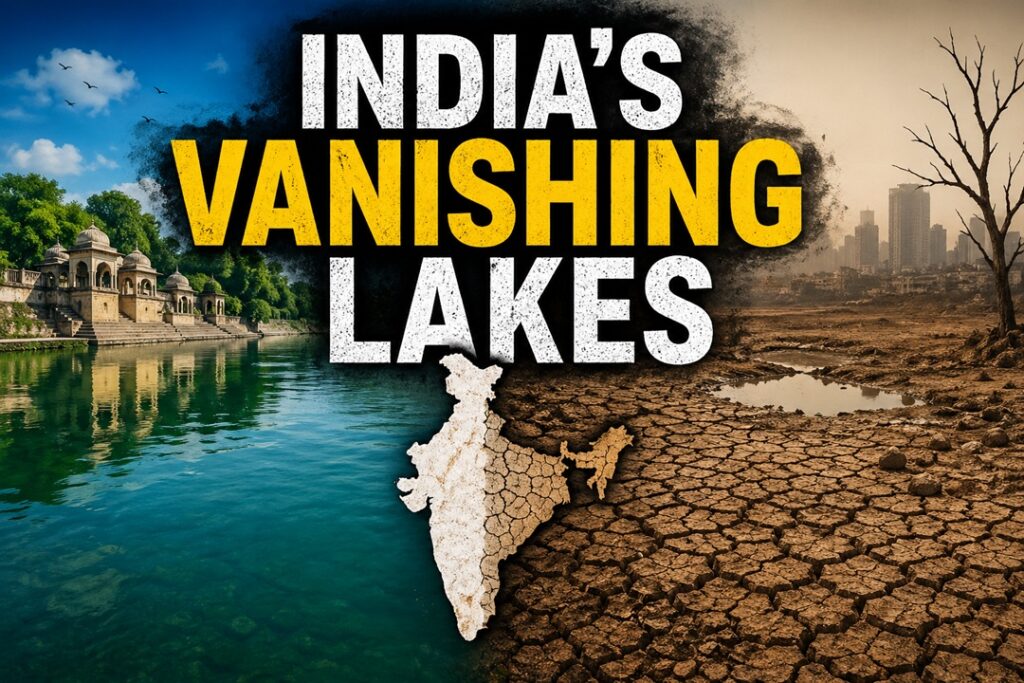
India’s lake ecosystems are shrinking rapidly due to rising human pressures in the Anthropocene era. This decline threatens environmental balance, economic resilience, and community well-being.
Why Lakes Matter: Ecological & Economic Importance
Water Security Backbone: Lakes act as natural recharge systems, replenishing groundwater crucial for drinking and irrigation needs in India.
Flood Moderation: They absorb excess rainfall and runoff, reducing flood intensity in urban and rural landscapes.
Biodiversity Reservoirs: Lakes support diverse ecosystems, hosting aquatic species and migratory birds. Chilika Lake is a prime example of a rich biodiversity hub.
Livelihood Engine: Fisheries, agriculture, tourism, and domestic usage depend heavily on lake ecosystems, sustaining local economies.
Cultural Heritage Sites: Lakes like Pushkar Lake and Dal Lake are deeply embedded in India’s spiritual and cultural traditions.
Freshwater Resource: Lakes contribute significantly to accessible surface freshwater, forming a vital natural asset globally.
Impacts of Shrinking Lakes
Ecosystem Disruption: Loss of lakes leads to habitat destruction, biodiversity decline, and disturbed food chains.
Water Stress Intensification: Reduced groundwater recharge worsens water scarcity, especially in urban and semi-arid regions.
Urban Flooding Risks: Absence of natural buffers increases vulnerability to frequent and severe floods.
Livelihood Losses: Fishing, farming, and tourism-dependent communities face economic setbacks.
Cultural Decline: Disappearance of sacred lakes erodes traditional practices and local identity.
Key Drivers Behind Lake Degradation
Pollution & Eutrophication: Untreated sewage, industrial waste, and agricultural runoff cause algal blooms and oxygen depletion. Lakes like Hussain Sagar Lake and Bellandur Lake exemplify severe pollution.
Encroachment & Urban Expansion: Wetlands are converted into real estate due to rapid urbanization and rising land demand.
Illegal Mining Activities: Sand and gravel extraction degrade lakebeds, reducing water retention capacity.
Tourism Pressure: Unregulated tourism leads to waste accumulation and ecosystem stress.
Cultural Practices: Idol immersion using non-biodegradable materials contributes to pollution.
Legal & Institutional Framework
Constitutional Mandate: Water falls under the State List, making states responsible for lake management.
Wetlands Rules, 2017: Established under the Environment Protection Act, emphasizing “wise use” and institutional mechanisms like State Wetland Authorities.
Limitations: Restricted coverage, fragmented governance, and exclusion of certain wetland categories.
Public Trust Doctrine: Reinforced by the Supreme Court in Swachh Association vs State of Maharashtra (2025), extending protection to artificial lakes as public resources.
Government Initiatives
National Lake Conservation Programme (2001): Focused on restoring water quality and ecological balance.
National Programme for Conservation of Aquatic Ecosystems (NPCA): Integrated approach combining lake and wetland conservation.
Challenges: Limited coverage, funding constraints, and weak monitoring mechanisms.
Governance Bottlenecks
Institutional Fragmentation: Multiple agencies with overlapping roles reduce efficiency.
Weak Enforcement: Poor implementation of environmental regulations.
Data Gaps: Lack of scientific mapping and real-time monitoring.
Low Public Participation: Limited involvement of local communities.
Audit Concerns: CAG reports highlight significant lake shrinkage in regions like Jammu & Kashmir.
Way Forward
National-Level Legislation: A comprehensive central law for uniform lake protection.
Dedicated Nodal Body: Coordinated governance across states and agencies.
Technology Integration: Use GIS and remote sensing for monitoring and encroachment prevention.
Strict Pollution Control: Enforce regulations on sewage and industrial discharge.
Community Engagement: Promote participatory conservation models.
Sustainable Urban Planning: Recognize lakes as ecological assets, not land banks.
Conclusion
India’s disappearing lakes signal deeper issues of environmental mismanagement and unsustainable growth. Protecting these ecosystems requires urgent, coordinated efforts combining legal reforms, scientific tools, and community participation to secure ecological stability and future water security.
Source : The Indian Express