
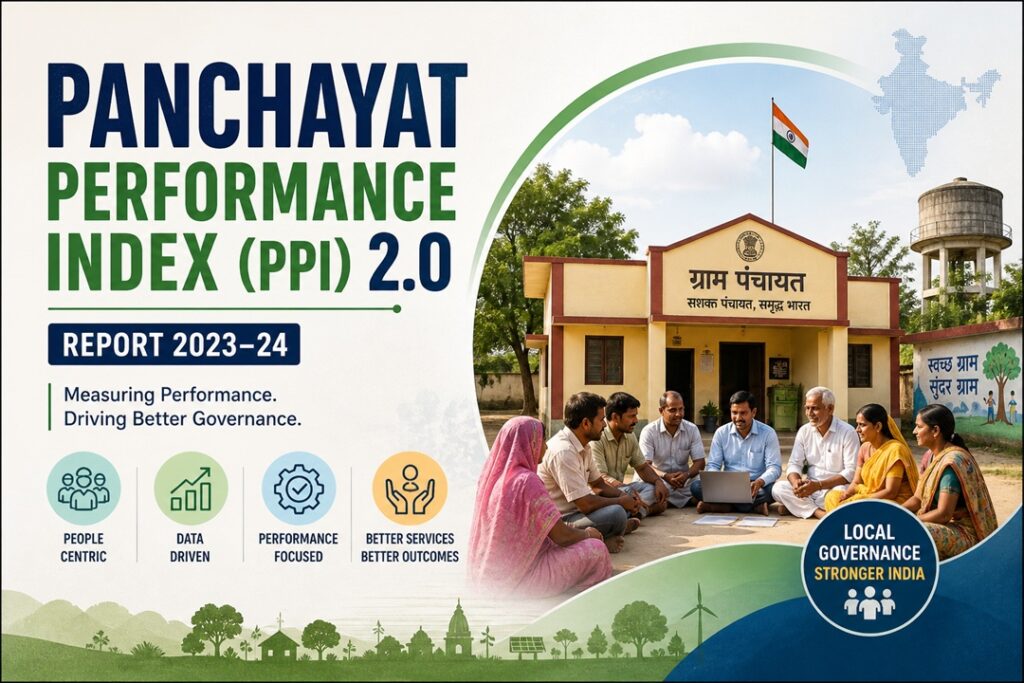
Panchayat Performance Index (PPI) 2.0 Report 2023–24
Context
The Ministry of Panchayati Raj released the Panchayat Performance Index (PPI) 2.0 Report for 2023–24 on the occasion of National Panchayati Raj Day, showcasing progress in grassroots governance.
About the Panchayat Performance Index (PPI) 2.0
Nature – A nationwide, evidence-based assessment tool to evaluate functioning of over 2.5 lakh Gram Panchayats (GPs) and Traditional Local Bodies (TLBs).
Objective – Acts as a decentralized “scorecard” to track progress towards Localization of Sustainable Development Goals (LSDGs).
Coverage – Built on 150 indicators and ~230 data points across nine thematic sectors including livelihood, health, infrastructure, and governance.
Evolution – Streamlined framework compared to earlier version (reduced from 500+ indicators), ensuring sharper monitoring and usability.
Major Findings & Insights
Participation Trend – Achieved ~97% coverage with 2.59 lakh Panchayats across 33 States/UTs, reflecting improved institutional adoption.
Grading System – Panchayats categorized into five tiers: Achiever (A+), Front Runner (A), Performer (B), Aspirant (C), Beginner (D).
Top Tier Presence – Around 3,600+ GPs qualified as Front Runners (Grade A).
Bulk Category – Nearly 46% Panchayats fall under Performer (Grade B), indicating moderate progress.
Livelihood Excellence – Over 3,300 GPs secured A+ in poverty alleviation and livelihood enhancement indicators.
Health Achievements – About 1,000+ GPs attained A+ in health-related metrics such as sanitation, nutrition, and preventive care.
Non-Participation – One major state (West Bengal) did not join; UTs like Delhi and Chandigarh excluded due to absence of GPs.
State-Level Highlights
Best Performer – Tripura leads with ~80% Panchayats in Front Runner category.
Highest Coverage – Uttar Pradesh recorded full participation (57,000+ GPs).
No A+ Panchayats – No GP achieved the highest “Achiever” category nationally, indicating scope for improvement.
Positive Transformations Observed
Data-Driven Planning – Panchayats are increasingly using index scores for Gram Panchayat Development Plans (GPDP).
Peer Learning Models – High-performing Panchayats emerging as knowledge hubs for capacity building.
Transparency Boost – Gram Sabha validation has strengthened accountability and citizen participation.
Digital Integration – Real-time dashboards and automatic data flow from ministries improving reliability of reporting.
Key Challenges Identified
Regional Disparities – States like Bihar show large clusters of Aspirant category Panchayats.
Digital Divide – Northeastern states such as Arunachal Pradesh and Nagaland face difficulties due to limited digital capacity.
Infrastructure Gaps – Weak performance in self-sufficient infrastructure theme due to funding constraints.
Social Equity Concerns – Lower scores in social justice and welfare indicators across several regions.
Fiscal Dependence – Limited own-source revenue restricts upward mobility of Panchayats in states like Jharkhand and Chhattisgarh.
Way Forward
Focused Funding – Direct additional resources to over 1.2 lakh Aspirant Panchayats for targeted improvement.
Capacity Enhancement – Strengthen training programs for elected representatives, especially in low-performing regions.
Incentive Linkage – Align Panchayat awards and rankings strictly with index performance.
Local Language Access – Expand vernacular interfaces to ensure inclusivity of traditional and remote bodies.
Policy Convergence – Use the index as a benchmark for evaluating outcomes of central rural schemes.
Conclusion
The PPI 2.0 marks a shift towards measurable and transparent grassroots governance by embedding data into rural administration. With high participation and structured evaluation, it lays a strong foundation for achieving decentralized development and aligning Panchayati Raj Institutions with SDG targets by 2030.
Source : NIE