
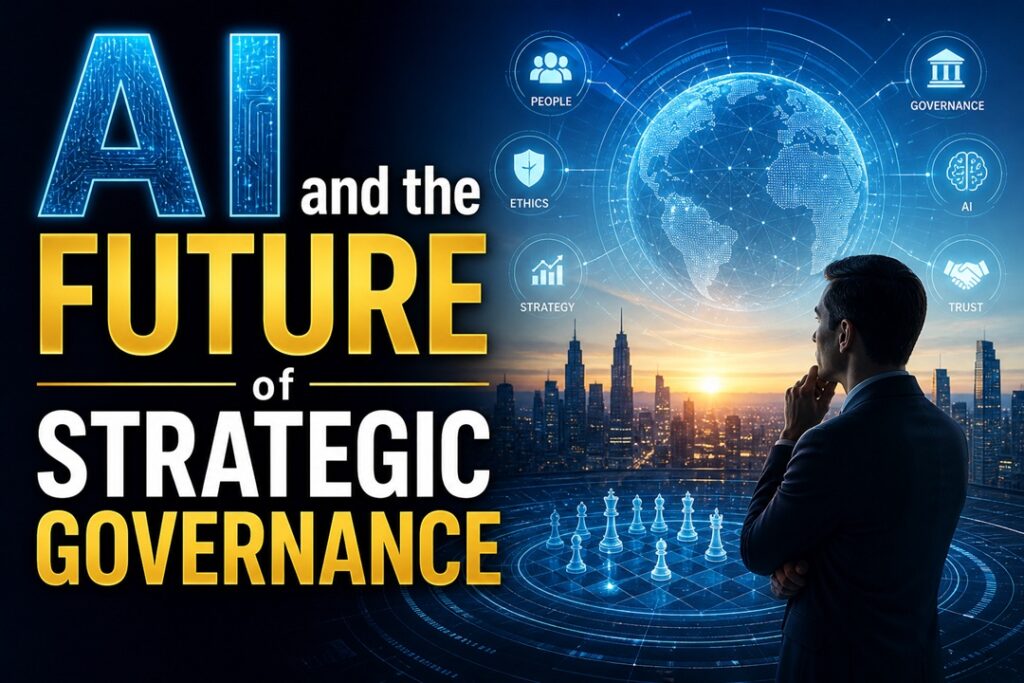
AI and the Future of Strategic Governance
Context
A senior diplomat from Vivian Balakrishnan recently demonstrated how artificial intelligence can reshape diplomacy by personally developing an AI assistant, signalling a shift in how states manage decision-making and negotiations.
What Defines AI in Strategic Governance?
Meaning: Refers to embedding advanced tools such as machine learning, large language models, and predictive systems into national security and diplomatic workflows.
Core Idea: Moves beyond routine automation to building “augmented cognition systems” that assist policymakers in analysis, drafting, and forecasting.
Scope: Includes data mining, scenario modelling, legal drafting, and institutional knowledge retrieval for faster governance.
How AI is Transforming Security and Diplomacy
Power Equalisation: Smaller countries gain analytical capabilities comparable to major powers through affordable AI tools.
Accelerated Negotiations: Drafting agreements, treaties, and policy briefs becomes near-instantaneous with multiple scenario outputs.
Strategic Forecasting: AI models simulate adversary responses and geopolitical risks, aiding pre-emptive policymaking.
Institutional Recall: Converts archives into searchable intelligence, enabling quick reference to past negotiations and commitments.
Administrative Efficiency: Reduces paperwork burden by summarising intelligence inputs into concise actionable insights.
Key Concerns and Risks
Loss of Human Judgment: AI lacks emotional intelligence, cultural understanding, and intuition required in diplomacy.
Bias in Algorithms: Systems may reproduce societal or data-driven prejudices, affecting critical decisions.
Erroneous Outputs: AI can generate misleading or fabricated interpretations, especially in complex historical contexts.
Automation Dependence: Over-reliance may weaken accountability and critical thinking in governance.
Global Inequality: Countries without indigenous AI capabilities risk strategic disadvantage and dependency.
Ethical Foundations for AI in Governance
Human Oversight: Critical decisions must always involve human judgment, especially in matters of war, peace, and rights.
Transparency: AI systems should be explainable and auditable to maintain trust in governance.
Cultural Alignment: Models must reflect domestic socio-political values rather than generic global datasets.
Data Sovereignty: Sensitive AI systems should operate within national infrastructure to ensure security.
Way Forward
Augmented Diplomacy Model: Combine AI-driven analytics with human-led negotiation and relationship-building.
Indigenous AI Capacity: Invest in domestic AI ecosystems to safeguard strategic autonomy.
Global Norms: Develop international frameworks to regulate AI use in military and diplomatic contexts.
Skill Development: Train officials in AI literacy to interpret outputs and identify risks.
Democratic Oversight: Ensure transparency and accountability in the deployment of government AI systems.
Conclusion
Artificial intelligence is redefining the mechanics of national security and diplomacy by enhancing speed, precision, and analytical depth. However, governance ultimately rests on human wisdom, ethics, and judgment. The challenge lies in ensuring that AI remains a tool of assistance—not authority—in shaping global order.
Source : The Indian Express