
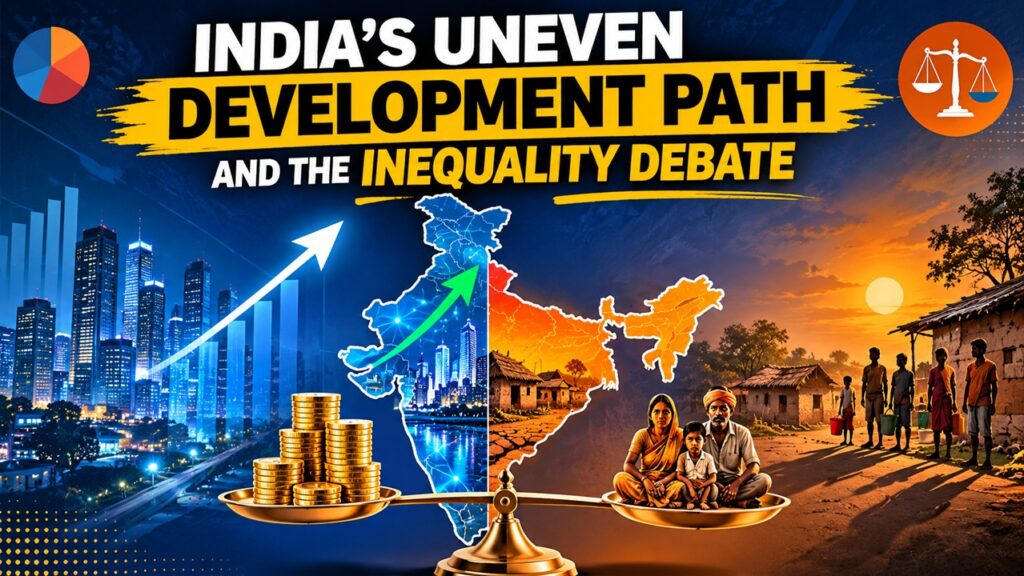
India’s Uneven Development Path and the Inequality Debate
Context
Recent discussions surrounding the rollout of revised labour reforms and the Bharat Grameen Livelihoods and Employment Assurance Framework, 2025, have intensified concerns over widening socio-economic disparities in rural India.
At the same time, fresh interpretations of the Household Consumption Expenditure Survey (HCES) 2023-24 indicate that consumption inequality remains deeply entrenched despite official claims of narrowing gaps.
India’s Uneven Development Path and the Inequality Debate
About India’s Uneven Development Path and the Inequality Debate:
What is Economic Inequality?
Economic inequality denotes the unequal distribution of income, assets, consumption, and economic opportunities among individuals or social groups. In India, disparities are shaped by factors such as caste, occupation, geography, gender, and access to education. The extent of inequality is commonly assessed using indicators like the Gini coefficient, where higher scores indicate greater imbalance.
Major Indicators and Trends:
Consumption Gap Persists:
Recent HCES 2023-24 findings estimate the consumption Gini coefficient at nearly 0.29, significantly above several official projections.
Sharp Urban-Rural Divide:
Urban households continue to spend far more on non-essential goods and services compared to rural households, reflecting unequal standards of living.
Decile-Based Disparities:
Average consumption expenditure among the richest urban households remains multiple times higher than that of the poorest rural households.
Spending Concentration:
A disproportionately high share of total urban consumption expenditure is concentrated within the top income brackets.
Structural Drivers of Rising Inequality in India
Causes Behind Expanding Inequality:
City-Led Economic Expansion:
Economic growth remains heavily concentrated in metropolitan and industrial regions, leaving rural areas relatively stagnant.
Example: Urban centres dominate high-value service sectors and discretionary spending patterns.
Continuing Agrarian Stress:
Agriculture-dependent populations face unstable incomes, low productivity, and climate vulnerabilities.
Example: Rural households continue to report comparatively weaker consumption growth.
Unequal Gains from Liberalisation:
Professional and managerial classes have benefited more from economic reforms than wage labourers or informal workers.
Example: Service-sector professionals witnessed sustained income growth while low-skilled labour remained vulnerable.
Weak Informal Sector Protection:
Informal workers lack adequate social security, stable wages, and labour protections.
Example: Daily wage earners and migrant workers remain economically insecure despite overall GDP growth.
Underestimation of Elite Wealth:
Conventional household surveys often fail to capture the consumption and asset ownership patterns of the ultra-rich.
Example: High-net-worth households are frequently absent from standard expenditure datasets.
Government Measures and Welfare Responses
Steps Taken by the Government:
Bharat Grameen Livelihoods and Employment Assurance Framework, 2025:
Introduced as a restructured rural livelihood support mechanism aimed at employment generation and rural asset creation.
Pradhan Mantri Garib Kalyan Initiatives:
Expanded food security and welfare coverage for economically vulnerable populations.
Labour Law Reforms:
New labour codes seek to simplify labour regulation and improve ease of doing business, though concerns remain over worker safeguards.
Public Distribution and Subsidy Networks:
Food subsidy programmes continue to support low-income households through targeted welfare delivery.
Impact of Inequality on India’s Growth Model
Consequences of Persistent Disparity:
Distorted Policy Planning:
Underestimating inequality may weaken welfare allocation and development planning.
Example: Lower inequality assumptions can reduce urgency for rural support programmes.
Consumption Driven by Borrowing:
Many low-income households increasingly rely on debt to sustain consumption.
Example: Informal borrowing has become common among vulnerable worker groups.
Weak Domestic Demand Base:
Large rural-urban disparities limit broad-based consumption expansion.
Example: Rural purchasing power remains insufficient to sustain balanced economic growth.
Reduced Social Mobility:
Class-based divides hinder upward economic mobility for poorer sections.
Example: The income gap between skilled professionals and agricultural labourers continues to widen.
Welfare Leakage and Inclusion Errors:
Benefits often reach relatively better-off groups while excluding the poorest households.
Example: Some affluent households continue to access subsidised welfare schemes.
The Road Ahead
Suggested Reforms:
Strengthen Statistical Accuracy:
Improve survey methodologies and data transparency for more reliable inequality assessment.
Focus on Group-Based Inequality:
Examine disparities across caste, occupation, and regional categories instead of relying solely on aggregate averages.
Narrow the Consumption Divide:
Introduce targeted measures to improve rural spending capacity and access to quality services.
Protect Informal Workers:
Ensure labour reforms include adequate safeguards for gig workers, migrants, and casual labourers.
Improve Wealth Measurement:
Develop mechanisms to better capture elite wealth concentration and high-end consumption patterns.
Conclusion
India’s economic transformation continues to generate substantial growth, but the benefits remain unevenly distributed across regions and social classes. Persistent rural distress, unequal access to opportunities, and concentration of consumption among affluent groups indicate that inequality remains a structural challenge. Sustainable and inclusive development will require stronger welfare systems, better labour protection, and more accurate economic measurement to ensure growth translates into broader social progress.
Source : The Hindu