
Rethinking the Legacy of Structural Adjustment Policies
Context
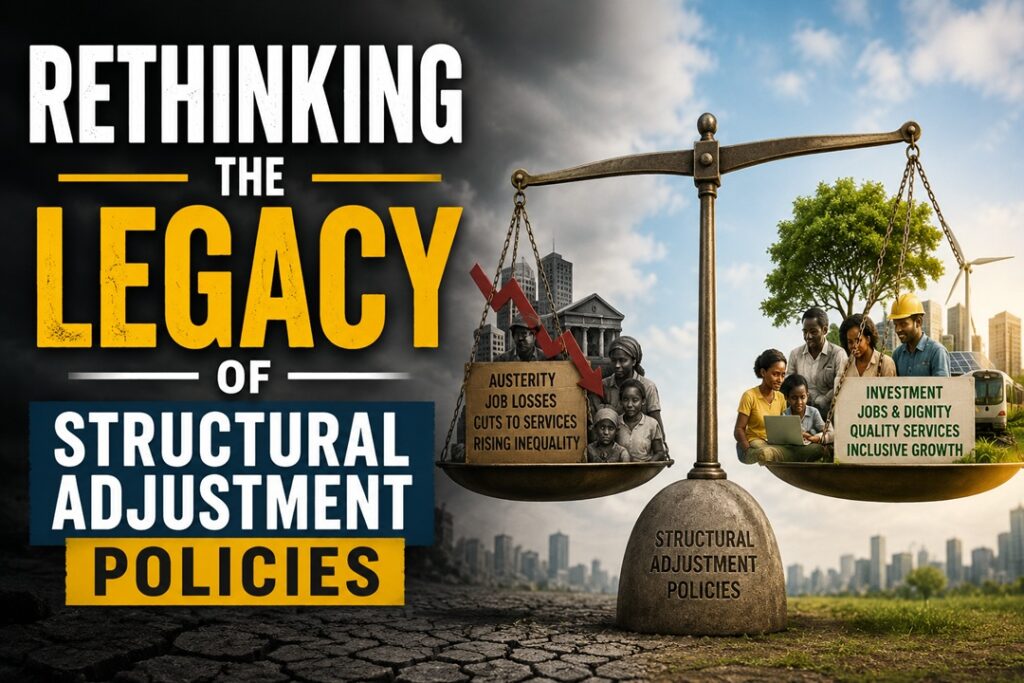
A recent study published in the journal BMJ Global Health has reignited debate over the long-term consequences of structural adjustment policies, with scholars demanding accountability and compensation from global financial institutions for the socio-economic damage caused in developing nations.
Revisiting the Legacy of Structural Reforms
About Structural Reform Programmes
What are Structural Reform Programmes?
Structural Reform Programmes (SRPs) were economic restructuring measures introduced by the International Monetary Fund and World Bank mainly from the 1980s onward as preconditions for financial assistance to indebted developing economies.
Key Objectives
- Stabilise national economies and reduce fiscal deficits.
- Promote export-led growth and market-oriented development.
- Strengthen debt repayment capacity of borrowing nations.
Emergence of Structural Reforms
Debt Crisis and Financial Pressures
Borrowing Expansion
During the 1970s, several developing countries borrowed heavily in foreign currencies to finance industrialisation and imports.
Global Interest Rate Shock
When the U.S. Federal Reserve sharply increased interest rates in the late 1970s, debt servicing costs surged dramatically for poorer nations.
Dollar-Denominated Debt Trap
Countries dependent on U.S.-dollar loans faced mounting repayment burdens without control over currency fluctuations.
Bretton Woods Institutions’ Role
To prevent widespread sovereign defaults, the IMF and World Bank extended financial rescue packages while imposing economic restructuring conditions known as Structural Reform Programmes.
Core Features of Structural Reform Policies
Fiscal Compression
Governments were compelled to reduce expenditure on welfare sectors such as healthcare, education, food support systems, and social protection programmes.
Asset Disinvestment
Public enterprises and essential services were transferred to private ownership through large-scale privatisation initiatives.
Market Liberalisation
Countries were required to weaken trade barriers, remove capital controls, relax labour regulations, and open domestic markets.
Restricted Policy Autonomy
Most debtor nations had little negotiating power because refusal risked financial isolation and default.
Historical Evolution and Global Expansion
Development Strategy Before Reforms
Following decolonisation, many countries in Asia, Africa, and Latin America adopted state-led industrialisation and public investment models to reduce dependence on former colonial powers.
Shift Triggered by Reforms
Structural reform measures reversed several protective economic policies and reopened vulnerable economies to external market pressures.
Growth Trends Before and After Reforms
Expansion During the 1960s–70s
Pre-Reform Economic Progress
Between 1960 and 1980, many developing economies recorded strong gains in real per capita income.
Social Investments
Newly independent states expanded public healthcare, education, and domestic industrial production.
Reform Era from the 1980s
IMF–World Bank Conditionalities
From the 1980s onward, structural reform programmes spread widely across the Global South.
Long-Term Development Challenges
Several countries continue to face persistent poverty, weak public services, and stagnant economic growth decades after implementation.
Socio-Economic Effects of Structural Reforms
Economic Slowdown
Before Structural Reforms
Average annual growth in developing economies stood near 3.2%.
During Reform Period
Growth rates declined sharply to around 0.7% in the 1980s and 1990s.
Estimated Income Losses
Developing countries collectively lost hundreds of billions of dollars annually in unrealised national income.
Regional Experiences
Latin America
Per capita incomes declined significantly after 1980 and recovered only decades later.
Sub-Saharan Africa
Several African economies experienced prolonged income contraction and delayed recovery.
Jamaica
Currency devaluation and trade liberalisation contributed to rising food prices during the early 1990s.
China
A phase of market-oriented restructuring witnessed increases in extreme poverty levels in certain regions.
Public Health Consequences
Child and Maternal Mortality
Research indicates that structural reform programmes adversely affected maternal and child health outcomes across many developing nations.
Healthcare System Weakening
Spending Cuts
Reduced public expenditure led to closure of health facilities and shortages of medical personnel.
Currency Depreciation
Imported medicines and medical equipment became significantly more expensive.
User Fees and Privatisation
Commercialisation reduced access to essential healthcare services for poorer populations.
Wage Erosion
Declining household incomes increased vulnerability to disease and malnutrition.
Financial Drain from the Global South
Capital Flight
Relaxation of capital controls enabled multinational firms to repatriate large volumes of profits abroad.
Trade Deregulation
Liberalised trade systems facilitated tax avoidance and outward financial flows.
Domestic Development Impact
Resources generated within developing economies became unavailable for public investment and welfare expansion.
Debate on Reparations and Accountability
Responsibility of Global Institutions
Critics argue that the IMF and World Bank, as principal designers of these reforms, should contribute toward restorative compensation.
Proposed Compensation Approaches
Economic Loss Assessment
Estimating lost wages, weakened public services, and capital outflows linked to reform policies.
Counterfactual Income Analysis
Comparing actual economic outcomes with hypothetical growth trajectories had reforms not been imposed.
Welfare Restoration
Calculating compensation based on poverty levels, mortality rates, and missed social development indicators.
Challenges to Compensation
Institutional Immunity
The IMF and World Bank possess sovereign immunity protections that shield them from conventional legal proceedings.
Unequal Governance Structure
Developed countries dominate voting power within both institutions, while the United States retains veto authority.
Way Forward
Institutional Reforms
Experts advocate:
- Ending structural adjustment conditionalities in future lending.
- Democratising governance structures within global financial institutions.
- Removing immunity protections to ensure accountability.
Emerging Alternatives
Institutions such as the New Development Bank and Asian Infrastructure Investment Bank are increasingly viewed as alternative financing mechanisms for developing countries without strict structural adjustment conditions.
Source : The Hindu