
Human-Wildlife Conflict in India
Context
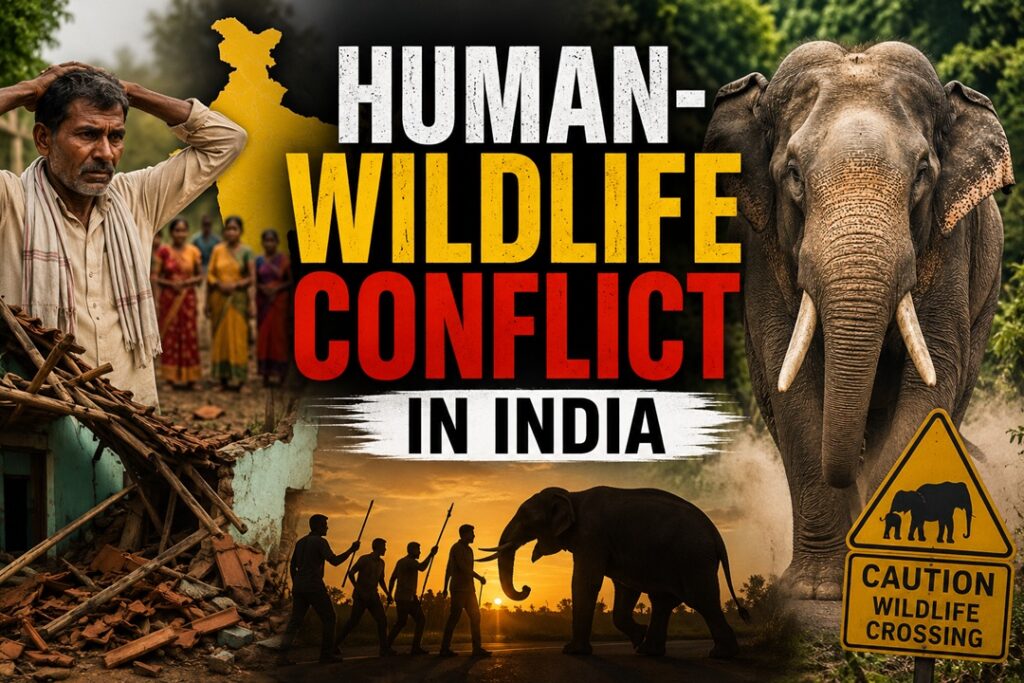
Rising incidents of human-animal encounters have emerged as a major ecological and governance challenge in India, with states like Karnataka, Assam, and Madhya Pradesh reporting increasing casualties, crop destruction, and wildlife deaths linked to shrinking habitats and expanding human settlements.
Balancing Ecology and Livelihoods in Wildlife Conflict Regions
About Balancing Ecology and Livelihoods in Wildlife Conflict Regions:
What is Human-Wildlife Interaction Crisis?
Human-wildlife interaction crisis refers to situations where increasing overlap between human activities and wildlife habitats leads to losses for both communities and animals. These interactions often result in human casualties, destruction of crops and property, livestock attacks, retaliatory killings of animals, and ecological instability.
Important Facts and Trends on Human-Wildlife Encounters
Human Casualties: India witnesses hundreds of deaths annually due to elephant, leopard, and tiger encounters, especially in forest-fringe regions of Odisha, Karnataka, Assam, and West Bengal.
Wildlife Deaths: Electrocution, train accidents, poaching, and poisoning continue to claim the lives of elephants, tigers, and leopards across multiple states.
Tiger Mortality Concern: India recorded a sharp rise in tiger deaths in recent years due to territorial stress, habitat pressure, poaching, and accidental conflict situations.
Agricultural Losses: Thousands of rural households face recurring crop destruction from elephants, wild boars, nilgai, and monkeys, severely affecting rural incomes.
Factors Responsible for Escalating Human-Wildlife Conflicts
Shrinking Natural Habitats
Rapid urbanisation, mining, dams, and highway construction have fragmented forests and disrupted animal movement routes.
Example: Infrastructure expansion in central Indian landscapes has disturbed traditional tiger and elephant corridors.
Expansion of Human Settlements
Agricultural and residential expansion near forest boundaries increases direct interaction between wildlife and humans.
Example: Leopard sightings have increased around peri-urban settlements in Maharashtra and Uttarakhand.
Climate Stress and Water Scarcity
Erratic rainfall and prolonged dry spells reduce food and water availability inside forests, pushing animals toward villages.
Example: Elephants frequently enter settlements in Jharkhand and Chhattisgarh during drought seasons.
Decline in Habitat Quality
Invasive species, forest degradation, and recurring wildfires reduce grazing resources for herbivores and prey species.
Example: Spread of invasive plants in southern tiger reserves has weakened natural food availability.
Changing Animal Behaviour
Frequent disturbance, crowding, and aggressive chasing methods alter wildlife behaviour and increase unpredictability.
Example: Panic-driven elephant movements in North-East India have led to accidental stampedes and casualties.
Steps Taken to Reduce Human-Wildlife Conflict
Integrated Wildlife Protection Measures
Government initiatives such as Project Tiger and elephant conservation programmes aim to strengthen habitat protection and wildlife management.
Technology-Driven Surveillance
AI-enabled sensors, drone monitoring, and SMS-based warning systems are being deployed in sensitive regions.
Landscape-Based Planning
Regional conservation plans focus on securing ecological corridors and reducing conflict hotspots across states.
Physical Barrier Mechanisms
Solar-powered fencing, trenches, and bio-fencing techniques are being used in vulnerable villages.
Community Response Teams
Local rapid-response squads and forest volunteers are trained to safely disperse animals and support rescue operations.
Key Challenges in Conflict Management
Slow Compensation Delivery
Victims often face delays in receiving financial assistance because of lengthy verification procedures.
Example: Remote tribal communities struggle to access compensation for livestock and crop losses.
Limited Technological Reach
Advanced monitoring systems are difficult to maintain in remote forested regions with poor connectivity.
Example: GPS tracking of elephants remains expensive and operationally challenging.
Weak Institutional Coordination
Coordination gaps between forest departments, local administration, and communities reduce the effectiveness of mitigation measures.
Degraded Ecosystems
Conservation efforts become ineffective when forest quality continues to deteriorate due to invasive species and human pressure.
Declining Public Trust
Repeated economic losses and fear reduce local support for conservation initiatives, sometimes triggering retaliatory actions.
Example: Poisoning and illegal trapping incidents have been reported in several conflict-prone districts.
Future Strategy for Sustainable Coexistence
Securing Wildlife Corridors
Protecting and restoring migratory corridors can reduce animal movement through densely populated areas.
Community Participation
Local communities should be integrated into conservation planning through eco-tourism benefits, livelihood support, and awareness programmes.
Faster Compensation Systems
Digital claim systems and direct-benefit transfers can ensure timely financial relief for affected families.
Ecological Restoration
Removal of invasive species and regeneration of grasslands and water bodies can improve habitat quality.
Wildlife-Friendly Infrastructure
Eco-bridges, underpasses, and animal passages should become mandatory in highways and railway projects crossing forest landscapes.
Conclusion
Human-wildlife conflict reflects the growing imbalance between developmental expansion and ecological sustainability. Managing these conflicts requires a long-term strategy focused on habitat connectivity, scientific planning, community involvement, and rapid institutional response. Promoting coexistence is essential not only for biodiversity conservation but also for ensuring the safety and livelihood security of local populations.
Source : The Hindu