
India’s Strategic Autonomy Challenges
Context
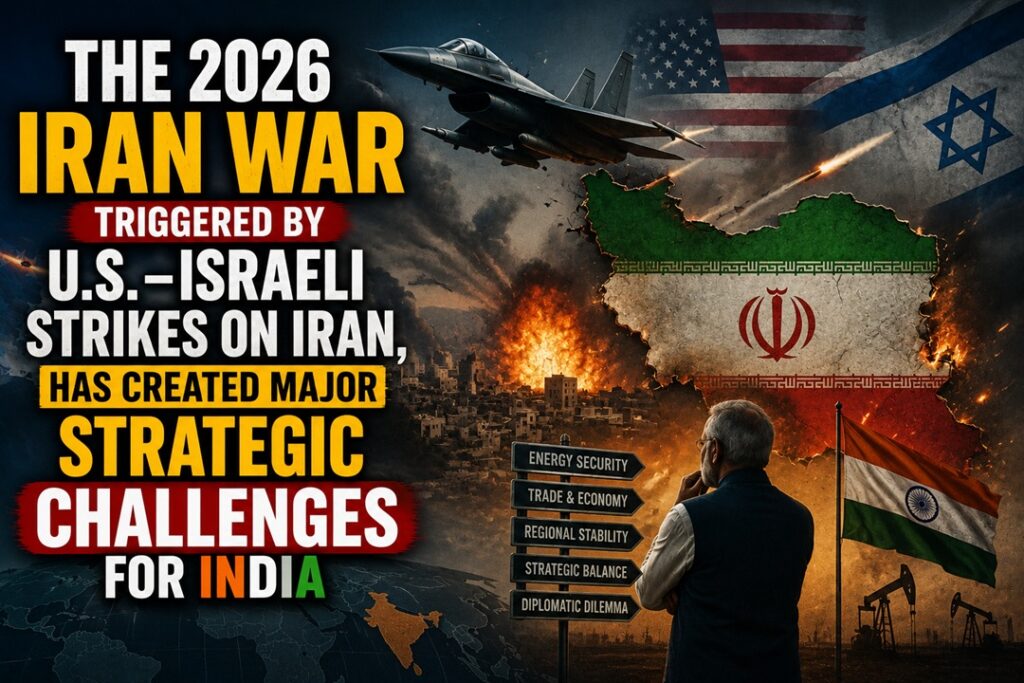
The 2026 Iran War, triggered by U.S.–Israeli strikes on Iran, has created major strategic challenges for India. The closure of the Strait of Hormuz disrupted energy supplies, while rising tensions in the Indian Ocean increased pressure on New Delhi to balance its ties with the United States, Iran, and Russia. The crisis has renewed debate over the future of India’s strategic autonomy in a polarized global order.
About India’s Strategic Autonomy Challenges
What is Strategic Autonomy?
Strategic autonomy refers to India’s long-standing foreign policy approach of preserving independent decision-making in global affairs without entering into rigid military alliances. It allows India to cooperate with multiple rival powers simultaneously while safeguarding national interest.
Key objectives include:
- Maintaining sovereignty in security and economic choices.
- Avoiding dependence on any single geopolitical bloc.
- Positioning India as an independent pole in a multipolar world order.
Key Data & Trends
- Energy Vulnerability: Nearly 91% of India’s LPG imports originate from the Gulf region; closure of the Strait of Hormuz triggered a sharp rise in domestic LPG prices.
- Trade Interdependence: The United States continues to remain India’s largest trading partner, with bilateral trade crossing $130 billion in 2025–26.
- Defence Diversification: India’s proposed acquisition of 114 Dassault Rafale fighter jets reflects efforts to diversify defence suppliers.
- Economic Pressure: U.S. tariffs and secondary sanctions have accelerated India’s push for a comprehensive trade agreement with the European Union.
Evolution of India’s Strategic Autonomy
Phase I: Non-Alignment (1947–1991)
Voice of the Global South
India emerged as a leading advocate of decolonized nations and resisted alignment with Cold War blocs.
Issue-Based Diplomacy
New Delhi assessed global crises independently rather than following ideological camps.
Protection of Sovereignty
Strategic space was viewed as essential for a newly independent developing nation.
Phase II: Pragmatic Realism (1991–2014)
Economic Liberalisation
Post-1991 reforms increased engagement with Western economies for technology, capital, and markets.
Independent Nuclear Policy
India conducted the 1998 nuclear tests despite sanctions, emphasizing sovereign security choices.
Regional Security Role
India strengthened its influence in the Indian Ocean while simultaneously deepening ties with both Israel and Iran.
Phase III: Multi-Alignment (2014–Present)
Simultaneous Partnerships
India participates in the Quad while also remaining active in BRICS and the SCO.
Strategic Hedging
Partnerships are increasingly driven by practical national interest rather than ideological alignment.
Linking Foreign Policy with Development
Initiatives like Make in India and energy security have become central to strategic autonomy.
Challenges to India’s Strategic Autonomy
U.S. Economic & Strategic Pressure
The growing linkage between security partnerships and economic compliance limits India’s freedom of manoeuvre.
Example: Threats of sanctions over de-dollarisation initiatives within BRICS constrain India’s financial alternatives.
Strategic Setback in the Indian Ocean Region
The sinking of the Iranian naval vessel IRIS Dena after participation in India’s International Fleet Review undermined India’s image as a regional security provider.
This incident exposed the limitations of India’s influence in the Indian Ocean amid major power rivalry.
Energy Insecurity
Dependence on Gulf energy supplies and pressure to reduce Russian oil imports increase India’s strategic vulnerability.
Example: Limited sanctions waivers from the U.S. created uncertainty in India’s energy supply chain.
Exclusive Western Supply Chains
Emerging Western economic blocs increasingly prioritize strategic and civilizational alignment.
This risks marginalizing developing economies into dependent positions within global supply chains.
Defence Technology Dependence
Although procurement diversification reduces reliance on a single supplier, critical technologies often remain externally controlled.
Example: Future upgrades and software integration for Dassault Rafale aircraft may continue to depend heavily on foreign vendors.
Way Forward
Accelerate Energy Self-Reliance
- Expand strategic petroleum and LPG reserves.
- Invest aggressively in green hydrogen and renewable energy.
- Diversify import routes beyond the Strait of Hormuz.
Deepen India–EU Engagement
The proposed India–EU FTA can act as a balancing mechanism against excessive dependence on any one major power.
Strengthen Maritime Security Capacity
India should expand independent naval escort operations and enhance indigenous maritime surveillance capabilities without formally joining military blocs.
Promote Technological Sovereignty
Future defence agreements must prioritize:
- Full technology transfer,
- Indigenous manufacturing,
- Source-code access,
- Domestic R&D ecosystems.
Champion Multipolarity
India can leverage platforms such as:
- G20,
- BRICS,
- Shanghai Cooperation Organisation
to advocate a more balanced international order.
Conclusion
The 2026 Iran conflict represents a defining moment for India’s foreign policy. Traditional non-alignment alone is insufficient in an era marked by economic coercion, technological dependency, and great-power competition. India’s future strategic autonomy will depend on its ability to build resilient domestic capabilities in energy, defence, technology, and trade while maintaining flexibility in an increasingly polarized global order.
Source : The Hindu