
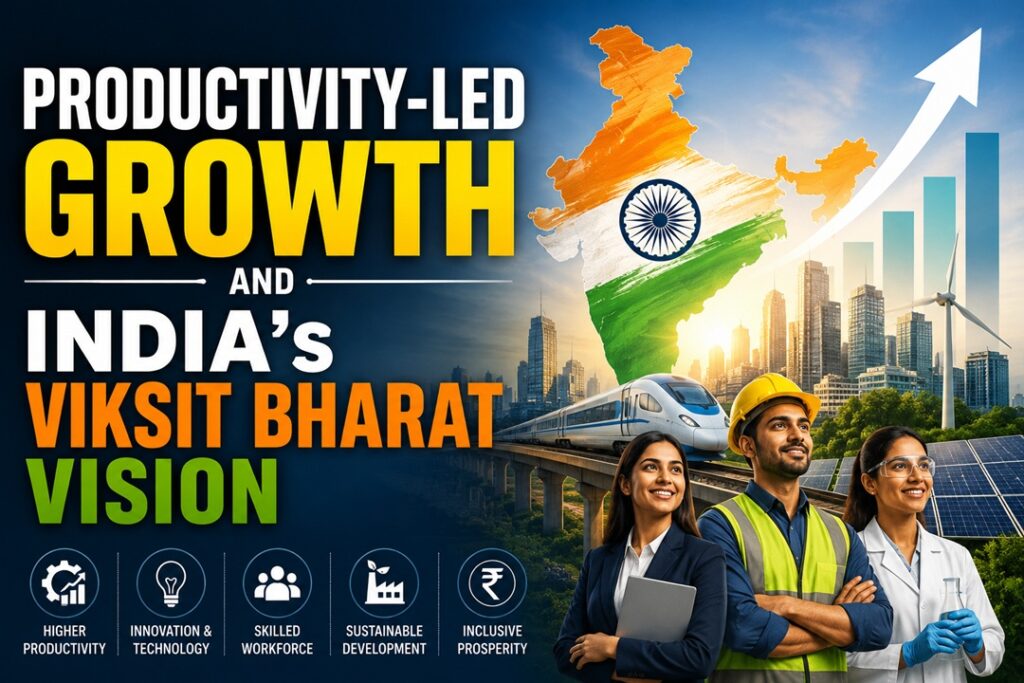
Productivity-Led Growth and India’s Viksit Bharat Vision
Context
The Economic Survey 2025–26 and recent macroeconomic reviews have highlighted that India’s long-term development strategy must move beyond headline GDP expansion and prioritize efficiency-led growth to achieve the vision of Viksit Bharat 2047.
Efficiency-Led Development
About Efficiency-Led Development: India’s Road to Viksit Bharat 2047
What is Economic Productivity?
In economics, productivity—particularly Total Factor Productivity (TFP)—refers to how efficiently an economy combines labour, capital, technology, and institutions to produce output. Unlike growth achieved merely by increasing workers or investments, productivity-led growth reflects innovation, better governance, advanced technology, improved logistics, and efficient allocation of resources.
Major Trends and Data on Productivity
Growth Still Dominated by Factor Expansion
India’s labour productivity increased by nearly 4.7% annually between 1990 and 2023, yet TFP contributed only around 1.2 percentage points, indicating continued dependence on capital formation and labour addition rather than efficiency gains.
Stable Macroeconomic Fundamentals
India’s GDP growth is projected to improve from 6.5% in FY25 to about 7.4% in FY26, while fiscal deficit levels declined significantly from 9.2% in FY21 to nearly 4.8% in FY25, indicating improving macroeconomic discipline.
Manufacturing Suffers from Scale Deficit
Nearly all manufacturing establishments remain micro-scale units, whereas medium-sized enterprises form only a tiny fraction, constraining export competitiveness and industrial productivity.
Agriculture Continues to Absorb Excess Labour
A large share of the rural workforce remains concentrated in low-productivity agriculture, while manufacturing has not expanded sufficiently to absorb surplus labour.
Financial Resources Locked in Weak Firms
A small number of financially distressed “zombie firms” continue to hold a disproportionately large share of corporate debt, reducing credit access for productive and innovative sectors.
Why Productivity Matters for Viksit Bharat 2047
Creating Employment-Intensive Growth
Higher productivity ensures that economic growth generates formal and quality jobs instead of merely increasing output without employment gains.
Example: Shifting labour from subsistence agriculture to modern manufacturing can improve wages and industrial competitiveness simultaneously.
Reallocating Idle Financial Capital
Removing inefficient firms from the economy enables banks and investors to redirect funds toward innovative and high-growth industries.
Example: Faster resolution of distressed companies can free capital for startups and export-oriented industries.
Strengthening Industrial Ecosystems
Improved productivity enables Indian manufacturing to move from basic assembly operations toward advanced value-added production systems.
Example: Expanding semiconductor components and precision electronics manufacturing can deepen India’s integration into Global Value Chains (GVCs).
Supporting Sustainable Non-Inflationary Growth
Efficient production systems help expand output without triggering excessive inflationary pressures.
Example: Reduced logistics and compliance costs can maintain manufacturing competitiveness despite volatile global commodity prices.
Improving Human Capital Utilisation
Productivity-oriented skill development helps bridge the mismatch between educational qualifications and industrial requirements.
Example: Technical re-skilling in industrial belts can transition workers into higher-value manufacturing and services sectors.
Government Measures to Improve Productivity
Insolvency and Bankruptcy Code (IBC)
Established a structured framework for resolving distressed firms and reallocating unproductive assets efficiently.
Production Linked Incentive (PLI) Schemes
Introduced across multiple strategic sectors to encourage domestic manufacturing scale, technology adoption, and export competitiveness.
National Logistics Policy and PM GatiShakti
Focused on integrated infrastructure development to reduce logistics costs and improve supply-chain efficiency.
Revamped Distribution Sector Scheme (RDSS)
Introduced reforms in electricity distribution through performance-linked support aimed at reducing technical and commercial losses.
Key Bottlenecks in Productivity Enhancement
Dependence on Capital-Led Growth
Economic expansion still relies heavily on infrastructure investment and capital accumulation instead of innovation-driven productivity.
Example: Large public investment projects increase GDP in the short run but may not necessarily improve long-term efficiency.
Regulatory and Institutional Rigidities
Complex land, labour, and compliance systems hinder efficient movement of resources across sectors.
Example: Small firms often avoid expansion due to rigid labour regulations and compliance burdens.
Corporate “Zombie Financing”
Weak credit allocation systems sometimes sustain financially distressed companies for prolonged periods.
Example: Repeated refinancing of non-performing firms crowds out lending to productive enterprises.
Industrial Skill Deficits
Many graduates lack industry-relevant technical and analytical capabilities required by modern sectors.
Example: Several employability surveys show limited practical readiness among engineering graduates.
Uneven Regional Industrialisation
Industrial productivity gains remain concentrated in a few advanced states, widening regional disparities.
Example: Southern and western states dominate industrial employment while several populous regions remain agriculture-dependent.
The Way Forward
Reforming Exit and Resolution Systems
Further strengthening insolvency mechanisms can accelerate the closure or restructuring of inefficient firms.
Promoting Equity-Based Financing
Developing deeper equity markets can reduce excessive dependence on bank-led corporate financing.
Modernising Vocational Education
Education and skilling systems must align more closely with emerging industrial and technological demands.
Expanding Industrial Growth Beyond Coastal Regions
Targeted infrastructure support for tier-2 and tier-3 cities can decentralize manufacturing growth.
Encouraging Innovation-Led Industrial Growth
Improved research commercialization and private-sector R&D incentives can support indigenous technological advancement.
Conclusion
India’s post-pandemic recovery has provided a stable macroeconomic base, but achieving Viksit Bharat 2047 will depend less on expanding inputs and more on improving efficiency. The next stage of economic transformation requires innovation, institutional reforms, skilled human capital, and sustained productivity growth to convert rapid expansion into durable and inclusive prosperity.
Source : The Hindu