
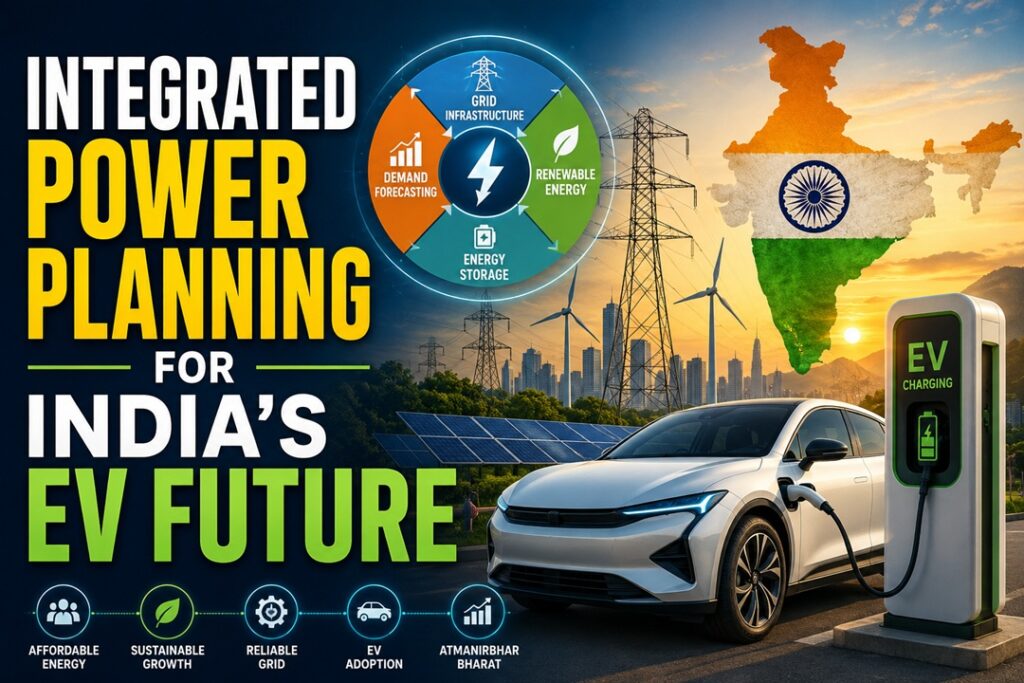
Integrated Power Planning for India’s EV Future
Context
Due to sharp fluctuations in global crude oil markets arising from the continuing West Asian tensions, power sector experts stressed the importance of developing a resilient electricity network to sustain India’s expanding electric mobility ecosystem.
Understanding EV-Power Integration
What is an EV-Power Integration Strategy?
An EV-power integration strategy refers to a coordinated policy framework that synchronizes transport electrification with electricity generation, transmission, storage, and distribution systems.
Rather than viewing electric vehicles as standalone transport units, this approach treats them as a large-scale, interconnected electricity demand network capable of influencing grid stability and energy planning.
Important Figures and Sectoral Insights
Rising Electricity Requirement
Completely electrifying India’s nearly 420 million registered vehicles could require an additional 900–1,100 TWh of electricity annually.
Mid-Century Transition Scenario
Achieving electrification of around half the national vehicle fleet by 2047 may increase yearly electricity demand by nearly 500 TWh, equivalent to almost one-third of India’s present power generation output.
Freight Transport Energy Burden
Although Heavy Goods Vehicles (HGVs) form barely 2% of the national vehicle stock, electrifying this segment alone could consume nearly 450–565 TWh annually because of their extremely high energy requirements.
Existing Power Capacity
By 2026, India’s total installed electricity capacity reached 520.51 GW, while successfully handling a record peak demand of 242.49 GW. More than half of the installed capacity now comes from non-fossil fuel sources.
Priority Areas in India’s EV Expansion
Electrifying Long-Distance Freight Networks
India aims to reduce diesel dependence in commercial logistics by shifting freight movement toward electricity-based transport systems.
Example: Large transport corridors such as the Golden Quadrilateral would require pre-planned high-capacity charging infrastructure before large-scale deployment of electric trucks.
Moving Beyond Two-Wheeler-Centric Policies
Experts argue that focusing only on electric scooters and bikes overlooks the much larger energy implications of commercial transport electrification.
Example: Even hundreds of millions of electric two-wheelers would contribute only a small share of total projected EV electricity demand compared to freight transport.
Managing Urban Peak Electricity Demand
Mass EV charging during evening hours could place severe stress on urban power distribution systems.
Example: Simultaneous residential charging after office hours may trigger localized transformer failures, power fluctuations, and tariff increases.
Expanding Clean Baseload Energy Sources
The additional electricity required for EV charging must come from diversified clean energy sources rather than coal-based generation.
Example: Combining solar, wind, battery storage, and small modular nuclear systems near transport corridors can ensure uninterrupted charging supply.
Developing a Domestic Battery Recycling Ecosystem
India is also focusing on establishing a circular battery economy capable of processing and recovering materials from end-of-life EV batteries.
Government Measures and Policy Initiatives
PM-E-DRIVE Programme
The PM-E-DRIVE initiative was launched to accelerate EV adoption, especially in segments such as electric buses and commercial transport vehicles.
Expansion under National Electricity Plan
The National Electricity Plan aims to expand transmission infrastructure to nearly 6.48 lakh circuit kilometers by 2032 with planned investments worth ₹9.15 lakh crore.
Unified Charging Standards
The Bureau of Indian Standards (BIS) introduced interoperable charging standards for electric buses, enabling compatibility across different charging systems.
Smart Metering under RDSS
More than 4 crore smart meters have been deployed through the Revamped Distribution Sector Scheme (RDSS) to facilitate real-time electricity management and consumption tracking.
Major Challenges in EV-Grid Synchronization
Financial Weakness of Distribution Companies
Many state discoms continue to face financial stress and lack adequate investment capacity for transformer and substation modernization.
Example: Industrial EV charging depots often encounter delays in obtaining high-voltage grid connections.
Risk of Indirect Carbon Emissions
Using coal-dominated electricity for EV charging merely shifts emissions from vehicle exhaust pipes to thermal power plants.
Example: Excessive reliance on thermal generation may increase coal imports despite reducing oil dependence.
Lack of Intelligent Charging Infrastructure
Many existing chargers do not support smart communication systems required for load balancing and dynamic pricing.
Example: Conventional charging stations may later require costly retrofitting to comply with smart-grid standards.
Sudden Load Surges
Unregulated charging behavior can significantly increase instantaneous electricity demand in cities.
Example: Simultaneous charging during peak summer conditions may destabilize urban distribution networks.
Uneven Regional Preparedness
EV readiness and renewable integration remain concentrated in a few advanced states, creating regional disparities.
Example: States such as Karnataka have achieved high EV adoption rates, while several inland regions remain underprepared.
Future Roadmap
Introducing Smart Charging Regulations
Future EV charging infrastructure should support automated communication with power grids for better demand management.
Coordinated Infrastructure Planning
Joint planning between transport and power ministries is necessary to install charging networks along freight and industrial corridors.
Dynamic Electricity Pricing
Time-of-use electricity tariffs can encourage EV charging during periods of surplus renewable energy generation.
Linking Financial Support with EV Preparedness
Central financial assistance to state discoms may be tied to measurable EV-grid readiness benchmarks.
Strengthening Energy Storage Infrastructure
Dedicated Battery Energy Storage Systems (BESS) and pumped-storage hydro facilities near charging hubs can ensure reliable power availability.
Conclusion
India’s transition toward clean mobility depends not only on expanding EV sales but also on strengthening the country’s electricity ecosystem. While electric two-wheelers are driving visible adoption in cities, the long-term success of the transition will ultimately depend on electrifying freight transport, modernizing distribution infrastructure, and ensuring access to reliable clean power.
Source : The Hindu