
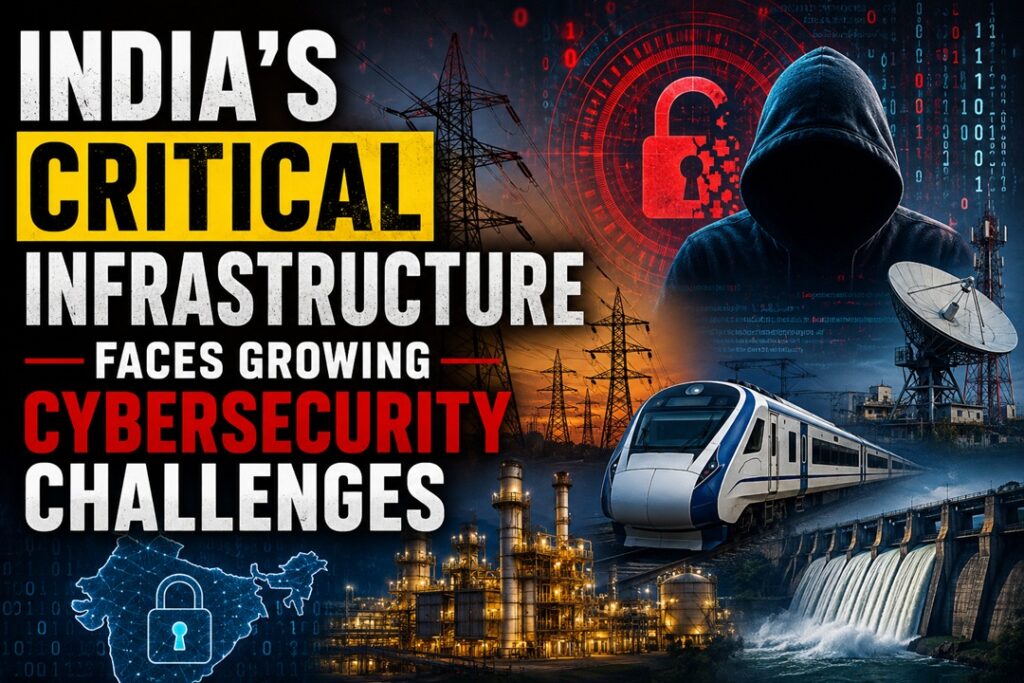
India’s Critical Infrastructure Faces Growing Cybersecurity Challenges
Context
With the growing integration of Artificial Intelligence (AI), Internet of Things (IoT), and Operational Technology (OT) into essential services, concerns have intensified regarding the cybersecurity resilience of India’s Critical National Infrastructure (CNI).
Securing India’s Critical National Infrastructure in the Digital Age
What is Critical National Infrastructure (CNI)?
Critical National Infrastructure (CNI) comprises the key physical assets, digital systems, communication networks, and public services that are indispensable for a nation’s economic stability, public welfare, and national security. Any disruption or compromise of these systems can lead to severe social, economic, and security consequences.
Major Trends and Emerging Risks
Rising Global Cyber Threats
Cyberattacks targeting critical sectors such as energy, transportation, and finance have increased significantly worldwide, with state-backed actors increasingly focusing on strategic infrastructure.
Security Gaps in Compliance Mechanisms
A considerable number of public sector organizations continue to depend on traditional audit-based security assessments rather than advanced hardware and firmware verification systems.
Vulnerabilities in Industrial IoT Networks
Many industrial control systems still operate with outdated authentication mechanisms, making them susceptible to unauthorized access and cyber intrusions.
Growing Risks to Digital Financial Systems
India’s banking ecosystem and digital payment infrastructure face a constant stream of cyber reconnaissance activities, phishing attempts, and distributed denial-of-service (DDoS) attacks.
Key Components of India’s Critical Infrastructure Ecosystem
Energy and Power Infrastructure
Includes thermal and hydroelectric power stations, nuclear facilities, renewable energy parks, load dispatch centers, and interstate transmission networks that ensure uninterrupted electricity supply.
Transport and Logistics Network
Comprises railway signaling systems, airport traffic management networks, smart highways, metro rail operations, and major maritime ports supporting trade and mobility.
Financial and Payment Infrastructure
Encompasses digital payment platforms, interbank settlement systems, stock exchanges, banking data centers, and financial communication networks.
Telecommunications and Digital Connectivity
Consists of national data centers, mobile communication towers, satellite communication systems, internet exchange points, and submarine cable networks.
Essential Public Service Networks
Includes water distribution systems, oil and gas pipeline controls, healthcare institutions, emergency response services, and law-enforcement communication platforms.
Challenges in Protecting Critical Infrastructure
Increasing Interconnectivity of Digital Systems
The convergence of Information Technology (IT), Operational Technology (OT), and IoT environments has expanded the cyber attack surface, exposing previously isolated industrial systems to remote threats.
Example: Internet-connected industrial sensors can provide attackers pathways to access operational control systems and manipulate physical processes.
Supply Chain Security Concerns
Weak procurement oversight may allow vulnerable or compromised foreign-made hardware and software components to enter strategic networks.
Example: Embedded backdoors in communication equipment can potentially enable unauthorized surveillance or operational disruption.
Delays in Security Certification and Testing
Lengthy approval and testing procedures often slow down the deployment of secure technologies, forcing organizations to continue operating outdated systems.
Example: Delayed certification of smart monitoring devices may prolong dependence on legacy infrastructure.
Evolving Nature of Cyber Warfare
Advanced Persistent Threats (APTs), malware implants, and cyber-espionage campaigns increasingly target civilian infrastructure as part of broader geopolitical strategies.
Example: Attackers may infiltrate industrial control systems and remain dormant until activation during a crisis.
Measures Undertaken by India
National Critical Information Infrastructure Protection Centre (NCIIPC)
Established as the nodal agency responsible for protecting critical information infrastructure and coordinating cybersecurity efforts across strategic sectors.
Strengthening CERT-In
The Indian Computer Emergency Response Team (CERT-In) provides incident response support, cyber threat intelligence, and security advisories for organizations.
Trusted Telecom Framework
Introduced to ensure that telecom operators procure network equipment only from approved and trusted vendors, reducing supply-chain vulnerabilities.
Enhanced Security Testing Mechanisms
Specialized testing facilities have been developed to evaluate imported digital devices, surveillance equipment, and IoT systems for hidden security risks.
The Way Forward
Adoption of Zero-Trust Security Models
Implement robust identity verification and continuous authentication mechanisms for all devices and users operating within critical networks.
Strengthening Procurement and Supply Chain Audits
Introduce comprehensive hardware, software, and firmware verification standards for all strategic infrastructure acquisitions.
Expanding Security Testing Capacity
Increase the number of accredited testing laboratories and streamline certification processes to accelerate deployment of secure technologies.
Leveraging Artificial Intelligence for Threat Detection
Deploy AI-powered monitoring systems capable of identifying unusual behavior patterns and responding to cyber incidents in real time.
Conducting Integrated Cybersecurity Exercises
Institutionalize regular cyber preparedness drills involving government agencies, infrastructure operators, and security organizations to improve response capabilities.
Conclusion
As India accelerates its digital transformation journey, safeguarding Critical National Infrastructure must remain a strategic national priority. Building resilient cyber defenses, securing supply chains, and adopting advanced security architectures will be essential to ensuring that technological advancement strengthens national security rather than creating new vulnerabilities.
Source : The Hindu