
Ayushman Bharat Digital Mission Reaches New Digital Health Milestone
Context
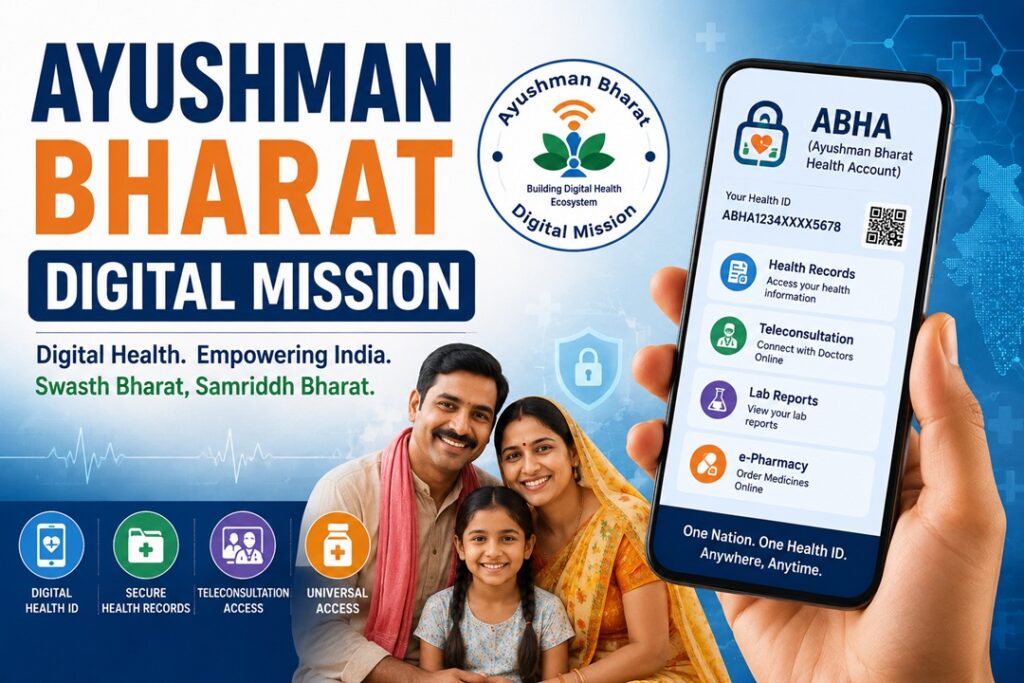
The Ayushman Bharat Digital Mission (ABDM) has achieved a major milestone by generating over 90 crore Ayushman Bharat Health Accounts (ABHAs) across the country, strengthening India’s digital healthcare ecosystem.
The Ayushman Bharat Digital Mission (ABDM)
Introduction
What is ABDM?
- The Ayushman Bharat Digital Mission (ABDM) is a flagship digital public infrastructure (DPI) initiative of the Government of India, implemented by the National Health Authority (NHA) under the Ministry of Health and Family Welfare.
- It creates a nationwide digital health network that connects citizens, healthcare providers, hospitals, laboratories, pharmacies, insurers, and other stakeholders through interoperable digital platforms.
- The mission seeks to modernize healthcare delivery by enabling seamless exchange of health information while ensuring data privacy and security.
- Launched: September 2021.
Vision and Objectives
Mission Goals
- To establish an integrated and interoperable digital health ecosystem across India.
- To create a standardized digital framework for healthcare service delivery.
- To empower citizens with control over their personal health records.
- To improve accessibility, affordability, and quality of healthcare services.
- To reduce fragmentation between public and private healthcare systems.
- To promote efficient and evidence-based decision-making through digital health data.
Key Building Blocks of ABDM
1. Ayushman Bharat Health Account (ABHA)
- ABHA is a unique 14-digit digital health identifier issued to every citizen.
- It serves as a gateway for storing, accessing, and sharing digital health records.
- Individuals can link medical reports, prescriptions, discharge summaries, and other health documents with their ABHA.
- It ensures portability of health records across healthcare providers and states.
2. Healthcare Professionals Registry (HPR)
- HPR is a verified national repository of healthcare professionals.
- It includes doctors, nurses, dentists, AYUSH practitioners, and allied healthcare personnel.
- The registry helps citizens identify qualified healthcare providers.
- It promotes transparency and trust within the healthcare ecosystem.
3. Health Facility Registry (HFR)
- HFR is a comprehensive database of healthcare facilities across India.
- It includes public and private hospitals, clinics, laboratories, diagnostic centres, pharmacies, and other health establishments.
- It provides a standardized digital identity for healthcare institutions.
- It facilitates easier discovery and verification of healthcare facilities.
4. Health Information Exchange & Consent Manager (HIE-CM)
- HIE-CM enables secure sharing of health data between healthcare entities.
- The framework operates on a consent-based mechanism.
- Citizens retain complete control over who can access their health records.
- Consent can be granted, monitored, and revoked electronically.
- It ensures privacy, security, and transparency in health data exchange.
5. Unified Health Interface (UHI)
- UHI is an open and interoperable digital protocol similar to UPI in the payments sector.
- It enables different healthcare applications to communicate seamlessly.
- Citizens can:
- Book appointments,
- Access telemedicine consultations,
- Search for healthcare services,
- Connect with healthcare providers through multiple applications.
- It promotes innovation by allowing private and public platforms to participate in the digital health ecosystem.
6. National Health Claims Exchange (NHCX)
- NHCX is a digital platform designed to streamline health insurance claim processing.
- It standardizes claim-related workflows between hospitals, insurers, and government schemes.
- It helps reduce paperwork and claim settlement delays.
- It improves transparency and efficiency in insurance claim management.
Salient Features of ABDM
Citizen-Centric Approach
- Individuals own and control their health data.
- Health records remain portable and accessible throughout a person’s lifetime.
Interoperability
- Enables seamless exchange of health information across different healthcare platforms and institutions.
- Uses open standards to ensure compatibility.
Data Privacy and Security
- Built on robust consent management mechanisms.
- Ensures secure transmission and storage of health information.
- Citizens determine when and with whom data can be shared.
Digital Inclusion
- Supports both public and private healthcare providers.
- Facilitates healthcare access in urban as well as rural areas.
Paperless Healthcare
- Reduces dependency on physical medical records.
- Promotes efficient healthcare administration and service delivery.
Benefits of ABDM
For Citizens
- Easy access to lifelong digital health records.
- Better continuity of care across healthcare providers.
- Reduced duplication of diagnostic tests.
- Faster access to healthcare services.
For Healthcare Providers
- Improved availability of patient medical history.
- Better clinical decision-making.
- Reduced administrative burden.
- Enhanced efficiency in service delivery.
For Hospitals and Institutions
- Streamlined record management.
- Improved coordination with insurers and healthcare professionals.
- Better patient management systems.
For Policymakers
- Availability of reliable and standardized health data.
- Improved planning and monitoring of healthcare programs.
- Enhanced evidence-based policymaking.
Significance of ABDM
- Strengthens India’s digital public infrastructure ecosystem.
- Supports the vision of Universal Health Coverage (UHC).
- Promotes efficient, transparent, and patient-centric healthcare delivery.
- Facilitates integration of public and private healthcare sectors.
- Enhances healthcare accessibility and quality across the country.
- Contributes to the Digital India initiative through technology-driven governance.
Conclusion
The Ayushman Bharat Digital Mission is transforming India’s healthcare landscape by creating a secure, interoperable, and citizen-centric digital health ecosystem. The achievement of over 90 crore ABHA accounts highlights the rapid adoption of digital health services and reflects the mission’s growing impact. By empowering citizens with ownership of their health data and enabling seamless healthcare delivery, ABDM is laying the foundation for a more efficient, inclusive, and technology-driven healthcare system in India.
Source : PIB