
Judicial Activism Through Suo Motu Powers: Balancing Intervention and Institutional Restraint
Context
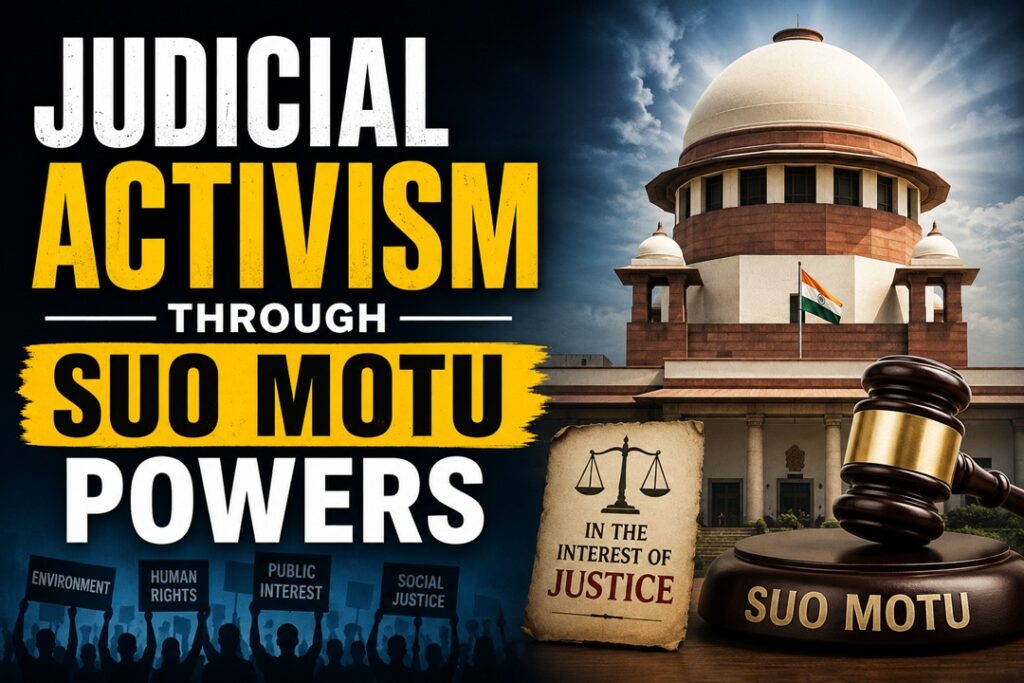
The increasing reliance of the Supreme Court on suo motu proceedings has reignited discussions on judicial activism, the autonomy of subordinate courts, and the influence of media-driven narratives in shaping judicial priorities.
Suo Motu Jurisdiction and the Boundaries of Judicial Activism
Understanding Suo Motu Jurisdiction
Meaning and Constitutional Basis
Suo motu jurisdiction refers to the authority of constitutional courts to initiate legal proceedings on their own without waiting for a petition from an affected individual or organization.
This extraordinary power has evolved through the development of Public Interest Litigation (PIL) and derives support from the broad constitutional powers granted under Articles 32 and 142 of the Constitution of India.
It serves as an institutional safeguard to protect fundamental rights, address exceptional cases of injustice, and respond to situations where executive agencies fail to act effectively.
However, the exercise of this power must remain consistent with constitutional principles such as separation of powers, judicial discipline, and federal balance.
Intended Purpose of Suo Motu Powers
The mechanism was conceived as an exceptional remedy to tackle systemic failures and extraordinary situations rather than to routinely supervise individual criminal proceedings that are already under consideration before competent trial courts.
Expansion of Suo Motu Proceedings
Growth in Judicial Intervention
What was once considered an infrequently used constitutional tool has gradually become a more visible and recurring feature of judicial functioning.
Increasing Case Registrations
The number of suo motu matters initiated by the Supreme Court has risen considerably in recent years, indicating a growing willingness of the apex court to intervene directly in issues that attract national attention.
Emerging Trend
Recent years have witnessed a notable increase in both civil and criminal suo motu cases, reflecting a broader shift from exceptional use toward a more regular exercise of the jurisdiction.
Judicial Intervention versus Structural Transformation
Visibility of Case-Based Activism
Immediate Public Impact
Intervening in individual high-profile matters often produces quick public attention and conveys a strong message of judicial responsiveness.
Limited Long-Term Effect
While such interventions may address specific grievances, they rarely resolve the institutional weaknesses responsible for recurring problems.
Necessity of Systemic Reforms
Strengthening Subordinate Courts
Meaningful judicial reform requires sustained efforts to improve the functioning of trial courts through better infrastructure, technology adoption, and administrative support.
Addressing Judicial Vacancies
Reducing case backlogs demands timely appointments and adequate staffing across all levels of the judiciary.
Enhancing Judicial Capacity
Investment in judicial education, training programmes, and modern case-management systems remains essential for improving efficiency and consistency.
Impact on Lower Courts
Frequent intervention by higher courts may unintentionally weaken confidence in subordinate judicial institutions and create a perception that local courts are incapable of handling sensitive or complex matters independently.
Insights from Prominent Suo Motu Interventions
The R.G. Kar Matter
Although the Supreme Court exercised oversight in the case, the substantive investigation, evidence assessment, trial proceedings, and eventual conviction were largely carried out by the competent trial court.
The Lakhimpur Kheri Case
Judicial scrutiny at the apex level attracted significant attention, yet the pace of witness examination and trial progress continued to face procedural challenges at the ground level.
The Manipur Violence Proceedings
Despite extensive monitoring and public focus, long-term resolution remained dependent upon local investigative and judicial mechanisms rather than solely on Supreme Court supervision.
The Hathras Example
The Supreme Court demonstrated institutional restraint by entrusting supervisory responsibilities to the concerned High Court, reaffirming the role of regional constitutional courts in addressing local issues.
Key Concerns Surrounding Suo Motu Actions
Influence of Media Narratives
Media as a Trigger
Cases receiving extensive television coverage and public attention often become candidates for judicial intervention, raising concerns about the criteria guiding case selection.
Perception Challenges
An excessive connection between media prominence and judicial action may create an impression that public visibility influences institutional priorities.
Risk to Judicial Neutrality
The framing and characterization of certain matters before a complete judicial inquiry may generate concerns regarding perceived impartiality and procedural fairness.
Selective Attention
Given the vast number of serious offences occurring annually, only a limited number of cases can realistically receive direct intervention from the apex court. This raises questions about consistency and objective prioritization.
Effect on Judicial Independence at Lower Levels
Repeated intervention in ongoing proceedings may affect the confidence and authority of trial courts and High Courts that are already actively dealing with such matters.
The Way Ahead
Applying the Principle of Institutional Subsidiarity
The Supreme Court should ordinarily allow local courts and High Courts to address region-specific criminal matters unless there is clear evidence of constitutional failure or systemic breakdown.
Prioritising Structural Modernisation
Greater emphasis should be placed on strengthening court infrastructure, improving digital case management, reducing vacancies, and enhancing administrative efficiency across the judicial hierarchy.
Establishing Clear Selection Standards
A transparent framework should be developed to determine when suo motu jurisdiction may be invoked, ensuring that intervention is based on constitutional necessity rather than public attention.
Reinforcing Cooperative Judicial Governance
Closer coordination among the Supreme Court, High Courts, state governments, and judicial institutions can help address long-standing structural deficiencies more effectively.
Conclusion
Suo motu jurisdiction remains an important constitutional mechanism for safeguarding rights and addressing exceptional circumstances. However, excessive dependence on direct judicial intervention risks shifting attention away from deeper institutional reforms. A balanced approach—combining constitutional vigilance with sustained investment in the lower judiciary—will strengthen both judicial accountability and the long-term delivery of justice.
Source : The Hindu