
India–Oman CEPA Comes into Effect: A New Trade Bridge to the Gulf
Context
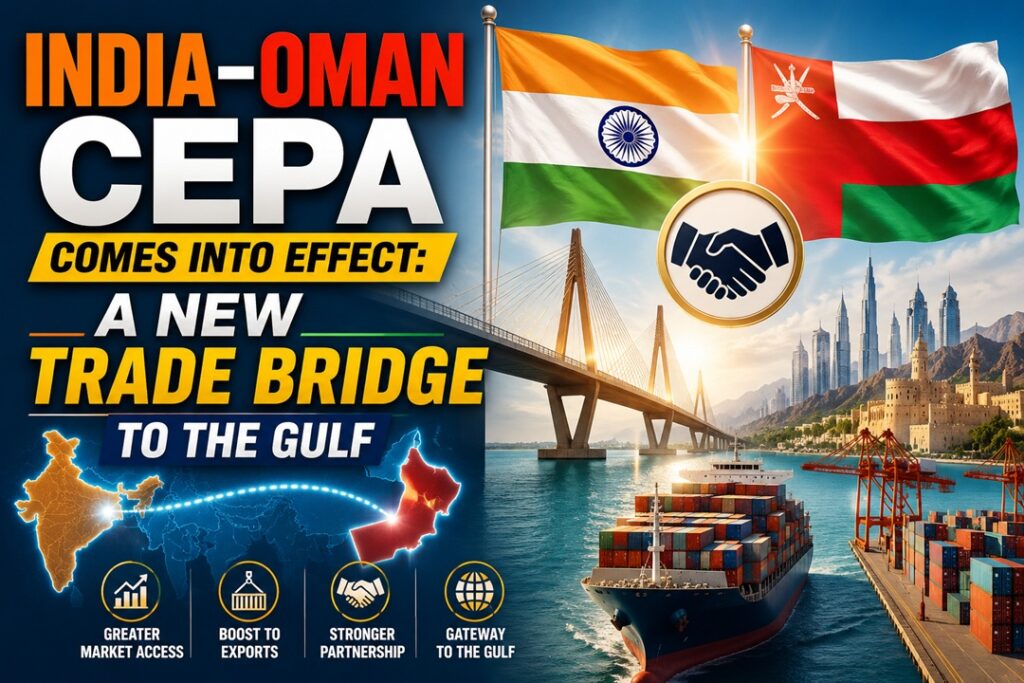
The landmark India–Oman Comprehensive Economic Partnership Agreement (CEPA) has officially entered into force. Signed in December 2025, the agreement creates a major economic corridor between India and Oman by substantially reducing trade barriers, expanding market access for goods and services, and providing a strategic trade route through Omani ports that bypasses the geopolitically sensitive Strait of Hormuz. The pact is expected to strengthen economic integration, improve supply-chain resilience, and deepen India’s engagement with the Gulf region.
India–Oman Economic Cooperation Pact
About the India–Oman Comprehensive Economic Partnership Agreement (CEPA)
What is the Agreement?
The India–Oman CEPA is a next-generation bilateral economic accord aimed at deepening trade, investment, services, and regulatory cooperation between the two countries.
Unlike conventional free trade agreements that primarily focus on tariff reductions, the CEPA establishes a broad framework covering merchandise trade, services, investment facilitation, professional mobility, and standards recognition.
With the agreement’s implementation, India joins a select group of countries that enjoy comprehensive economic engagement with the Sultanate of Oman, strengthening long-term strategic and commercial ties.
Major Features of the Agreement
Extensive Tariff Elimination for Indian Goods
Oman has provided duty-free access to nearly all Indian exports, covering over 99% of export value and a vast majority of tariff categories.
This significantly expands market access compared to the earlier Most Favoured Nation (MFN) regime, under which only a limited share of Indian products enjoyed zero-duty treatment.
Accelerated Approval Mechanism for Pharmaceutical Products
Pharmaceutical products and vaccines approved by leading international regulatory agencies will receive expedited market clearance in Oman.
The streamlined approval process is expected to reduce compliance costs and improve the competitiveness of Indian pharmaceutical companies.
Expanded Opportunities in the Services Sector
The agreement grants enhanced market access across more than 120 service categories, including healthcare, education, engineering, information technology, and professional consultancy.
Indian professionals will benefit from clearer mobility provisions and improved business opportunities in Oman.
Liberalized Business Mobility Framework
The CEPA introduces more flexible provisions for business visitors, independent professionals, and intra-corporate transferees.
Longer stay durations and higher quotas for corporate transfers are expected to facilitate investment and business expansion.
Recognition of Indian Certification Systems
Oman has agreed to recognize various Indian inspection and certification mechanisms, including standards related to export quality, organic products, and halal certification.
This reduces procedural barriers and facilitates smoother export flows.
Safeguards for Sensitive Domestic Industries
India has protected strategically important sectors from market liberalization.
Products such as dairy items, edible oils, cereals, fruits, vegetables, spices, rubber, and certain agricultural commodities remain shielded through exclusion provisions.
Bilateral Trade Performance
Growing Trade Engagement
Trade between India and Oman has continued to expand steadily, reflecting strong economic complementarities and increasing commercial integration.
The agreement is expected to further accelerate bilateral trade volumes over the coming years.
Key Indian Exports
India’s export basket to Oman includes:
- Refined petroleum products
- Machinery and engineering goods
- Iron and steel products
- Agricultural commodities
- Chemicals and industrial materials
- Basmati rice
Major Imports from Oman
India imports a range of strategic commodities from Oman, including:
- Crude oil
- Liquefied natural gas (LNG)
- Fertilizers
- Methanol
- Ammonia
- Other industrial raw materials
Oman’s Role During Regional Uncertainty
As geopolitical tensions affected parts of the Gulf region, Oman emerged as a reliable economic partner for India.
Its stable trade routes and energy supplies helped maintain commercial continuity despite disruptions elsewhere in the region.
Challenges Ahead
Limited Domestic Market Size
Although tariff concessions improve competitiveness, the scale of export growth may be constrained by Oman’s relatively small consumer market and economic size.
Building Presence in Premium Product Segments
Indian exporters in sectors such as gems, jewellery, and luxury goods must strengthen brand recognition and distribution networks to capture larger market shares.
Competition from Established Global Suppliers
Indian products will compete with well-entrenched exporters from countries such as China, Turkey, Italy, and other major manufacturing economies.
Pending Labour and Social Security Arrangements
While professional mobility has improved, negotiations on broader labour welfare and social security frameworks remain a work in progress.
Finalizing such arrangements would further benefit Indian workers and businesses operating in Oman.
Why the CEPA Matters for India
Strategic Access Beyond the Strait of Hormuz
Omani ports such as Port of Salalah and Port of Duqm are located outside the Strait of Hormuz, providing India with an alternative and more resilient trade corridor during regional disruptions.
Strengthening Manufacturing Competitiveness
Duty-free access enhances the price competitiveness of Indian exports, particularly in sectors such as textiles, engineering goods, pharmaceuticals, gems, and jewellery.
Enhanced Mobility for Skilled Professionals
The agreement facilitates movement of Indian professionals, creating new opportunities in healthcare, education, information technology, and engineering services.
Expansion of Agricultural Exports
Reduced trade barriers improve prospects for Indian agricultural and food products in the Omani market.
Gateway to Wider Regional Markets
Oman’s industrial zones and logistics infrastructure can serve as launchpads for Indian businesses seeking access to the wider Gulf Cooperation Council (GCC) region and African markets.
Conclusion
The operationalization of the India–Oman CEPA represents a major milestone in India’s trade and strategic engagement with the Gulf region. By securing extensive duty-free access, facilitating professional mobility, strengthening supply-chain resilience, and leveraging Oman’s location as a gateway beyond the Strait of Hormuz, the agreement is poised to boost exports, attract investment, and support India’s long-term vision of becoming a globally competitive economy under Viksit Bharat @2047.
Source : NDTV