
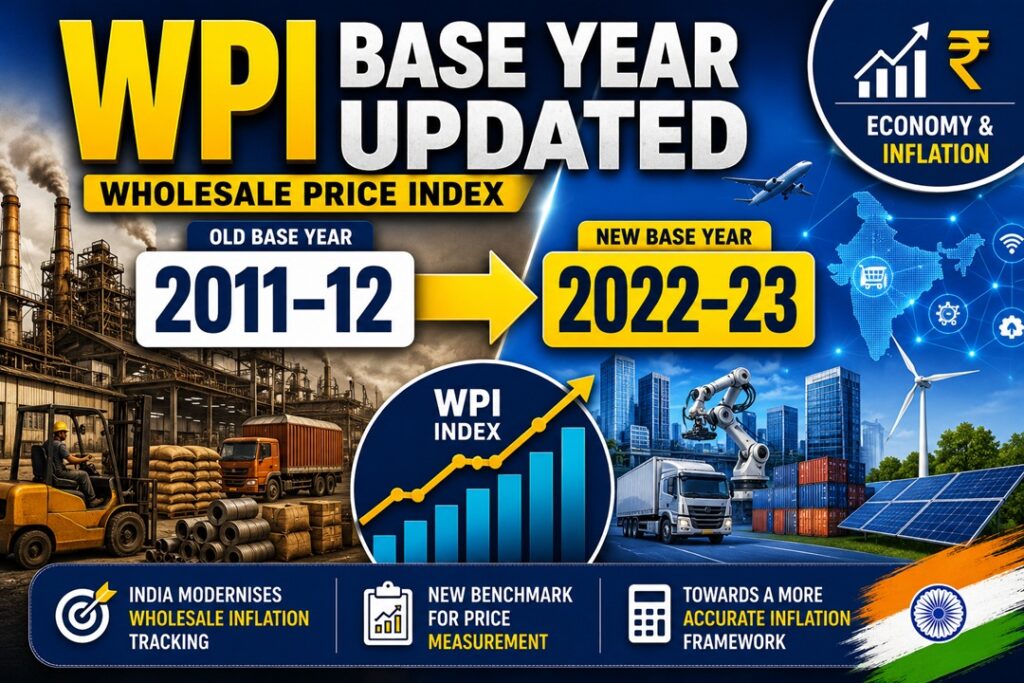
Base Year of Wholesale Price Index Updated from 2011–12 to 2022–23
Context
The Ministry of Commerce and Industry has unveiled a revamped Wholesale Price Index (WPI) series by updating the base year from 2011–12 to 2022–23 and initiating a gradual transition towards a Producer Price Index (PPI)-based inflation framework.
Wholesale Price Index gets a new base year
About the reform
What is it?
It is a major overhaul of India’s producer-level inflation measurement system. The exercise updates the reference year to 2022–23, refreshes the commodity basket to reflect current economic realities, and lays the foundation for a phased shift from the Wholesale Price Index (WPI) to a more internationally accepted Producer Price Index (PPI) framework.
Objective
The reform seeks to improve the accuracy of inflation measurement, capture changes in production patterns, remove distortions arising from an outdated base year, and bring India’s statistical practices closer to global standards recommended by international agencies.
Major changes in the new WPI series
Broader product basket
The number of commodities included in the index has increased from 697 to 957, ensuring better representation of emerging industries and evolving consumption-production trends.
Renewable energy recognition
For the first time, solar power, wind energy, and nuclear electricity have been incorporated into the electricity segment, reflecting the growing importance of clean energy in India’s economy.
Reorganized energy classification
Crude oil and natural gas have been shifted from the ‘Primary Articles’ category to the ‘Fuel and Power’ group, creating a unified classification for major energy resources.
Output-based weight assignment
Commodity weights will now be determined using Gross Value of Output (GVO), replacing the earlier trade-oriented approach. This offers a more accurate reflection of the contribution of goods to domestic production.
Chain-linking methodology
The revised series adopts a short-term chain-linking approach for calculating elementary indices, allowing quicker adaptation to structural changes in the economy.
Improved treatment of missing data
The new framework introduces Targeted Mean Imputation for handling unavailable price quotations, replacing the older carry-forward method and improving statistical reliability.
Parallel producer price indices
The government will simultaneously publish:
- Output Producer Price Index (OPPI),
- Experimental Input Producer Price Index (IPPI) for manufacturing, and
- Service Producer Price Index (SPPI) covering key service sectors such as banking, insurance, telecommunications, rail transport, air passenger services, pension fund management, and securities-related services.
Differentiated price concepts
- WPI, OPPI, and SPPI will be compiled using Basic Prices, excluding indirect taxes and distribution margins.
- Input PPI will be based on Purchaser Prices, reflecting the actual cost incurred by producers while procuring inputs.
Significance
More contemporary inflation tracking
The updated base year aligns the index with present-day production structures and economic conditions.
Global statistical alignment
The move advances India’s transition towards internationally accepted producer-price measurement practices.
Better policy formulation
Improved inflation indicators will provide policymakers with more reliable inputs for industrial, fiscal, and monetary decision-making.
Enhanced sectoral representation
The inclusion of renewable energy and service-sector PPIs enables a more comprehensive assessment of price movements across the economy.
Source : PIB