
Southwest Monsoon Arrives in Kerala: Significance, Challenges and Climate Implications
Context
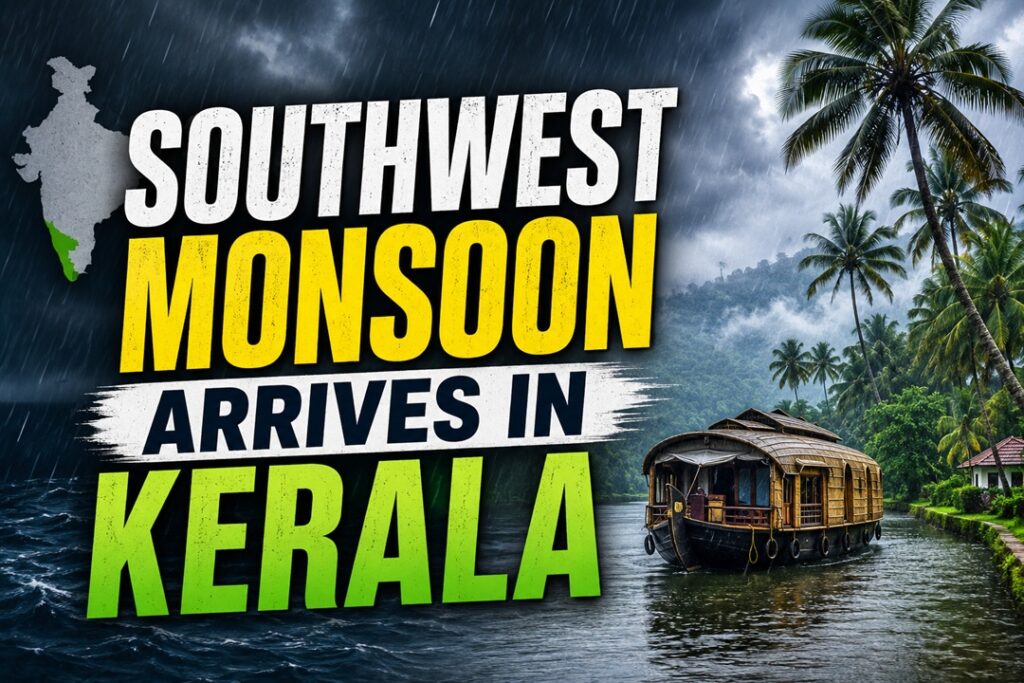
The India Meteorological Department (IMD) has officially declared the onset of the Southwest Monsoon over Kerala on 4 June 2026, marking the beginning of India’s principal rainy season. The arrival of the monsoon is a crucial climatic event that influences agriculture, water resources, food security, energy production, and overall economic activity across the country.
Why Does the Southwest Monsoon Enter India Through Kerala?
Geographical Advantage
- Kerala occupies the southwestern tip of the Indian peninsula and directly faces the Arabian Sea.
- Moisture-laden winds originating from the Indian Ocean and Arabian Sea first encounter the Kerala coast before advancing inland.
Role of the Western Ghats
- The Western Ghats run parallel to Kerala’s western coastline.
- These mountains act as a natural barrier, forcing moisture-rich winds to rise.
- As the air ascends, it cools and condenses, producing heavy rainfall through orographic precipitation.
Seasonal Atmospheric Circulation
- During summer, intense heating of the Indian landmass creates a low-pressure zone over northern and central India.
- The pressure difference between land and ocean draws moisture-bearing winds towards the subcontinent.
- Kerala becomes the natural gateway for the advancing monsoon currents.
What is the Southwest Monsoon?
Definition
- The Southwest Monsoon is a seasonal wind system that brings rainfall to most parts of India between June and September.
- It accounts for nearly 75–80% of the country’s annual rainfall.
Branches of the Monsoon
Arabian Sea Branch
- Reaches Kerala first and moves northward along the western coast.
- Produces heavy rainfall over the Western Ghats and adjoining regions.
Bay of Bengal Branch
- Moves towards northeastern India before spreading across the Indo-Gangetic plains.
- Contributes significantly to rainfall in eastern and northern India.
Why is the Southwest Monsoon Important for India?
Agricultural Significance
- Nearly 50% of India’s net sown area depends directly on monsoon rainfall.
- It supports the cultivation of major Kharif crops such as:
- Rice
- Cotton
- Pulses
- Sugarcane
- Maize
- Oilseeds
- Timely rainfall improves crop productivity and farmer incomes.
Food Security
- Adequate rainfall ensures higher agricultural output and sufficient food grain stocks.
- It strengthens nutritional security and stabilizes food supply chains.
- Good harvests help contain food inflation.
Economic Importance
- Agriculture continues to employ a large segment of India’s workforce.
- Strong monsoon performance stimulates rural demand, consumption, and economic growth.
- Weak monsoons can adversely impact GDP growth, inflation, and employment.
Water Resource Replenishment
- Monsoon rains recharge:
- Rivers
- Reservoirs
- Lakes
- Groundwater aquifers
- Adequate water storage supports irrigation and drinking water needs throughout the year.
Energy Security
- Hydroelectric power generation depends heavily on reservoir levels maintained by monsoon rainfall.
- Deficient rainfall may increase dependence on thermal power generation and fossil fuels.
Ecological Importance
- Monsoon rainfall sustains forests, wetlands, rivers, and biodiversity-rich ecosystems.
- It supports groundwater-dependent habitats and ecological balance.
What Monsoon Alerts Have Been Issued in Kerala?
Orange Alert
- Indicates very heavy rainfall ranging between 11 cm and 20 cm within 24 hours.
- Requires preparedness for:
- Flooding
- Landslides
- Transportation disruptions
- Damage to infrastructure
Yellow Alert
- Indicates heavy rainfall ranging between 6 cm and 11 cm in 24 hours.
- Calls for vigilance and continuous monitoring of local conditions.
Importance of Early Warning Systems
- Alerts improve disaster preparedness and response mechanisms.
- They are particularly important in districts vulnerable to landslides, flash floods, and coastal hazards.
How Do El Niño and La Niña Affect the Indian Monsoon?
El Niño
What is El Niño?
- El Niño is a climate phenomenon characterized by abnormal warming of sea-surface temperatures in the central and eastern Pacific Ocean.
Impact on India
- Weakens monsoon circulation.
- Leads to below-normal rainfall in many regions.
- Increases the likelihood of:
- Droughts
- Heatwaves
- Water shortages
- Negatively affects agricultural production and reservoir storage.
La Niña
What is La Niña?
- La Niña is characterized by cooler-than-normal sea-surface temperatures in the central and eastern Pacific Ocean.
Impact on India
- Strengthens monsoon circulation.
- Often results in above-normal rainfall across South Asia.
- Improves water availability and agricultural prospects.
Concerns for 2026
- International climate forecasts indicate the possibility of a moderate-to-strong El Niño phase.
- If it intensifies during the monsoon season, India could face:
- Rainfall deficits in several regions
- Lower agricultural productivity
- Food inflation pressures
- Increased water and energy stress
What are the Challenges Associated with Monsoon Variability?
Agricultural Uncertainty
- Irregular rainfall patterns can cause droughts or floods.
- Crop losses create income instability for farmers.
- Agricultural planning becomes difficult.
Water Resource Stress
- Unpredictable rainfall affects groundwater recharge and reservoir storage.
- Water shortages may emerge for irrigation and domestic use.
Floods and Infrastructure Damage
- Extreme rainfall events damage:
- Roads
- Railways
- Bridges
- Houses
- Public utilities
- Economic losses can be substantial.
Economic Consequences
- Poor monsoon performance affects agricultural output and rural demand.
- Food prices may rise, increasing inflationary pressures.
- Governments often incur higher relief and rehabilitation expenditures.
Public Health Risks
- Floods increase the spread of:
- Cholera
- Diarrhoeal diseases
- Dengue
- Malaria
- Delayed rainfall may aggravate heat-related illnesses.
Energy Sector Challenges
- Reduced rainfall lowers hydropower generation capacity.
- Excessive rainfall can damage energy infrastructure and transmission systems.
Climate Change Amplification
- Climate change is increasing the frequency of:
- Extreme rainfall events
- Prolonged dry spells
- Unpredictable monsoon behaviour
- These changes complicate planning and adaptation efforts.
Social Inequality
- Vulnerable and low-income communities suffer disproportionately from climate shocks.
- Limited resources reduce their ability to recover from disasters.
Migration and Livelihood Disruptions
- Crop failures and water scarcity can trigger rural-to-urban migration.
- This places additional pressure on urban infrastructure and employment opportunities.
What are the Ethical Dimensions Involved?
Equity and Fairness
- Millions of small and marginal farmers depend on monsoon rainfall for survival.
- Fair access to water resources and disaster relief is an important governance responsibility.
Climate Justice
- Communities contributing least to climate change often experience its worst impacts.
- Climate adaptation measures must prioritize vulnerable populations.
Intergenerational Responsibility
- Sustainable management of water, forests, and agricultural resources is necessary to protect future generations.
- Present development choices should not compromise future ecological security.
Ethical Governance
- Policymakers must promote:
- Climate-resilient agriculture
- Sustainable water management
- Inclusive disaster preparedness
- Equitable distribution of resources
- Development strategies should balance economic growth with environmental sustainability.
Government Initiatives for Monsoon and Climate Resilience
Pradhan Mantri Krishi Sinchayee Yojana (PMKSY)
- Promotes efficient irrigation and water-use efficiency.
National Mission for Sustainable Agriculture (NMSA)
- Encourages climate-resilient agricultural practices.
Atal Bhujal Yojana
- Focuses on sustainable groundwater management.
Dam Rehabilitation and Improvement Project (DRIP)
- Enhances the safety and operational efficiency of dams.
Flood Management and Border Areas Programme (FMBAP)
- Supports flood-control infrastructure and disaster mitigation.
Way Forward
The arrival of the Southwest Monsoon over Kerala is far more than a seasonal weather event; it serves as a key indicator of India’s agricultural health, water security, economic performance, and environmental sustainability. As climate change intensifies monsoon variability and global phenomena such as El Niño create additional uncertainties, India must strengthen climate-resilient agriculture, improve forecasting systems, expand water conservation measures, enhance disaster preparedness, and promote sustainable resource management to secure long-term food, water, and energy security.
Source : The Hindu