
India-Middle East-Europe Economic Corridor (IMEC): Strategic Relevance Amid West Asian Instability
Context
Growing geopolitical uncertainty in West Asia, particularly tensions involving Iran and disruptions in key maritime routes, has revived discussions on the need for resilient and diversified global connectivity networks. In this backdrop, the India-Middle East-Europe Economic Corridor (IMEC) has gained renewed strategic significance as an alternative trade and energy corridor linking Asia, the Middle East, and Europe.
India-Middle East-Europe Corridor (IMEC): An Overview
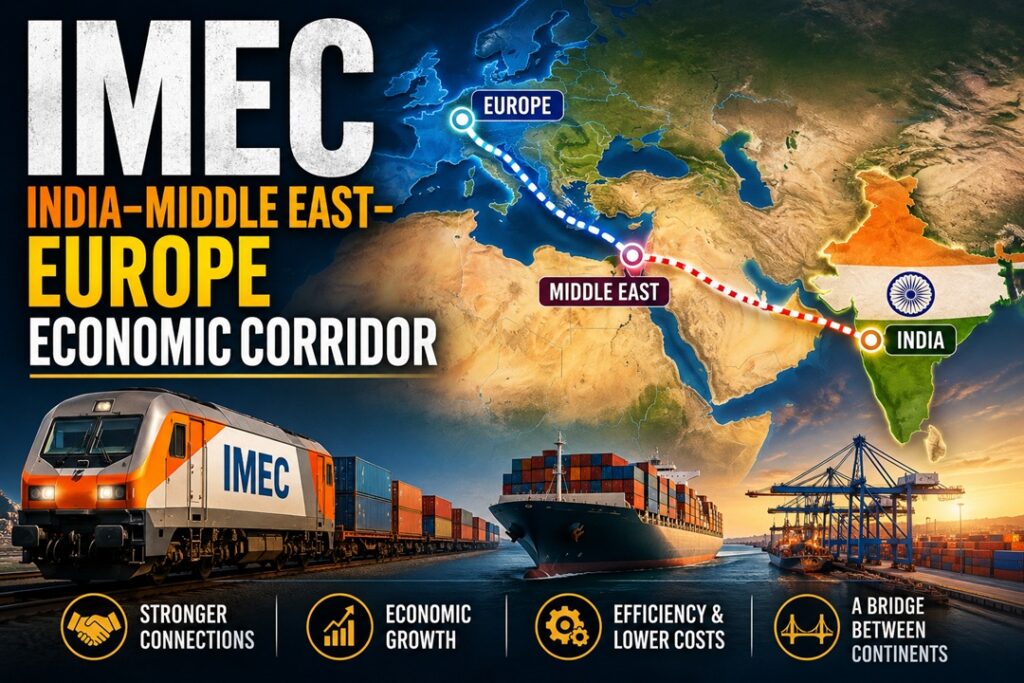
About IMEC – The India-Middle East-Europe Economic Corridor is a strategic connectivity initiative designed to strengthen trade, transport, energy, and digital linkages between India, West Asia, and Europe.
Launch – The corridor was unveiled on the sidelines of the G20 Leaders’ Summit held in New Delhi in 2023.
Participating Members – India, the United States, Saudi Arabia, the United Arab Emirates, France, Germany, Italy, and the European Union.
Core Objective – To establish a seamless multimodal network integrating maritime transport, rail connectivity, energy infrastructure, and digital systems across three regions.
Structure of the Corridor
India–Gulf Link – Maritime connectivity connecting Indian ports with the UAE.
Arabian Land Network – Rail and logistics infrastructure extending through the UAE, Saudi Arabia, Jordan, and Israel.
Mediterranean Gateway – Maritime routes linking Israeli ports with European markets.
Supporting Infrastructure
The project envisages the development of:
- Cross-border railway corridors
- Advanced port facilities
- Power transmission networks
- Green hydrogen transport systems
- Digital communication infrastructure
- Integrated logistics and supply-chain systems
Why IMEC Matters Strategically
Faster Trade Movement – Reduces transit duration between Asia and Europe.
Lower Logistics Expenditure – Enhances cost efficiency for global commerce.
Enhanced Connectivity for India – Strengthens India’s access to European markets.
Energy Diversification – Facilitates alternative channels for energy transportation.
Regional Economic Integration – Encourages greater cooperation among participating economies.
Alternative Trade Architecture – Offers additional options beyond traditional trade routes.
The corridor has the potential to significantly transform international trade flows and supply-chain networks through its integrated transport model.
Why Regional Tensions Reinforce the Importance of IMEC
Reducing Dependence on Maritime Bottlenecks
Recent concerns surrounding the Strait of Hormuz have highlighted the risks associated with excessive reliance on narrow sea passages.
Other vulnerable chokepoints include:
- Suez Canal
- Strait of Malacca
- Bab-el-Mandeb Strait
IMEC can provide supplementary routes that improve trade continuity and reduce exposure to disruptions.
Supporting Long-Term Energy Security
Energy supply disruptions caused by geopolitical conflicts underscore the need for diversified transport infrastructure.
Proposed electricity grids and green hydrogen corridors under IMEC can help create safer and more resilient energy networks.
Strengthening Supply-Chain Resilience
From the COVID-19 pandemic to regional conflicts, recent crises have demonstrated the fragility of global supply chains.
A diversified corridor such as IMEC can help sustain trade flows during periods of instability.
Promoting Connectivity Diversification
Developing multiple trade pathways reduces overdependence on any single route and contributes to greater economic stability.
Major Challenges Facing IMEC
Persistent Regional Conflicts
The conflict in Gaza, followed by broader tensions involving Iran, has slowed momentum for the project.
Security concerns continue to affect several transit regions critical to the corridor.
Risks to Key Logistics Hubs
Important Gulf ports such as Jebel Ali and Fujairah face growing security concerns due to their proximity to conflict-prone areas.
Similarly, Israel’s Haifa Port remains vulnerable to regional instability.
Coordination Challenges Among Partners
The success of IMEC depends on sustained cooperation among participating nations.
Differences in strategic priorities and regional competition among key stakeholders may complicate implementation efforts.
Investment and Risk Concerns
Large infrastructure projects require predictable political conditions.
Ongoing conflicts can increase project risks, insurance costs, and investor uncertainty.
Need for a Flexible Connectivity Framework
Identifying Alternate Transit Gateways
Ports in Oman such as Salalah, Duqm, and Muscat could serve as alternative eastern entry points due to their strategic location outside the Strait of Hormuz.
On the western side, Egypt’s ports and logistics infrastructure could offer additional links to European markets.
Creating Multi-Route Supply Chains
Future connectivity initiatives should avoid dependence on a single transport corridor.
A network-based model with multiple routes can improve resilience against geopolitical disruptions.
Deepening Regional Collaboration
Strong institutional frameworks for coordination, dispute resolution, and infrastructure management will be essential for long-term success.
India’s Contribution to IMEC
Facilitating Regional Dialogue
India maintains strong diplomatic relations with major stakeholders including Saudi Arabia, the UAE, Israel, Oman, and European nations.
This positions India as a key facilitator of cooperation and confidence-building.
Driving Economic Benefits
Improved connectivity through IMEC can support India’s aspirations to become a global manufacturing, logistics, and export hub.
Providing Strategic Direction
India can play a leading role in:
- Developing resilient supply chains
- Expanding digital connectivity
- Promoting clean energy partnerships
- Mobilising international investments
Partnerships with European countries can further strengthen the corridor’s political and financial foundations.
Ethical Considerations
IMEC embodies principles of international cooperation, shared prosperity, sustainable development, and energy security.
The initiative highlights the importance of balancing national interests with collective welfare, regional stability, environmental responsibility, and inclusive economic growth.
Way Forward
The recent tensions involving Iran have exposed the vulnerabilities of existing trade and energy networks while simultaneously reinforcing the need for alternative connectivity frameworks.
IMEC offers a promising vision for strengthening global trade resilience, but its success will depend on adaptability, regional cooperation, diversified transit routes, and sustained political commitment.
For India, the corridor is not merely an infrastructure initiative; it represents a strategic opportunity to shape emerging patterns of global connectivity, trade, and economic integration in the twenty-first century.
Source : The Hindu