
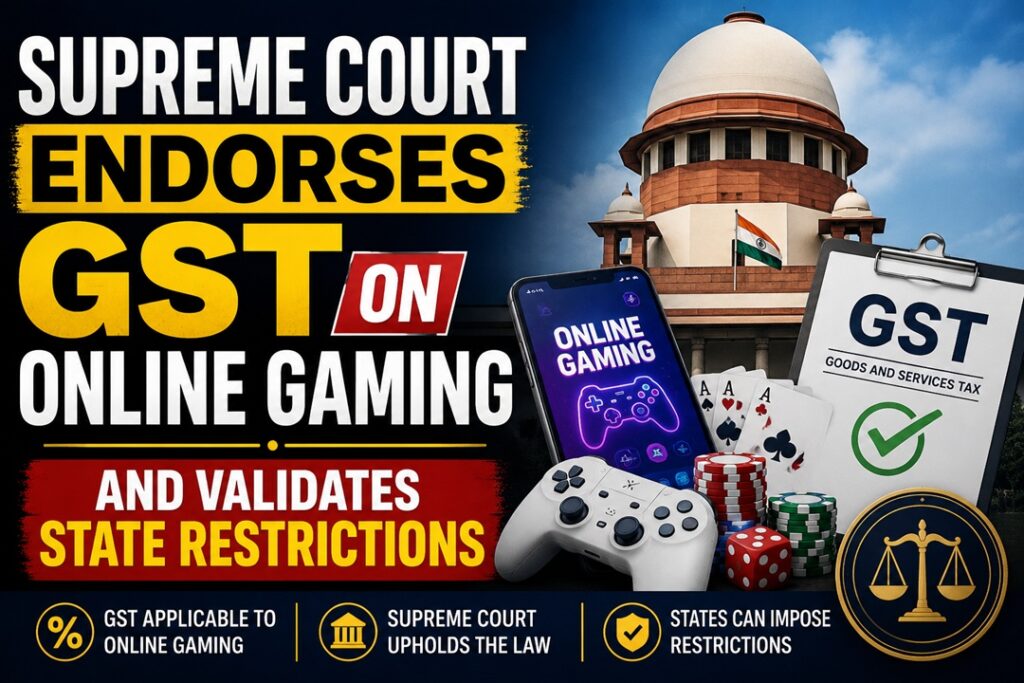
Supreme Court Endorses GST on Online Gaming and Validates State Restrictions
Context
Recently, the Supreme Court upheld the legality of the Centre’s retrospective 28% GST on online gaming involving monetary stakes and also confirmed the constitutional validity of State laws regulating or prohibiting real-money gaming platforms.
Online Gaming Regulation: Key Issues Before the Supreme Court
1. Validity of State Laws Governing Online Betting
State Measures – Several States, including Tamil Nadu and Karnataka, enacted laws in 2021 to curb online betting activities and imposed penal consequences for violations.
High Court Decisions – These enactments were subsequently invalidated by the Madras and Karnataka High Courts.
States’ Challenge – The respective State governments appealed before the Supreme Court, arguing that:
- Betting and gambling fall within the legislative domain of States under Entry 34 of the State List.
- Regulatory intervention was necessary to address concerns such as addiction, financial distress, and public welfare.
2. GST Treatment of Online Gaming with Monetary Stakes
Earlier Court Rulings – The Bombay and Karnataka High Courts held that online gaming transactions could not be classified as actionable claims under GST provisions and quashed tax demands.
Centre’s Position – The Union Government contended that:
- Online gaming involving stakes constitutes a taxable activity.
- GST should be imposed on the entire amount wagered rather than only the platform’s service fee.
Why Did the Court Sustain the 28% GST Levy?
GST Council Framework
2023 Tax Clarification – The GST Council, in August 2023, clarified that online games involving wagering or betting would attract GST at 28%.
Uniform Tax Treatment – The levy applies irrespective of whether the game is based predominantly on skill or chance.
Tax Base – GST is payable on the full value of deposits or stakes placed by participants.
Tax Notices Issued
Enforcement Action – The Directorate General of GST Intelligence (DGGI) issued notices demanding tax liabilities for both:
- The period after the 2023 amendments.
- Earlier periods, treating the amendments as clarificatory in nature.
Industry’s Objections
Limited Consideration Argument – Gaming firms argued that taxation should apply only to the platform’s retained revenue and not to the entire pool of user contributions.
Commercial Concerns – Companies claimed that taxing total stakes would be economically unsustainable and ignored the established distinction between skill-based and chance-based games.
Court’s Findings
Wagering Characteristics – The Court observed that platforms involving monetary stakes, incentives, bonuses, and repeated participation resemble wagering ecosystems.
Skill-Chance Distinction Not Determinative – For GST purposes, once money is risked on an uncertain outcome, the distinction between skill and chance loses significance.
Statutory Basis – The CGST Act already taxes actionable claims related to lottery, betting, and gambling, providing sufficient legal foundation for the levy.
Nature of 2023 Amendments – The Court held that the amendments merely clarified and standardized the existing legal position rather than creating a new tax regime, enabling retrospective application.
Why Were State Restrictions on Real-Money Gaming Upheld?
Betting Outside Ordinary Trade Protection
Res Extra Commercium Doctrine – The Court reiterated that betting and gambling do not enjoy the same constitutional protections as legitimate commercial activities.
Effect of Monetary Stakes
Transformation of Activity – Even where a game contains elements of skill, the presence of financial stakes can impart a wagering character, bringing it within State regulatory authority.
Fantasy Sports Examination
Skill-Based Claim Rejected – The Bench observed that predicting sporting outcomes remains inherently uncertain despite analytical tools and statistical models.
About Fantasy Sports – Participants create virtual teams of real-world athletes and earn points based on actual performance during live sporting events.
Digital Gambling Concerns
Technology-Driven Expansion – The Court noted that smartphones, online payment systems, and digital platforms have significantly expanded access to betting activities.
Constitutional Authority of States
States may regulate or prohibit such activities under:
- Entry 34, State List – Betting and Gambling.
- Entry 1, State List – Public Order.
This provides a constitutional basis for restrictions on real-money online gaming.
Broader Implications of the Judgment
Impact on the Online Gaming Industry
2025 Regulatory Law – The Promotion and Regulation of Online Gaming Act, 2025 prohibited most forms of online real-money gaming while permitting limited categories such as:
- E-sports competitions.
- Educational gaming platforms.
- Social and recreational games without monetary wagering.
Government Rationale – The law cited concerns relating to money laundering, illicit financial flows, and misuse of digital payment systems.
Tax Recovery Challenges
Financial Stress – The GST liabilities imposed on gaming firms far exceed the revenues of many operators.
Industry Restructuring – Several companies have relocated operations abroad or diversified into social gaming and financial technology segments.
Potential Insolvencies – The magnitude of tax demands could trigger widespread insolvency proceedings within the sector.
Federalism and Legislative Competence
State Subject Reaffirmed – By recognizing betting and gambling as matters under Entry 34 of the State List, the judgment reinforces State authority in this domain.
Future Constitutional Questions – The ruling may generate fresh litigation over whether Parliament can regulate online gaming through powers derived from the Union List, particularly when States retain primary legislative competence over betting and gambling.
Conclusion
The judgment significantly strengthens both the Centre’s taxation powers over online gaming involving monetary stakes and the States’ authority to regulate or prohibit betting-related activities. It is likely to reshape India’s digital gaming landscape, influence future regulatory frameworks, and trigger further constitutional debates regarding the division of powers between the Union and the States.
Source : The Hindu