
India–Nepal Territorial Dispute: A Fresh Perspective
Context
Nepal’s newly elected Prime Minister Balendra Shah (Balen) has signaled a fresh diplomatic approach toward the long-pending Kalapani–Lipulekh–Limpiyadhura territorial dispute with India, advocating evidence-based dialogue and constructive engagement instead of confrontational rhetoric.
Understanding the Disputed Region
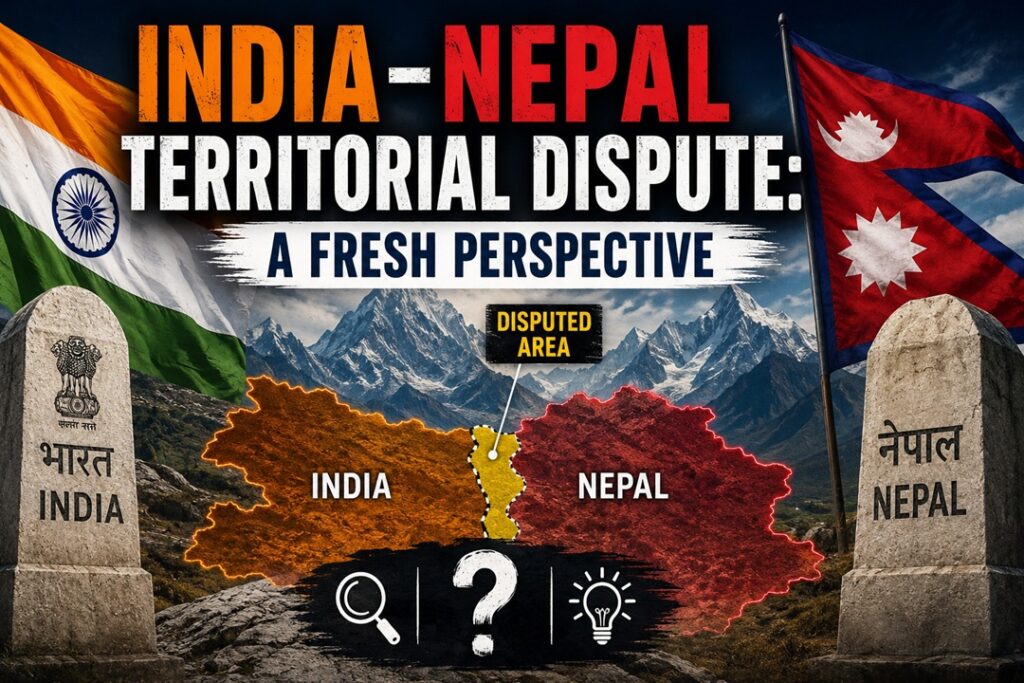
- The disagreement revolves around a strategically important tri-junction zone covering nearly 372 sq. km, encompassing Kalapani, Lipulekh, and Limpiyadhura along the India–Nepal border in the Himalayan region.
- The area is geopolitically significant as it overlooks the Lipulekh Pass, a crucial route for trade, border management, and the annual Kailash Mansarovar pilgrimage.
Origins of the Boundary Controversy
Treaty-Era Legacy
- The roots of the dispute trace back to the Treaty of Sugauli (1816) signed between Nepal and the British East India Company.
- The treaty identified the Kali River as Nepal’s western boundary but did not clearly specify the river’s exact source.
Divergent Interpretations
- Nepal’s Claim: Nepal contends that the Kali River originates from Limpiyadhura, placing Kalapani and Lipulekh within Nepalese territory.
- India’s Claim: India argues that the river begins near Kalapani, consistent with maps used by British India after the mid-19th century and the administrative arrangements maintained since 1947.
Developments That Intensified the Issue
- Nepal objected to the reopening of India–China trade activities through Lipulekh Pass.
- India’s construction of an access road for the Kailash Mansarovar Yatra triggered further diplomatic disagreements.
- India viewed Nepal’s objections as inconsistent with the long-standing administrative reality on the ground.
Changing Dynamics in Nepal’s Foreign Policy
Emergence of New Political Leadership
- The rise of younger leaders and reform-oriented political forces reflects growing public demand for efficient governance, economic opportunities, and accountability.
Shift Toward Institutional Diplomacy
- Nepal’s current leadership favors a rules-based and sovereign-equality framework, moving beyond traditional dependency narratives in bilateral relations.
Fact-Centered Resolution Approach
- Prime Minister Shah has emphasized that border concerns should be addressed through historical evidence, technical assessment, and diplomatic negotiations rather than emotional nationalism.
Interest in Wider Historical Research
- Nepal has suggested examining archival materials from countries such as China and the United Kingdom to better understand historical boundary records.
Major Obstacles to Resolution
Conflicting Cartographic Records
- Historical maps produced during different periods often contain inconsistencies, creating competing interpretations regarding the boundary alignment.
Strategic Security Considerations
- India views the area as critical from a national security standpoint due to its proximity to the China frontier and important mountain passes.
Domestic Political Narratives
- Border issues are periodically used by political actors in Nepal to mobilize public opinion during periods of internal political uncertainty.
Slow Progress in Negotiations
- Extended technical discussions without political direction can prolong disagreements and reduce momentum for settlement.
The Road Ahead
Strengthening the Open-Border Framework
- Both countries should preserve and build upon their unique open-border arrangement, which has historically facilitated people-to-people connectivity.
Expanding Security Cooperation
- Existing trust and cooperation between the Indian and Nepalese armed forces can contribute to confidence-building measures.
Focusing on Shared Economic Interests
- Greater emphasis on energy trade, infrastructure connectivity, digital integration, and cross-border commerce can deepen mutual benefits.
Exploring Innovative Border Solutions
- Joint environmental conservation initiatives and cooperative management mechanisms could help manage disputed areas while maintaining respective claims.
Enhancing Political-Level Engagement
- Regular dialogue between top leadership can accelerate decision-making and prevent bureaucratic delays from undermining bilateral relations.
Conclusion
The emergence of a new generation of leadership in Nepal presents an opportunity to recalibrate India–Nepal relations. A balanced combination of diplomacy, historical clarity, economic cooperation, and mutual respect can help both countries manage boundary differences while preserving their long-standing cultural, strategic, and economic partnership.
Source : The Hindu