
India’s Rise as a Global Space Power: Building a Self-Reliant and Innovation-Driven Space Ecosystem
Context
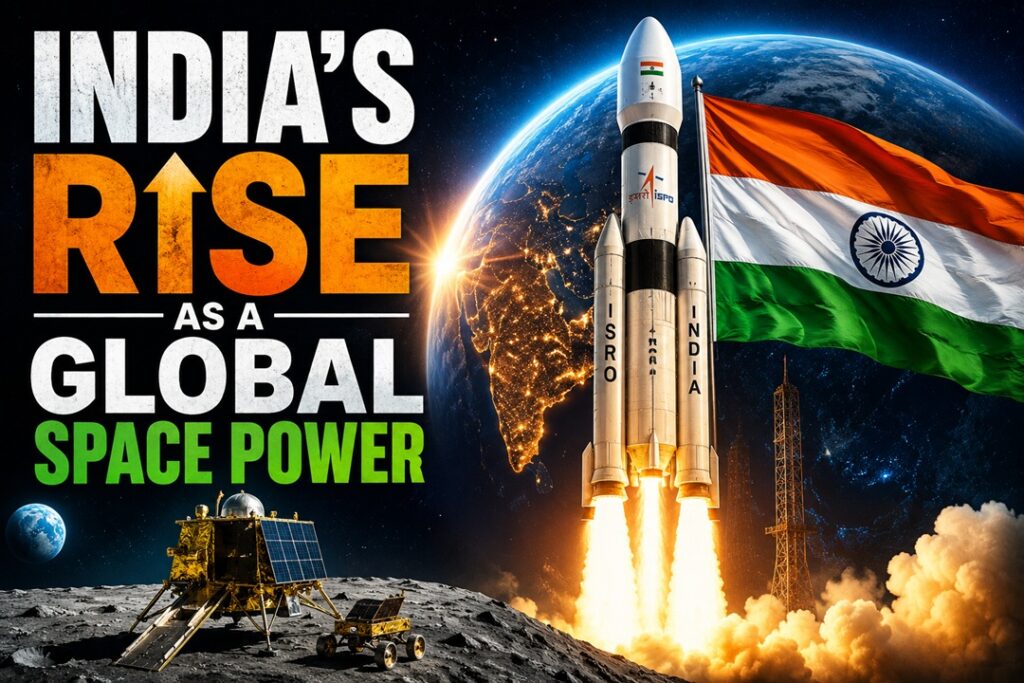
The Press Information Bureau (PIB) has released a detailed report highlighting India’s remarkable rise as a leading space-faring nation over the past decade. Guided by the vision of Aatmanirbhar Bharat and Viksit Bharat 2047, India is strengthening its position through advanced space exploration, private sector participation, and citizen-centric space applications.
India’s Expanding Space Ecosystem
About India’s New Space Ecosystem
What is it?
India’s space sector has evolved from a government-dominated scientific programme into a comprehensive ecosystem that combines research, innovation, commercialization, and strategic development.
This modern framework leverages satellite technology, navigation systems, geospatial intelligence, and communication infrastructure to support governance, agriculture, disaster management, national security, and economic growth.
Key Indicators Reflecting Growth and Transformation
Strong Growth in Space Commercialization
- Revenue generated by NewSpace India Limited (NSIL) increased significantly from ₹321.77 crore in FY 2021-22 to ₹3,246.09 crore in FY 2024-25.
- This growth highlights India’s expanding role in the global space commerce market.
Rapid Expansion of Space Startups
- India’s space startup ecosystem grew from one startup in 2014 to over 400 active startups by February 2026.
- The sector has attracted substantial private investments and technological innovation.
Rising Global Confidence in Indian Launch Services
- India successfully launched 399 foreign satellites between 2014 and March 2026, compared to a much smaller number in earlier years.
- This demonstrates growing international trust in India’s launch capabilities.
Reformed Foreign Investment Framework
India has liberalized its FDI regime for the space sector:
- Up to 100% automatic-route FDI in satellite component manufacturing.
- Up to 74% FDI in satellite operations.
- Up to 49% FDI in launch vehicle and spaceport development.
Advancements in Space-Based Scientific Research
- Aditya-L1, India’s first dedicated solar observatory, has generated more than 27 TB of scientific data, contributing to global solar research.
Institutional Framework Supporting India’s Space Growth
IN-SPACe: Single-Window Regulatory Platform
What is IN-SPACe?
The Indian National Space Promotion and Authorization Centre (IN-SPACe) acts as an autonomous regulator facilitating private participation in the space sector.
Key Functions
- Authorizes and supervises private space activities.
- Promotes industry participation.
- Facilitates technology transfer from ISRO to private entities.
- Encourages public-private partnerships.
Indian Space Policy 2023
Significance
The policy provides a comprehensive framework for:
- Satellite manufacturing.
- Launch services.
- Space-based applications.
- Commercial exploitation of space technologies.
Impact
- Opened the sector to private players.
- Enhanced ease of doing business in the space domain.
- Encouraged domestic and foreign investments.
Role of NewSpace India Limited (NSIL)
Functions
- Commercialization of ISRO-developed technologies.
- Marketing of launch services.
- Satellite capacity leasing.
- Industrial production of launch vehicles through partnerships.
NavIC: India’s Indigenous Navigation Network
What is NavIC?
Navigation with Indian Constellation (NavIC) is India’s regional satellite navigation system.
Importance
- Provides accurate positioning services across India and surrounding regions.
- Enhances strategic autonomy.
- Reduces dependence on foreign navigation systems.
Norms, Guidelines and Procedures (NGP) 2024
Objective
To establish transparent operational standards for private space entities.
Benefits
- Improved regulatory certainty.
- Enhanced investor confidence.
- Greater ease of participation for startups and industries.
Major Upcoming Space Missions and Programmes
Gaganyaan Human Spaceflight Mission
Objective
To send Indian astronauts into Low Earth Orbit using indigenous technologies.
Key Features
- Human-rated launch vehicle.
- Indigenous life-support systems.
- Development of advanced crew safety technologies.
Bharatiya Antariksh Station (BAS)
Vision
India plans to establish its own modular space station in Low Earth Orbit.
Expected Benefits
- Long-duration scientific experiments.
- Human spaceflight capability enhancement.
- Strengthening India’s presence in space research.
Chandrayaan-4 Mission
Objective
- Land on the Moon.
- Collect lunar samples.
- Return the samples safely to Earth.
Significance
Would place India among a select group of nations capable of lunar sample-return missions.
Venus Orbiter Mission
Purpose
To study:
- Venusian atmosphere.
- Surface characteristics.
- Climate evolution.
Importance
Will deepen understanding of planetary evolution and climate systems.
LUPEX (Lunar Polar Exploration Mission)
Collaboration
Joint mission between India and Japan.
Objective
- Search for water ice deposits near the lunar south pole.
- Explore possibilities for future lunar habitation.
Next Generation Launch Vehicle (NGLV)
Features
- Heavy-lift launch capability.
- Enhanced payload capacity.
- Potential reusable variants.
Benefits
- Lower launch costs.
- Increased competitiveness in the global launch market.
TRISHNA Thermal Infrared Mission
Partnership
Joint mission between India and France.
Applications
- Monitoring crop health.
- Water resource management.
- Urban heat island assessment.
- Climate change studies.
Major Challenges Facing India’s Space Sector
Limited Global Market Share
- India currently accounts for only a small proportion of the global space economy.
- Greater commercialization is needed to increase competitiveness.
Scaling Domestic Manufacturing Capacity
Challenge
Transforming research-grade technologies into mass-produced aerospace products.
Need
- Stronger industrial supply chains.
- Advanced manufacturing infrastructure.
- Skilled workforce development.
Human Spaceflight Safety
Critical Requirements
- Reliable life-support systems.
- Safe crew recovery mechanisms.
- Precision docking technologies.
Planetary Mission Complexities
Challenges
- Extreme temperatures.
- High atmospheric pressure.
- Harsh chemical environments on planets such as Venus.
Long-Term Financial Sustainability
Issue
Simultaneously funding:
- Human space missions.
- Deep-space exploration.
- New launch facilities.
- Space station development.
Way Forward
Expand India’s Presence in the Global Space Economy
- Increase private sector participation.
- Promote exports of space technologies.
- Enhance launch service capacity.
Develop Advanced Space Infrastructure
- Accelerate construction of new launch facilities.
- Strengthen satellite manufacturing hubs.
- Expand testing and research infrastructure.
Promote Wider Adoption of NavIC
- Integrate NavIC into smartphones, automobiles, logistics systems, and strategic sectors.
- Encourage domestic chipset development.
Invest in Reusable Space Technologies
- Advance reusable launch vehicle programmes.
- Develop cost-efficient propulsion systems.
- Reduce launch expenses through technological innovation.
Strengthen International Cooperation
- Expand satellite-based services for friendly nations.
- Promote regional disaster management and communication networks.
- Increase scientific collaborations with global space agencies.
Conclusion
India’s space transformation reflects a successful combination of scientific achievement, institutional reforms, private-sector participation, and strategic vision. By strengthening commercial capabilities while pursuing ambitious missions such as Gaganyaan, Bharatiya Antariksh Station, Chandrayaan-4, and the Venus Orbiter Mission, India is steadily positioning itself as a major space power and a key contributor to the future of global space governance under the vision of Viksit Bharat 2047.
Source : PIB