
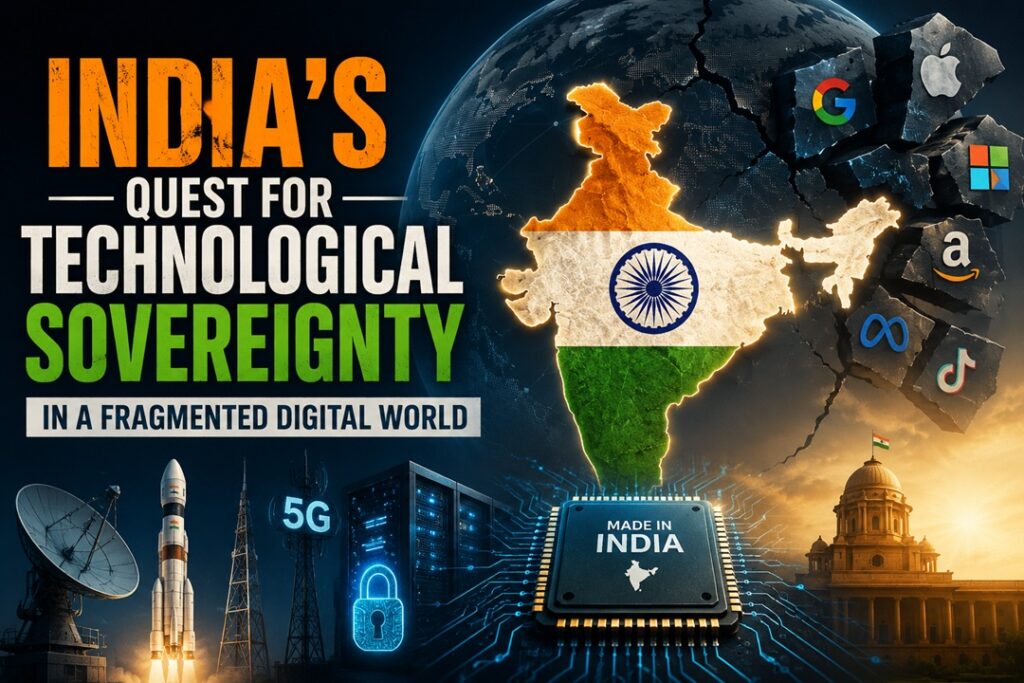
India’s Quest for Technological Sovereignty in a Fragmented Digital World
Context
Recent cyber breaches and technology-related disruptions have exposed the vulnerabilities arising from India’s dependence on foreign-owned digital platforms. These developments have intensified discussions on technological sovereignty, strategic autonomy, and the need for indigenous digital infrastructure to safeguard national security, economic stability, and governance.
How Have Recent Events Exposed India’s Digital Dependence?
Cyber Incidents Reveal Systemic Risks
- In April 2026, several Indian CCTV networks were reportedly compromised through the Chinese software platform EseeCloud, leading to concerns over exposure of sensitive defence-related information.
- In July 2025, Nayara Energy lost access to critical digital services, including corporate email, collaboration tools, and cloud-based data after Microsoft enforced European Union sanctions linked to the company’s ownership structure.
Hidden Dependence on Foreign Platforms
- These incidents underline a structural challenge: many of India’s essential digital services rely on software, cloud infrastructure, and authentication systems controlled by overseas technology corporations.
- Even when data resides within Indian territory, foreign legal frameworks may compel technology providers to disclose information to their home governments.
Erosion of Strategic Control
- Dependence on externally governed digital infrastructure can shift operational control away from Indian institutions.
- During geopolitical tensions or crises, such vulnerabilities could disrupt governance, trade, and national security operations.
Why Is India More Exposed Than Many Other Countries?
Critical Services Built on External Technology
- Government agencies, businesses, and essential services depend heavily on foreign software and cloud ecosystems.
- External policy decisions or sanctions could potentially affect:
- Public administration
- Commercial transactions
- Industrial production
- Defence readiness
The Emerging Threat of Software-Centric Warfare
- Modern military capability increasingly depends on software-driven systems rather than physical hardware alone.
- Fighter aircraft, missile networks, surveillance systems, and radar platforms rely on code that is often controlled by foreign manufacturers.
- In extreme scenarios, software updates or remote configurations could:
- Reduce system effectiveness
- Limit operational capabilities
- Compromise intelligence integrity
Historical Reminder: Kargil Experience
- During the 1999 Kargil War, India faced restrictions in accessing high-precision GPS support.
- The episode demonstrated how reliance on external technology can become a strategic liability during conflicts.
How Are Other Countries Responding?
Global Shift Towards Technological Independence
Many countries are actively reducing reliance on foreign technology providers.
France
- Plans to transition government agencies away from platforms like Microsoft Teams and Zoom and adopt sovereign communication systems by 2027.
Netherlands, Denmark and Germany
- Exploring domestic alternatives to critical software applications and cloud services.
European Union
- Investing in independent cloud infrastructure and digital ecosystems to reduce dependence on American technology providers.
Türkiye
- Pursuing policies aimed at strengthening indigenous technological capabilities and reducing foreign dependence.
What Obstacles Stand in India’s Path?
Strategic Pressures on Emerging Powers
- According to Power Transition Theory, established global powers often seek to contain or constrain rapidly rising competitors.
- As India’s economic and geopolitical influence expands, technological dependence may become a strategic vulnerability.
Dependence on Imported Digital Infrastructure
- Reliance on foreign cloud services, operating systems, and enterprise software creates exposure to sanctions and external policy shifts.
Defence Technology Gaps
- Many advanced military platforms continue to depend on foreign technologies, limiting complete operational autonomy.
Insufficient Research and Innovation Spending
- India’s R&D expenditure averaged only 0.74% of GDP between 2000 and 2020, significantly below the global average of 2.07%.
- Lower investment restricts the country’s capacity for technological breakthroughs.
Risk of Technological Marginalisation
- In an increasingly fragmented global order, insufficient domestic capability could weaken India’s long-term strategic position.
What Measures Can Strengthen India’s Technological Sovereignty?
Expanding Indigenous Digital Infrastructure
- Lessons from the Kargil conflict contributed to the development of India’s own satellite navigation system.
- Current efforts include:
- Building a domestic semiconductor ecosystem
- Expanding homegrown cloud and software solutions
- Migrating government services to indigenous platforms such as Zoho
Learning from the UPI and RuPay Model
- India’s success with UPI and RuPay demonstrates the value of creating nationally controlled digital infrastructure.
- Similar approaches can be adopted for:
- Cloud computing
- Digital identity systems
- E-commerce platforms
- Defence technologies
Accelerating Defence Innovation
- Greater participation from the private sector can enhance innovation and reduce dependence on imported technologies.
- The Advanced Medium Combat Aircraft (AMCA) programme reflects this evolving approach.
Building Strategic Technology Partnerships
- Collaborations with trusted partners can reduce the risks associated with unilateral technology restrictions.
- Examples include:
- The BrahMos missile programme with Russia
- Micron’s semiconductor facility in Gujarat
- India’s participation in Pax Silica, a U.S.-led initiative focused on AI and supply-chain security
Increasing R&D Investments
- Achieving technological leadership requires significantly higher spending on research, innovation, and advanced manufacturing.
- Enhanced investment is essential for developing globally competitive indigenous technologies.
Conclusion
For a country with India’s demographic scale, economic ambitions, and rising geopolitical profile, technological sovereignty has become a strategic necessity rather than a policy choice. The extent to which India develops resilient indigenous capabilities while maintaining productive international partnerships will determine its economic competitiveness, national security, and strategic autonomy in the evolving global order.
Source : The Hindu