
India’s AI Adoption Gap: Bridging the Divide Between Users and Builders
Context
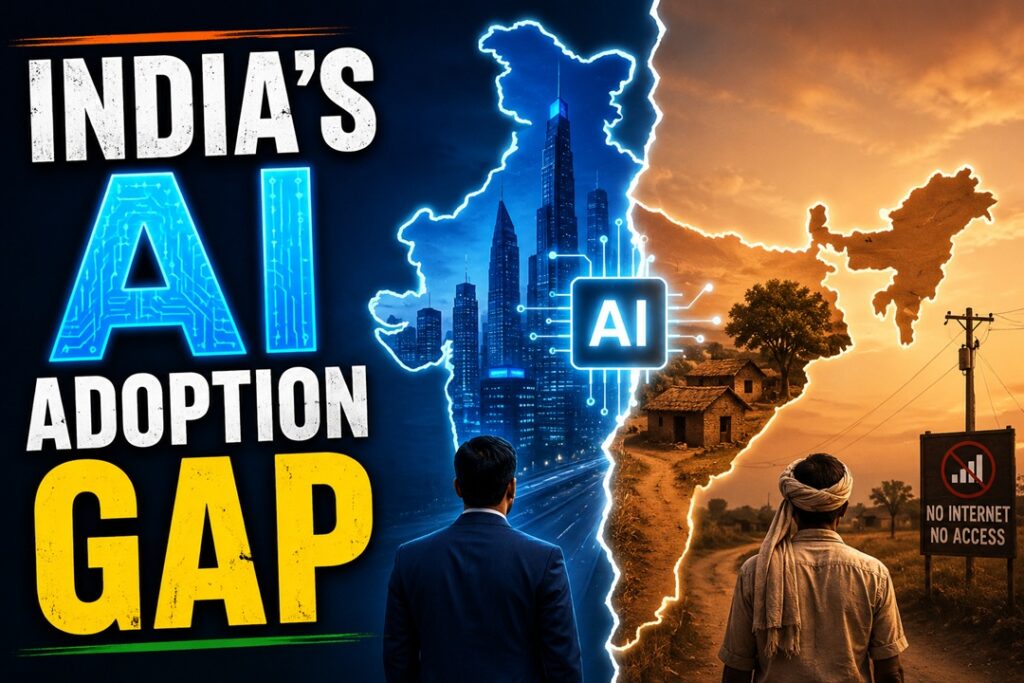
The recently released Global AI Diffusion Q1 2026 Report highlights significant disparities in artificial intelligence adoption across countries, revealing India’s challenges in translating AI awareness into advanced technological capabilities and deployment expertise.
What are the major highlights of the report?
Global AI Penetration
- AI usage has expanded rapidly, reaching 17.8% of the global working-age population.
- However, adoption remains uneven, with advanced economies integrating AI much faster than developing nations.
Unequal AI Expansion
- The Global North is adopting AI at nearly twice the rate of the Global South, deepening existing technological inequalities.
- Differences in digital infrastructure, electricity access, internet penetration, and workforce skills continue to drive this gap.
What are the key global trends in AI adoption?
Leading Nations
- The United Arab Emirates ranks first globally with an adoption rate exceeding 70%.
- Singapore and Ireland follow among the world’s most AI-enabled economies.
Fastest Growth Markets
- Asian countries recorded the strongest quarterly gains.
- South Korea and Japan emerged as major growth drivers in AI implementation.
Persistent Development Divide
- AI adoption in developed economies stands at approximately 27.5%, compared to 15.4% in developing regions.
- The disparity reflects unequal access to frontier technologies and digital resources.
United States Performance
- Despite being a pioneer in AI innovation and infrastructure, the United States ranks only 21st globally.
- Around 31.3% of its working-age population actively uses generative AI.
India’s Standing
- India occupies the 64th position globally.
- With an adoption rate of 17.6%, the country remains well behind leading AI economies despite increasing awareness initiatives.
What does India’s AI landscape reveal?
Skill Development Mismatch
- India is producing a large number of AI users but relatively few professionals capable of developing and deploying AI systems.
- Studies indicate widespread use of generative AI tools among employees, alongside a severe shortage of advanced GenAI expertise.
Premium Demand for AI Talent
- The scarcity of specialised AI professionals has led to substantial salary growth.
- Compensation packages for AI graduates and specialists have risen sharply due to industry demand.
Growing Need for Deployment Specialists
- Demand is surging for professionals who can integrate AI systems into real-world business operations.
- Such roles require expertise in deployment, testing, monitoring, and optimisation of AI models.
Limited Domestic Capacity
- India currently supplies far fewer deployment-focused AI professionals than required by global markets.
- This creates a bottleneck in scaling AI applications across industries.
Strategic Choices Before India
India faces two parallel pathways:
- Developing indigenous AI models and platforms.
- Adapting and deploying open-source AI models while reducing long-term technological dependence on external ecosystems.
How are universities shaping AI leadership globally?
Importance of Higher Education
- Universities play a decisive role in accelerating AI adoption by producing industry-ready graduates.
- They influence both innovation capacity and technology diffusion.
China’s Higher-Education Transformation
- China restructured thousands of academic programmes between 2021 and 2025.
- New courses were introduced in AI, robotics, semiconductors, and advanced manufacturing to align education with future industries.
UAE’s University-Led Strategy
- Universities in the UAE have closely aligned academic programmes with national AI priorities.
- Dedicated institutions and targeted AI education initiatives have strengthened the country’s leadership position.
Key Lesson
- Universities are not merely research centres; they are critical institutions determining the pace and quality of AI adoption across economies.
What reforms are required in Indian universities?
Modernising Academic Curricula
- Traditional programmes should be replaced with industry-oriented courses focusing on:
- Data engineering
- AI model customisation
- Model evaluation
- MLOps and deployment systems
Integrating Work-Based Learning
- Academic programmes should incorporate internships, apprenticeships, and industry-linked projects.
- Students must gain hands-on experience with real-world AI systems.
Building AI-Enabled Campuses
- Universities should deploy AI in administration, libraries, healthcare facilities, and learning systems.
- This would create practical learning environments for students.
Strengthening Faculty and Infrastructure
- Faculty upskilling, industry collaboration, and shared computing resources are essential to bridge capability gaps.
What challenges does India face?
Shortage of Deployment Engineers
- India is rapidly creating AI users but not enough professionals capable of building and deploying AI solutions.
- This imbalance could weaken long-term competitiveness.
Policy Coordination Deficit
- AI diffusion requires active public policy intervention rather than relying solely on market forces.
- Strategic planning is needed to expand adoption and technological self-reliance.
Access Constraints
- Growing restrictions on advanced semiconductor exports and frontier AI technologies may limit access to critical infrastructure.
Technological Sovereignty Concerns
- Dependence on foreign AI platforms and models creates strategic vulnerabilities.
- True digital sovereignty requires domestic engineering and deployment capabilities.
What should be India’s roadmap ahead?
Launch a National AI Talent Initiative
- A comprehensive national mission is required to develop advanced AI capabilities and prevent future skill shortages.
Adopt a Three-Pronged Strategy
Industry-Led Skill Development
- Encourage partnerships between technology companies and educational institutions to provide large-scale AI training.
Competency-Based Certification
- Shift from tool-oriented certifications toward assessments that measure real-world deployment capabilities.
Higher-Education Transformation
- Universities should be evaluated on their ability to produce deployment-ready graduates and continuously update curricula.
Develop Separate Talent Pipelines
- Distinct pathways should be created for:
- AI researchers
- AI engineers and deployment specialists
Enhance Institutional Coordination
- India has successfully expanded AI awareness.
- The next phase requires stronger coordination between government, academia, and industry to convert participation into deep technological capability and long-term resilience.
Conclusion
India’s AI challenge is no longer merely about increasing adoption rates. The larger objective is to cultivate a robust ecosystem of innovators, engineers, institutions, and infrastructure capable of developing and deploying AI technologies independently. Strengthening this foundation will be crucial for ensuring technological sovereignty, economic competitiveness, and sustainable growth in the AI-driven era.
Source : The Hindu