
India’s Public Health Policy: From Community Healthcare to Individual Wellness
Context
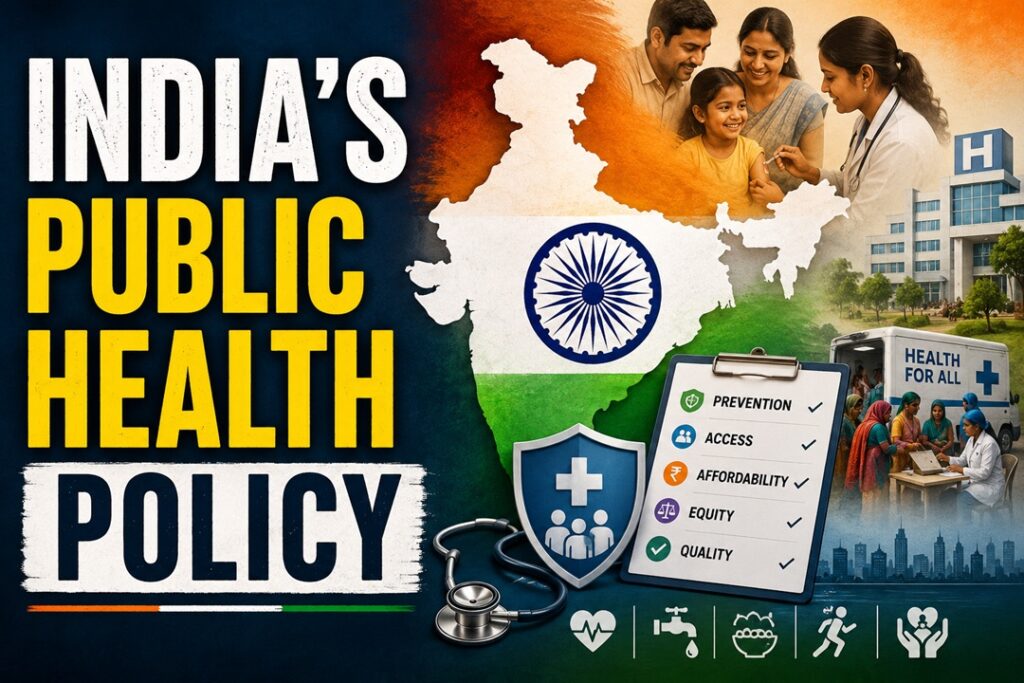
Several public health experts have raised concerns that India’s evolving healthcare policies are increasingly emphasizing individual wellness and digital health ecosystems instead of strengthening population-centric public healthcare services based on evidence and community needs.
Transformation of India’s Healthcare Governance
Overview
What is the Emerging Shift?
India’s healthcare framework is gradually transitioning from a community-oriented public health model—which traditionally focused on preventive, promotive, curative, and rehabilitative services for the entire population—to a person-centric wellness approach. This transformation places greater emphasis on digital health records, personal well-being, and lifestyle management, while administrative changes have also altered the identity of grassroots healthcare institutions.
Important Facts & Figures
Rapid Expansion of Digital Health Infrastructure
- Under the Ayushman Bharat Digital Health Mission (ABDHM), digital health records have increased from fewer than 1,000 linked records during the pilot phase to over 100 crore digital health documents.
Growing Investment in Health Digitization
- The Union Government spends nearly ₹300 crore annually to maintain digital health platforms, registries, and related infrastructure.
Limited Spending on Social Protection
- India allocates only about 0.02% of GDP towards disability support and broader social welfare measures.
Funding Imbalance
- While digital health initiatives receive significant financial support, many Primary Health Centres (PHCs) and Community Health Centres (CHCs) continue to face shortages of infrastructure, workforce, and essential resources.
Major Government Initiatives
Ayushman Bharat Health and Wellness Centres (2018)
- Upgraded Sub-Centres, PHCs, and CHCs into Health and Wellness Centres (HWCs) to provide expanded primary healthcare services.
Ayushman Bharat Digital Health Mission (2021)
- Established a nationwide digital health ecosystem integrating health records, telemedicine services, and healthcare professionals.
ABHA (Ayushman Bharat Health Account)
- Introduced a unique digital health identity for every citizen to facilitate seamless storage and access to medical records.
Expansion of Ayushman Arogya Mandirs
- More than 1.84 lakh primary healthcare facilities have been operationalized nationwide by February 2026.
Universal Health Coverage (UHC)
- Continues to guide national health policy by ensuring equitable access to quality healthcare without causing financial hardship.
Key Concerns
Blurring Institutional Roles
- Renaming grassroots facilities under a common “Health and Wellness” identity has reduced clarity regarding the distinct responsibilities of Sub-Centres, PHCs, and CHCs.
Difficulty in Measuring Wellness
- Wellness is highly subjective, making it difficult to develop objective indicators for evaluating healthcare outcomes.
Digital Records Without Service Delivery
- Large-scale generation of ABHA IDs improves documentation but cannot substitute for functional hospitals, trained personnel, and accessible healthcare services.
Insufficient Attention to Social Determinants
- Policies focusing mainly on individual lifestyle choices may overlook structural challenges such as sanitation, nutrition, clean drinking water, and chronic disease management.
Gap Between Patient Needs and Policy Priorities
- Critics argue that immediate public demand for affordable diagnosis and treatment often receives less attention than wellness promotion campaigns.
Way Forward
Strengthen Public Healthcare Delivery
- Prioritize investments in curative healthcare infrastructure alongside preventive and promotive services.
Revitalize the Three-Tier Health System
- Increase funding and capacity building for Sub-Centres, PHCs, and CHCs to improve accessibility and service quality.
Develop Evidence-Based Health Indicators
- Replace subjective wellness assessments with measurable indicators based on disease burden, treatment outcomes, and unmet healthcare needs.
Integrate Digital Platforms with Ground-Level Services
- Ensure that digital health records are effectively connected with hospitals and primary healthcare facilities for seamless patient care.
Promote Community-Based Healthcare
- Encourage local participation and integrate traditional knowledge systems to develop responsive and culturally appropriate healthcare interventions.
Conclusion
India’s digital health initiatives have significantly modernized health information management and expanded digital access. However, sustainable improvements in public health require parallel investments in strong healthcare institutions, affordable treatment services, and community-based healthcare systems. Balancing technological innovation with robust public infrastructure will be essential to achieving equitable and universal healthcare for all citizens.
Source : The Hindu