
Ayushman Bharat Digital Mission (ABDM): Building India’s Digital Health Ecosystem
Context
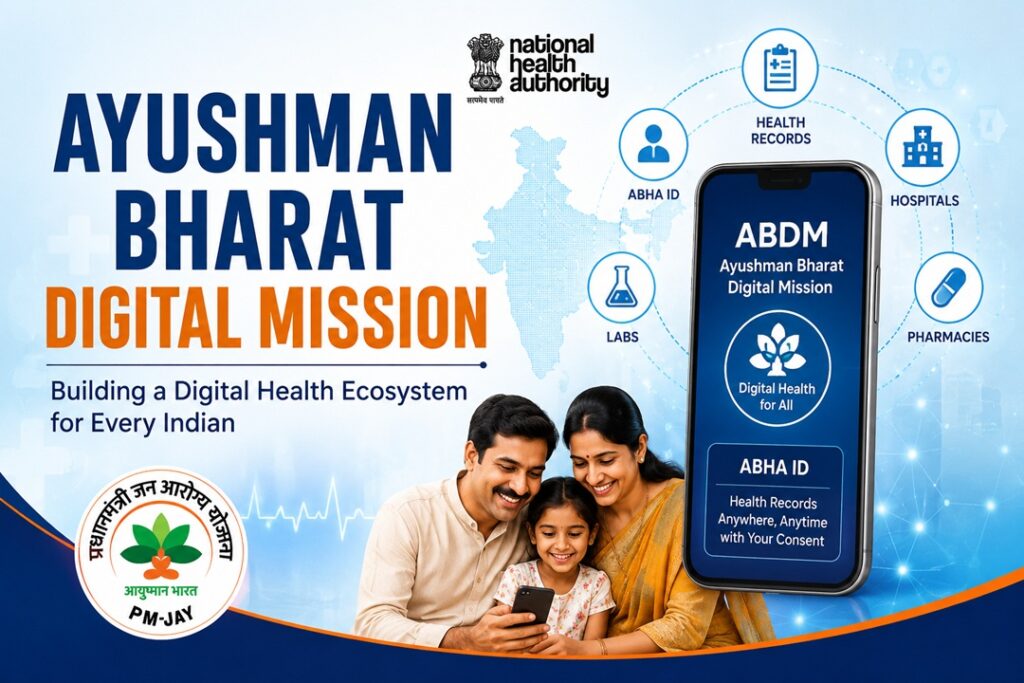
The Ayushman Bharat Digital Mission (ABDM) has crossed a major milestone by successfully linking over 104 crore digital health records, reflecting the rapid expansion of India’s digital health infrastructure. The achievement highlights the growing adoption of secure, consent-based digital healthcare services aimed at improving accessibility, efficiency, and continuity of care across the country.
Ayushman Bharat Digital Mission (ABDM)
Overview
- Launched: September 2021.
- Nodal Agency: National Health Authority (NHA), Ministry of Health & Family Welfare.
- Objective: To build a secure, interoperable, and citizen-centric digital health ecosystem that enables seamless exchange of health information with patient consent.
Major Goals
- Create lifelong digital health identities for every citizen.
- Enable secure, consent-based sharing of medical records.
- Improve quality and continuity of healthcare services.
- Minimise paperwork and administrative inefficiencies.
- Support evidence-based policymaking through anonymised health data.
- Encourage digital innovation in healthcare through open digital infrastructure.
ABDM plays a crucial role in helping India achieve Universal Health Coverage (UHC) under Sustainable Development Goal (SDG) 3.
Core Building Blocks of ABDM
Ayushman Bharat Health Account (ABHA)
- A 14-digit unique digital health ID assigned to every citizen.
- Functions as a lifelong health identity similar to Aadhaar for healthcare.
- Enables secure linkage of medical records from hospitals, laboratories, pharmacies, insurers, and government health programmes through consent-based access.
Healthcare Professionals Registry (HPR)
- National digital database of verified healthcare professionals.
- Includes doctors, dentists, nurses, AYUSH practitioners, and allied health workers.
Health Facility Registry (HFR)
- Comprehensive digital directory of registered healthcare facilities.
- Covers public and private hospitals, clinics, laboratories, diagnostic centres, pharmacies, and imaging centres.
Unified Health Interface (UHI)
- Open digital network inspired by the success of UPI.
- Allows patients and healthcare providers to connect irrespective of the applications they use.
Aarogya Setu 2.0
- Expanded from a COVID-19 contact-tracing application into a comprehensive citizen digital health platform integrated with ABDM services.
Digital Innovations Transforming Healthcare
Digital Health Records
- Healthcare providers can create and access digital medical records linked with ABHA after obtaining patient consent.
- Improves continuity of care and clinical decision-making.
Scan & Share Facility
- Introduced by the National Health Authority.
- Patients scan QR codes to generate digital OPD queue tokens, reducing registration time and paperwork.
eSushrut@Clinic
- Lightweight Hospital Management Information System (HMIS) designed for smaller healthcare facilities.
- Developed by C-DAC (Centre for Development of Advanced Computing) under the Ministry of Electronics & Information Technology (MeitY).
Digital Health Incentive Scheme (DHIS)
- Encourages healthcare institutions and professionals to adopt ABDM digital standards through financial incentives.
National Health Claims Exchange (NHCX)
- Digital platform connecting hospitals, insurers, beneficiaries, and regulators.
- Simplifies insurance claim processing and reduces delays.
Artificial Intelligence and ABDM
ABDM enables the creation of anonymised health datasets that support AI-driven healthcare innovation while protecting patient privacy.
SAHI
Strategy for Artificial Intelligence in Healthcare for India
- Provides ethical and governance principles for responsible AI deployment.
- Promotes transparency, accountability, and fairness.
BODH
Benchmarking Open Data Platform for Health AI
- Supports secure federated learning without exposing raw patient data.
- Encourages innovation while maintaining data privacy.
These initiatives strengthen India’s position in responsible AI-enabled healthcare.
Data Privacy Framework
ABDM follows a Privacy-by-Design approach.
Key Safeguards
- Health records remain with the original healthcare provider.
- No central repository stores all patient information.
- Data sharing occurs only after explicit patient consent.
- Strong interoperability and consent management mechanisms protect sensitive health information.
Key Challenges
Digital Infrastructure Gaps
- Limited broadband connectivity and inadequate digital devices in rural and remote areas hinder implementation.
Low Digital Literacy
- Many citizens require assistance from ASHA workers and other frontline health workers to access digital health services.
Data Privacy Concerns
- Long-term storage of sensitive health records raises cybersecurity and consent-management challenges.
State-Level Integration Issues
- Existing state digital health systems require better interoperability with the national ABDM platform.
Limited Public Awareness
- Insufficient awareness regarding ABHA and ABDM benefits affects voluntary adoption.
Measures to Strengthen ABDM
Expand Private Sector Participation
- Increase onboarding of private clinics, laboratories, and pharmacies.
- Promote wider utilisation of the Digital Health Incentive Scheme.
Improve Digital Health Literacy
- Train ASHA and Anganwadi workers as digital health facilitators.
- Simplify consent mechanisms using multilingual and audio-visual communication.
Strengthen Digital Infrastructure
- Ensure ABDM-compliant HMIS adoption across hospitals.
- Standardise QR-code-based OPD registration systems nationwide.
Enhance Privacy and Trust
- Strengthen Health Information Exchange & Consent Manager (HIE-CM).
- Enforce the Digital Personal Data Protection (DPDP) Act.
- Conduct rigorous security audits for third-party Personal Health Record (PHR) applications.
Promote Emerging Technologies
- Integrate AI, interoperable standards, and predictive healthcare tools to improve preventive care and clinical outcomes.
Way Forward
The Ayushman Bharat Digital Mission is laying the foundation for a modern, interoperable, and patient-centric healthcare ecosystem in India. Through platforms such as ABHA, UHI, NHCX, Aarogya Setu 2.0, and Digital Health Records, ABDM is improving healthcare accessibility, efficiency, transparency, and continuity of care. Continued investment in digital infrastructure, privacy protection, public awareness, and AI-driven innovation will help ABDM emerge as a global benchmark for digital health governance while accelerating India’s progress towards Universal Health Coverage (UHC).
Source : PIB