
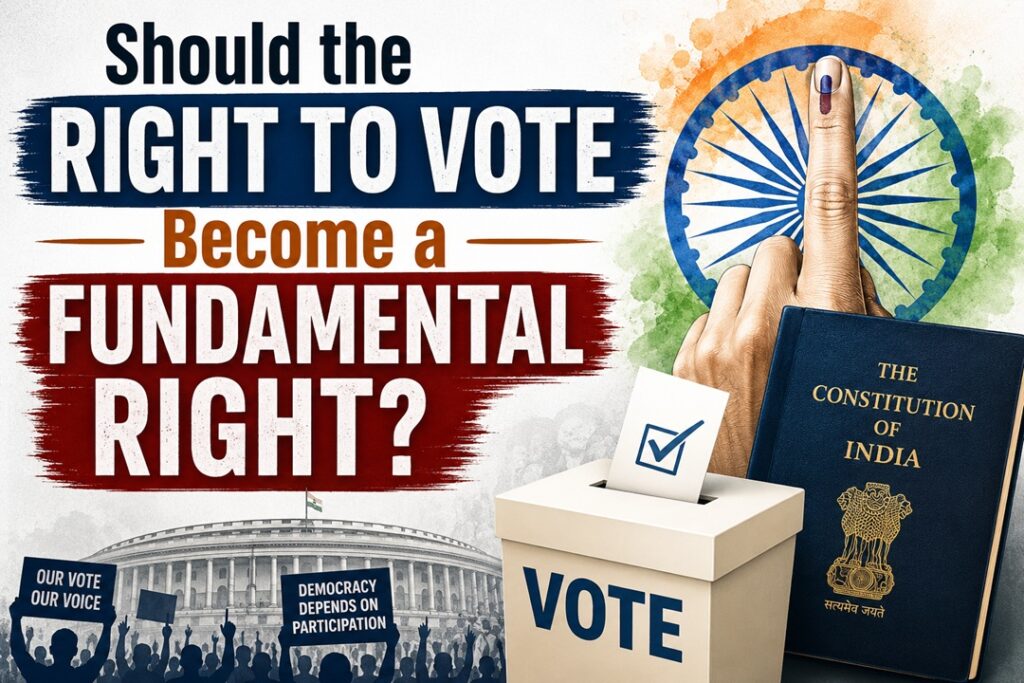
Should the Right to Vote Become a Fundamental Right?
Context
A former Chief Election Commissioner has revived the constitutional debate on whether the right to vote should be elevated from a statutory right to a Fundamental Right, highlighting its central role in India’s democratic framework.
Should the Right to Vote Be Elevated to a Fundamental Right?
Overview
The discussion focuses on the constitutional status of voting in India. Although courts have traditionally regarded voting as a statutory right, the Supreme Court has gradually extended constitutional protection to several connected electoral rights, including the right to know candidates’ backgrounds, ballot secrecy, and the NOTA option, creating a growing demand for stronger constitutional recognition.
Current Constitutional Position of Voting Rights
Earlier Judicial Understanding
- The Supreme Court consistently held that the right to vote is a statutory right, available only through laws enacted by Parliament.
- Electoral rights were viewed as legal entitlements rather than Fundamental Rights.
Legal Foundation
- The Representation of the People Acts provide the legal framework governing elections, voter registration, qualifications, and disqualifications.
- These laws regulate the electoral process but operate within the constitutional framework.
Constitutional Support
- Article 326 establishes universal adult suffrage for elections to the Lok Sabha and State Legislative Assemblies.
- Every citizen aged 18 years and above, subject to lawful restrictions, is entitled to vote.
Changing Constitutional Interpretation
- Recent Supreme Court decisions increasingly describe voting as a constitutional right, recognizing its close relationship with democratic governance and political participation.
Why Should Voting Receive Constitutional Protection?
Constitutional Origin
- Voting derives its legitimacy directly from Article 326, while election laws merely regulate its exercise.
- Statutes facilitate implementation but do not create the constitutional entitlement.
Essential for Democracy
- Democracy forms part of the Basic Structure Doctrine.
- Meaningful democracy requires citizens to participate freely in elections.
Resolving the NOTA Contradiction
- The Supreme Court has protected the NOTA option under Article 19(1)(a) as political expression.
- Granting constitutional protection to rejecting candidates while not clearly protecting the choice of a candidate creates a legal inconsistency.
Expression of Popular Sovereignty
- Elections allow citizens to exercise sovereign power and ensure democratic accountability.
- Voting remains the principal instrument through which people shape governments.
Safeguarding Electoral Inclusion
- Arbitrary deletion from electoral rolls can deprive eligible citizens of meaningful democratic participation.
- Stronger constitutional protection would strengthen safeguards against unjust exclusion.
Major Supreme Court Decisions
- N.P. Ponnuswami v. Returning Officer (1952): Held that voting and contesting elections are statutory rights created by election laws.
- Jyoti Basu v. Debi Ghosal (1982): Reaffirmed that electoral rights are statutory despite their democratic significance.
- Kuldip Nayar v. Union of India (2006): Held that while democracy is part of the Constitution’s Basic Structure, the individual right to vote arises through statute.
- ADR (2002) & PUCL (2003): Recognized voters’ right to know candidates’ criminal, educational, and financial information under Article 19(1)(a).
- NOTA Judgment (2013) & Anoop Baranwal (2023): Strengthened constitutional recognition of electoral participation and democratic freedoms.
Way Forward
Re-examine Earlier Precedents
- The Supreme Court should revisit earlier judgments to remove inconsistencies regarding the constitutional status of voting rights.
Strengthen Constitutional Safeguards
- The right to vote should receive explicit constitutional recognition as a core democratic guarantee.
Retain Legislative Flexibility
- Parliament should continue regulating electoral procedures through reasonable statutory provisions.
Recognize Voting as a Democratic Pillar
- Voting should be treated as an essential component of the Constitution’s Basic Structure.
Adopt a Citizen-Centric Constitutional Approach
- Constitutional interpretation should reinforce citizens’ role as active participants in democratic governance.
Conclusion
The Supreme Court’s evolving jurisprudence increasingly recognizes voting as more than a statutory privilege by protecting essential electoral freedoms under the Constitution. Granting stronger constitutional status to the right to vote would resolve existing legal inconsistencies and reinforce India’s democratic constitutional framework.
Source : The Hindu