
India’s Demographic Dividend Under Pressure
Context:
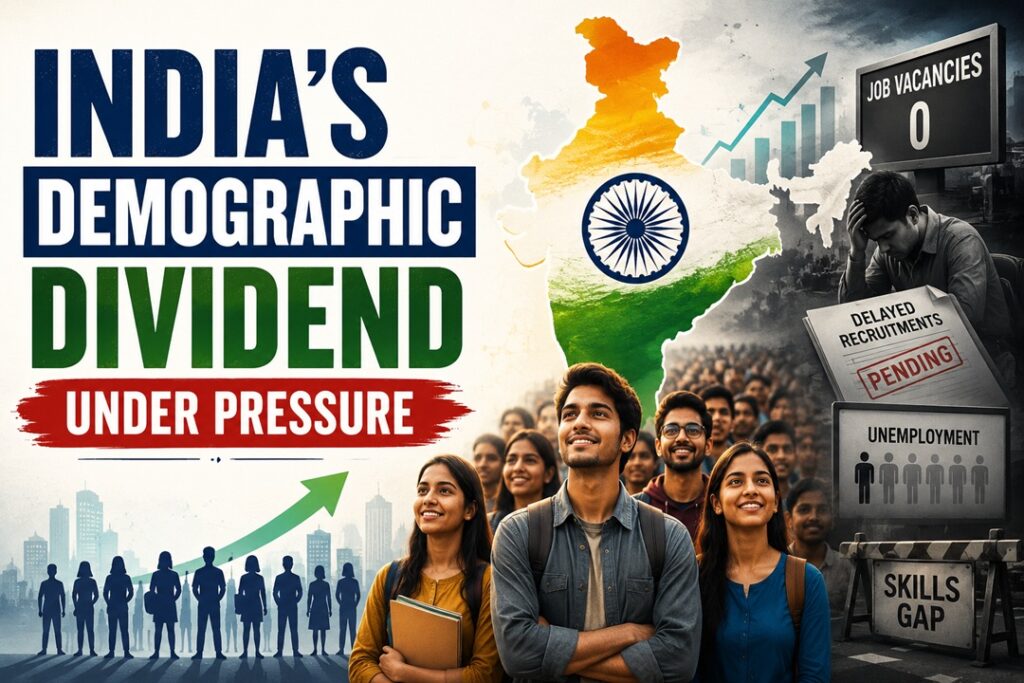
A recent assessment has raised concerns that India’s demographic advantage is gradually weakening due to prolonged government recruitment processes, limited formal job creation, inadequate skill development, and delays in welfare implementation.
India’s Shrinking Demographic Opportunity
About India’s Shrinking Demographic Opportunity
What does it mean?
India’s demographic dividend refers to the period when a large share of its population is of working age, creating the potential for faster economic growth. However, this opportunity is increasingly at risk because employment generation, recruitment systems, skill development, and welfare delivery have not kept pace. With nearly two-thirds of the population in the productive age group, failure to utilise this workforce effectively could permanently reduce India’s long-term growth prospects before the demographic window closes by the early 2040s.
Major Facts and Figures
- Limited Skill Training: Only about 3% of India’s workforce has received formal vocational training.
- Large Informal Workforce: More than 30 crore workers are registered on the e-Shram Portal.
- Educated Youth Employment Gap: The adjusted unemployment rate among educated youth is estimated at 18%.
- Working-Age Population: Around 65% of Indians belong to the 15–64 years age group.
- Low-Skilled Employment: Nearly 2% of workers remain engaged in elementary or low-skilled occupations.
- Hidden Employment Crisis: While PLFS reports youth unemployment near 2%, inclusion of discouraged job seekers raises it to nearly 18%.
- Gender Employment Gap: Urban young women face unemployment of around 20.1%, with female labour-force participation remaining slightly above 20%.
Key Concerns
Delayed Recruitment Cycle
Recruitment examinations, litigation, and administrative delays often prolong appointments by 3–4 years, leaving candidates trapped in repeated preparation cycles.
Short-Term Policy Priorities
Public spending frequently emphasizes new announcements and visible projects rather than timely completion of existing programmes.
Unequal Impact
Recruitment delays disproportionately affect economically weaker sections and first-generation graduates who cannot sustain long periods without employment.
Rise of Informal Employment
Greater dependence on contractual employment weakens job security, reduces social protection, and discourages employer investment in workforce skills.
Slow Welfare Delivery
Implementation delays in schemes such as PMAY and PM-Kisan keep eligible beneficiaries waiting due to lengthy verification and administrative bottlenecks.
International and Indian Best Practices
South Korea – Outcome-Oriented Industrial Policy
Government incentives, industrial licences, and financial support were linked with employment generation and export performance.
Brazil – Targeted Social Assistance
The Bolsa Família programme connected welfare benefits with education and healthcare requirements, helping reduce long-term poverty.
Kerala – Local Governance Model
The People’s Plan Campaign transferred a significant share of development funds to local governments, improving monitoring of public projects.
Germany – Apprenticeship-Based Workforce Development
Strong apprenticeship systems and worker participation encouraged industries to invest in long-term skill formation.
Way Forward
- Establish strict timelines for completion of public infrastructure and welfare projects.
- Transform Skill India and PMKVY into industry-driven apprenticeship programmes with longer training duration.
- Complete government recruitment within a fixed annual schedule, preferably within one year.
- Redesign welfare programmes to facilitate a gradual transition towards stable formal employment.
- Strengthen labour protections by ensuring minimum wages, social security, and continuous skill development for contract workers.
Conclusion
India’s demographic dividend offers a once-in-a-generation opportunity for economic transformation. However, persistent recruitment delays, inadequate skill development, slow welfare implementation, and insufficient formal employment threaten to convert this advantage into a missed opportunity. Prioritising timely execution, employment creation, and human capital development is essential to ensure that the country fully benefits from its youthful workforce before the demographic window narrows.
Source : Frontline