
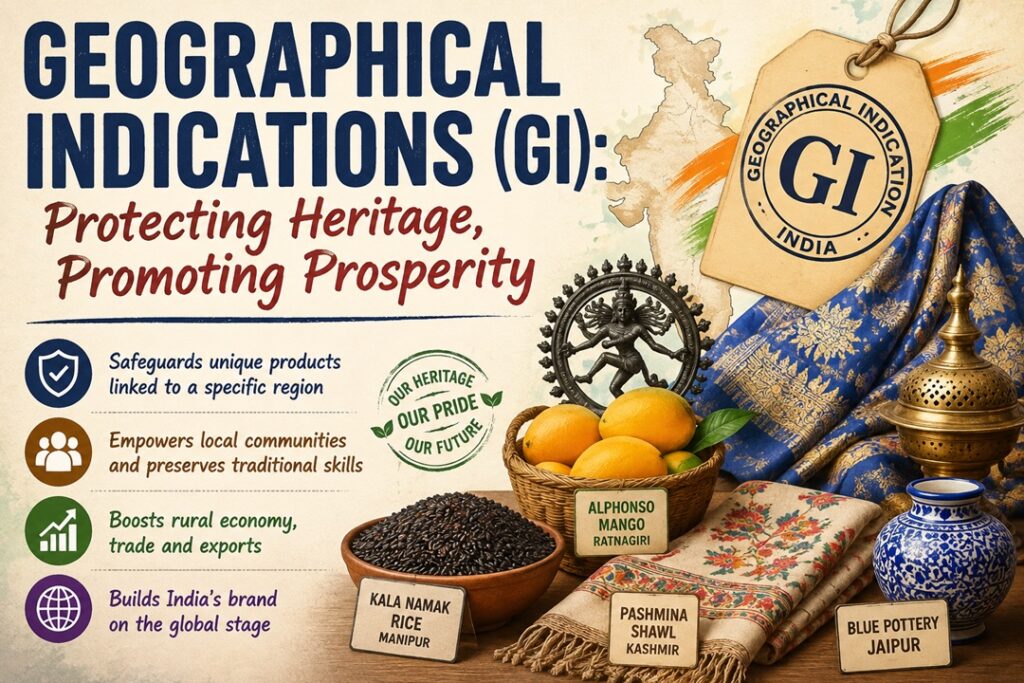
Geographical Indications (GI): Protecting Heritage, Promoting Prosperity
Context
The Government of India is accelerating efforts to promote Geographical Indication (GI) products as premium global brands by strengthening legal protection, expanding exports, integrating tourism, and supporting artisans under the vision of a heritage-based economy.
What is a Geographical Indication (GI)?
Definition
A Geographical Indication (GI) is a form of Intellectual Property Right (IPR) that identifies products originating from a specific geographical region whose quality, reputation, or other unique characteristics are essentially attributable to their place of origin.
Key Highlights
- India has more than 800 registered GI products.
- Around 607 GI registrations have been granted since 2014.
- Indian GI products are exported to major markets such as the United Kingdom, Italy, UAE, Bahrain, Qatar, the United States, and South Korea.
International Recognition
GI protection is recognised under:
- Paris Convention for the Protection of Industrial Property.
- WTO Agreement on Trade-Related Aspects of Intellectual Property Rights (TRIPS).
Legal Framework in India
- Governed by the Geographical Indications of Goods (Registration and Protection) Act, 1999.
- Supported by the Geographical Indications Rules, 2002.
- The law became operational in 2003 and registrations started during 2004–05.
- The Rules were amended in 2025.
- Registration is administered by the Geographical Indications Registry, Chennai, which has jurisdiction across India.
Major Categories of GI Products
Handicrafts
Traditional craft products reflecting regional heritage and artisan skills.
Examples:
- Pashmina (Jammu & Kashmir)
- Baluchari Saree (West Bengal)
- Banaras Gulabi Meenakari Craft (Uttar Pradesh)
Agricultural Products
Includes region-specific crops and farm produce such as:
- Cereals
- Fruits
- Vegetables
- Spices
- Plantation crops
- Non-Basmati rice varieties
Manufactured Products
Industrially processed products with distinctive geographical identity.
Examples:
- Nashik Valley Wine
- Kannauj Perfume
Food Products
Traditional prepared or processed foods enjoying GI protection.
Examples:
- Bardhaman Mihidana
- Sitabhog
- Kendrapara Rasabali
- Tirupati Laddu
Natural Products
India currently has five registered natural GI products:
- Makrana Marble (Rajasthan)
- Chunar Balua Patthar (Uttar Pradesh)
- Lac of Purulia (West Bengal)
- Panna Diamond (Madhya Pradesh)
- Ambaji White Marble (Gujarat)
GI Registration Framework in India
Who Can Apply?
Applications may be filed by:
- Registered producers’ associations.
- Organisations representing producers.
- Statutory authorities acting in the interest of producers.
Registration Procedure
- Applications are submitted directly to the GI Registry in Chennai.
- Applicants who are not producers must establish that they genuinely represent the producer community.
What Cannot Be Registered?
The following are excluded:
- Generic names that have lost protection in their country of origin.
- Indications likely to mislead consumers regarding geographical origin.
- Names hurting religious sentiments.
- Scandalous, offensive, or obscene indications.
- Indications prohibited under any existing law.
Validity
- GI registration remains valid for 10 years.
- It can be renewed indefinitely for successive ten-year periods.
Cancellation and Revocation
Authority
Under Section 27, an aggrieved person may seek cancellation or variation of a GI. The Registrar or Appellate Board may also initiate proceedings on its own.
Grounds
- Fraud or misrepresentation.
- Loss of protection in the country of origin.
- Continuous non-use.
- Consumer deception.
- Violation of law.
- Scandalous or obscene matter.
Importance of GI Tags
Income Enhancement
According to the Ministry of Textiles, GI recognition can increase artisans’ and producers’ incomes by 20–30%.
Brand Recognition
GI certification assures authenticity and geographical origin, strengthening consumer trust.
Greater Consumer Confidence
Consumers associate GI products with:
- Quality.
- Heritage.
- Authenticity.
- Traditional craftsmanship.
Better Returns for Producers
GI status enables producers to:
- Access premium domestic and international markets.
- Gain greater visibility.
- Improve bargaining power.
- Receive a higher share of product value.
Cultural Preservation
GI protection safeguards:
- Traditional knowledge.
- Indigenous craftsmanship.
- Regional identity.
- Cultural heritage.
Community Empowerment
GI promotion supports the vision of:
- Aatmanirbhar Bharat.
- Vocal for Local.
It creates sustainable livelihoods for artisans, farmers, weavers, and local producer communities.
Government Schemes Promoting GI Products
PM Ekta Mall
An allocation of ₹5,000 crore (FY 2023–24) has been made to establish malls promoting:
- One District One Product (ODOP).
- GI-tagged products.
- Handicrafts.
One Station One Product (OSOP)
Railway stations provide dedicated stalls for GI products, enabling direct marketing opportunities for artisans and farmers.
Tourism Integration
GI clusters are being linked with tourism destinations such as:
- Pochampally Ikkat village.
- Darjeeling Tea Estates.
This promotes rural tourism alongside local products.
Assam’s Silk Heritage Initiative
In June 2026, Assam launched:
- Muga Silk Trail.
- Silk Tourism Park.
- Muga Utsav.
These initiatives promote silk-based heritage tourism.
MSME Innovative Scheme
Provides up to 100% reimbursement, subject to a ceiling of ₹2 lakh, towards GI registration under the Intellectual Property Rights (IPR) component.
Protection of GI Rights
The Ministry of Textiles provides:
- Up to ₹1.5 lakh towards legal enforcement of GI rights.
- Financial assistance through the National Handloom Development Programme (NHDP) and National Handicrafts Development Programme (NHDP).
Handloom Marketing Assistance
As of June 2026:
- 104 GI handloom products
- 53 GI registrations
receive marketing support under NHDP.
APEDA Support
APEDA assists GI agricultural products through:
- Quality improvement.
- Infrastructure development.
- Capacity building.
- Export promotion.
- International branding.
Domestic Promotion
GI products are promoted through:
- Dilli Haat.
- Craft fairs.
- GI awareness programmes.
- Seminars and workshops.
- Virasat se Vikas Tak campaign.
- World Food India 2025.
- Tribal Conclave 2025.
- India AI Summit 2026.
- Airport and metro advertising.
International Promotion
Indian GI products are showcased globally through exhibitions such as:
- Autumn Fair International 2024 (United Kingdom).
- Bazaar Berlin 2024 (Germany).
Expanding Global Recognition
India–EU Free Trade Agreement
The proposed FTA is expected to:
- Reduce trade barriers.
- Increase exports.
- Strengthen recognition of Indian GI products.
- Improve market access for regional specialties.
India–Oman CEPA
The export of 3 metric tonnes of GI-certified Indi Lime to Oman in 2025 demonstrated the export potential and market value of GI-certified products.
New Zealand Recognition
New Zealand has agreed to provide legal protection for several Indian GI products, including:
- Darjeeling Tea.
- Basmati Rice.
- Indian handicrafts.
This expands legal recognition beyond European markets.
Way Forward
India has set an ambitious target of 10,000 GI registrations by 2030. Achieving this goal will require stronger legal protection, improved branding, wider market access, digital promotion, export-oriented strategies, and deeper integration of GI products with tourism and e-commerce. By preserving traditional knowledge while creating sustainable livelihoods, GI products can become a key pillar of India’s heritage economy and rural development.
Source : PIB