
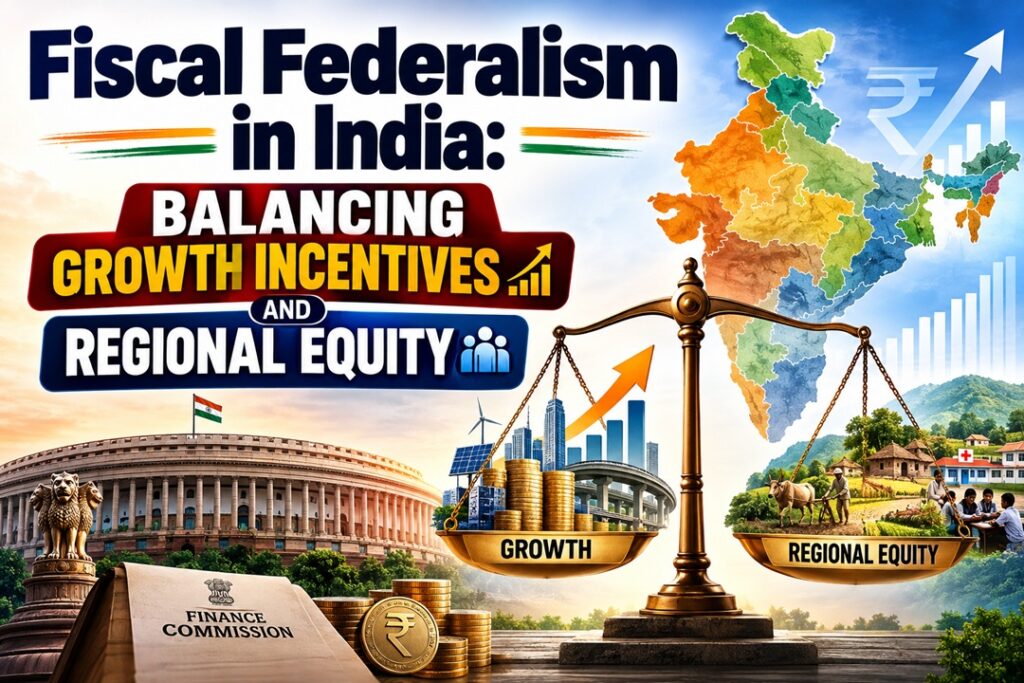
Fiscal Federalism in India: Balancing Growth Incentives and Regional Equity
Context
The recommendations of the 16th Finance Commission (2026–31) have reignited the debate on India’s fiscal federalism after retaining 41% vertical tax devolution while significantly reducing the proportion of grants-in-aid to states. The new framework emphasizes fiscal efficiency and performance but has raised concerns regarding equity and support for economically weaker states.
Fiscal Federalism: Balancing Efficiency with Inclusive Development
What is Fiscal Federalism?
- Fiscal federalism refers to the system through which financial powers, taxation, expenditure responsibilities, and revenue transfers are distributed between the Union and State Governments.
- It aims to ensure that states possess adequate financial resources to discharge their constitutional responsibilities while maintaining national economic stability.
- The framework constantly seeks to strike a balance between:
- Efficiency – encouraging fiscal responsibility, better revenue generation, and improved economic performance.
- Equity – ensuring that financially weaker states receive adequate support to overcome regional and developmental disparities.
Constitutional Foundations of Fiscal Federalism
Addressing Vertical Fiscal Imbalance
- The Constitution assigns the major share of taxation powers to the Union, whereas states shoulder substantial expenditure obligations in sectors such as health, education, agriculture, and rural development.
- The Finance Commission serves as the constitutional mechanism to bridge this imbalance through tax sharing and financial transfers.
Example:
Article 280 provides for the periodic constitution of the Finance Commission to recommend tax devolution and grants.
Equalisation through Special Grants
- Article 275 empowers the Union to provide grants to states facing unique financial challenges that cannot be adequately addressed through tax devolution alone.
- Such grants support states with difficult geographical conditions or limited fiscal capacity.
Example:
Additional financial assistance for Himalayan and North-Eastern states due to higher infrastructure and service delivery costs.
Rewarding National Contributions
- Fiscal transfers also recognize states that generate benefits extending beyond their boundaries by providing important national public goods.
Example:
States conserving forests or maintaining strategic border regions contribute significantly to national interests despite limited revenue opportunities.
Strengthening Cooperative Federalism
- Fiscal federalism promotes balanced regional development by reducing disparities among states and reinforcing national unity through equitable resource distribution.
Major Features of the 16th Finance Commission Recommendations
Continuation of 41% Tax Devolution
- The Commission retained the 41% share of divisible central taxes for states, declining demands for increasing the share to 50%.
Rationalisation of Grants
- Grants-in-aid have been substantially reduced, with a greater focus on targeted transfers instead of broad-based assistance.
- The proportion of grants in total Finance Commission transfers has declined considerably.
Withdrawal of Revenue Deficit Support
- Traditional Revenue Deficit Grants (RDGs) and many sector-specific grants have been phased out.
- Grants are now largely confined to local bodies and disaster management purposes.
Revised Horizontal Distribution Formula
- Greater importance has been assigned to State Gross Domestic Product (GSDP) while slightly reducing the weight given to income distance, thereby rewarding stronger economic performance.
Performance-Oriented Local Government Funding
- Local bodies will receive significant financial support, but release of funds will depend on compliance with governance indicators such as audited accounts, sanitation, and water management.
Advisory on Cesses and Surcharges
- The Commission has recommended a gradual reduction in the Union’s reliance on non-shareable cesses and surcharges, though the proposal is advisory rather than mandatory.
Key Concerns Regarding the New Framework
Reduced Support for Economically Weaker States
- Lower weight for income distance combined with the withdrawal of Revenue Deficit Grants may significantly reduce financial support for less-developed states.
Example:
Several North-Eastern and eastern states could experience declines in both tax transfers and grants.
Unequal Fiscal Capacity Across States
- The framework assumes that all states possess comparable abilities to mobilize revenue, overlooking structural differences in economic development.
Example:
States with limited industrialisation and narrow tax bases may struggle to generate sufficient revenues independently.
Imbalance in Fiscal Discipline
- States are expected to adhere to stricter fiscal discipline, while the Centre continues to retain substantial revenues through cesses and surcharges that are outside the divisible pool.
Reduced Flexibility for Local Governments
- Linking grants to compliance conditions may reduce the financial autonomy of Panchayats and Urban Local Bodies.
Example:
Delays in audits or procedural compliance could postpone the release of essential development funds.
Growing Regional Disparities
- Greater emphasis on economic performance may channel larger resources toward already prosperous states, widening interstate income gaps.
Example:
Industrially advanced states may receive relatively larger transfers than economically lagging regions.
Way Forward
Restore Need-Based Equalisation Grants
- Reintroduce targeted financial assistance for states facing persistent structural, geographical, or demographic disadvantages.
Rationalise Cesses and Surcharges
- Gradually merge non-shareable cesses into the divisible tax pool to strengthen cooperative fiscal federalism and enhance states’ revenue share.
Rebalance Horizontal Devolution Criteria
- Increase the weight assigned to factors such as income distance, ecological conservation, and developmental needs to ensure more equitable distribution.
Enhance Local Government Autonomy
- Combine performance-linked grants with adequate untied grants so that local bodies retain flexibility in addressing local priorities.
Recognise Cost Disabilities
- Incorporate objective indicators such as difficult terrain, climate vulnerability, border management responsibilities, and sparse populations while determining transfers.
Conclusion
The 16th Finance Commission reflects a stronger emphasis on fiscal discipline, performance, and economic efficiency. However, sustaining India’s cooperative federal structure requires balancing incentives for growth with adequate support for states facing structural disadvantages. A more equitable fiscal transfer mechanism that combines efficiency with regional inclusion will be essential for promoting balanced development, reducing interstate disparities, and strengthening the spirit of cooperative federalism.
Source : The Hindu