
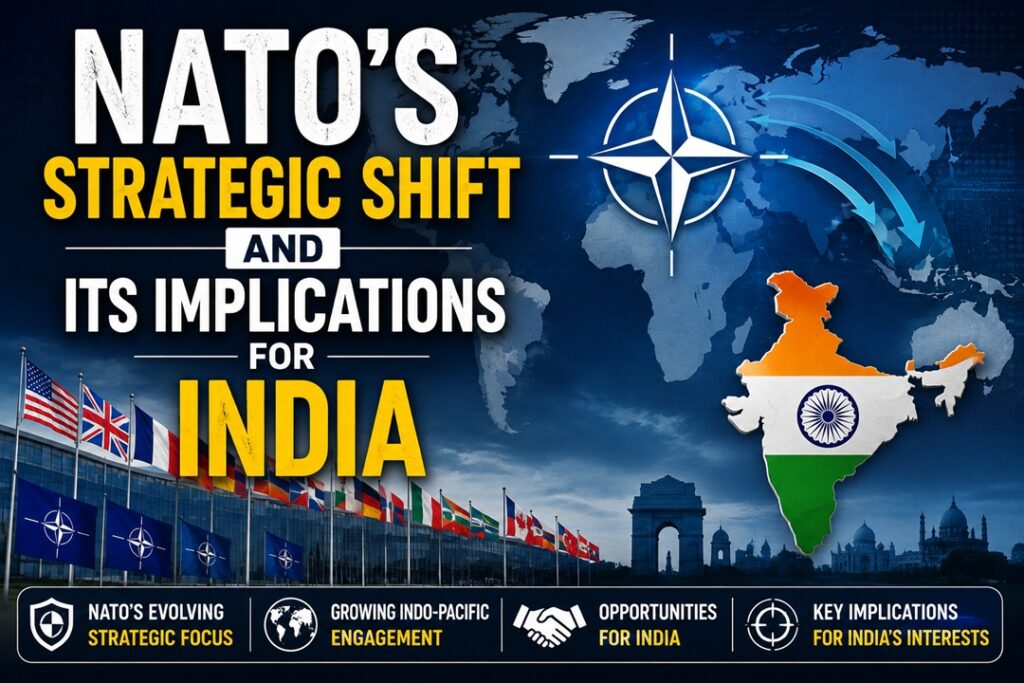
NATO’s Strategic Shift and Its Implications for India
Context
The outcomes of the 36th NATO Summit underline a changing transatlantic security landscape, with the United States gradually shifting its strategic attention towards the Indo-Pacific, while European allies assume greater responsibility for regional defence and military preparedness.
NATO’s Strategic Shift and Its Implications for India
Why in News?
The 36th NATO Summit highlighted the Alliance’s evolving priorities, including stronger European defence commitments, increased support for Ukraine, and a broader strategic focus on the Indo-Pacific region, carrying significant geopolitical implications for India.
What is NATO?
North Atlantic Treaty Organization (NATO) is a political and military alliance established to safeguard the collective security of its member nations.
Key Features
Established: 4 April 1949 through the Washington Treaty.
Founding Members: Belgium, Canada, Denmark, France, Iceland, Italy, Luxembourg, Netherlands, Norway, Portugal, the United Kingdom and the United States.
Headquarters: Brussels, Belgium.
Objective: To preserve peace, protect democratic values, and ensure the collective defence of member states through political consultation and military cooperation.
Collective Defence Principle: Under Article 5, an armed attack against one member is regarded as an attack against the entire Alliance.
Only Invocation of Article 5: Following the 11 September 2001 terrorist attacks in the United States.
How has the US–Europe Security Relationship Changed?
Cold War Era
- Europe relied heavily on American military protection against the Soviet Union.
- NATO served as the cornerstone of Western security.
Post-Cold War Phase
- Focus shifted towards peacekeeping missions, counter-terrorism operations and crisis management.
- NATO expanded eastward by admitting several Central and Eastern European countries.
Current Strategic Transition
- Russia’s aggression has revived Europe’s focus on territorial defence.
- The United States increasingly prioritises the Indo-Pacific and competition with China.
- European nations are investing more in independent military capabilities while remaining within the NATO framework.
Major Decisions Taken at the 36th NATO Summit
Strengthening Collective Security
- Member states reaffirmed their commitment to Article 5.
- NATO reiterated its determination to maintain credible deterrence across all domains.
- Emphasis was placed on preserving Alliance unity amid emerging global threats.
Higher Defence Spending
- Allies agreed to gradually raise defence and security expenditure to 5% of GDP by 2035.
- The commitment aims to improve military readiness and long-term resilience.
- Defence industrial production and procurement are expected to expand significantly.
Building Future Military Capabilities
Priority investments include:
- Long-range precision strike systems.
- Integrated air and missile defence.
- Autonomous and unmanned platforms.
- Artificial Intelligence-enabled military technologies.
- Cyber defence infrastructure.
- Intelligence, surveillance and reconnaissance capabilities.
- Space-based security assets.
- Interoperable transatlantic digital command networks.
Continued Assistance to Ukraine
- NATO reaffirmed sustained military and financial assistance for Ukraine.
- European allies and Canada remain the principal contributors.
- Approximately €70 billion has been committed for military equipment, training and assistance during 2026, with continued support expected beyond.
Middle East Security
- NATO reiterated that Iran should not acquire nuclear weapons.
- The Alliance stressed the importance of maintaining freedom of navigation in the Strait of Hormuz for global energy security.
Europe’s Defence Modernisation: Progress and Constraints
Recent Developments
- European countries have substantially increased defence budgets.
- Germany has sharply expanded military expenditure and aims to meet NATO targets ahead of schedule.
- NATO will review members’ defence spending progress in 2029.
Key Challenges
- Europe still depends on the United States for several advanced military capabilities.
- Gaps remain in:
- Strategic airlift.
- Missile defence.
- Intelligence and surveillance.
- Space assets.
- Nuclear deterrence.
- Advanced logistics.
- Developing a fully integrated European defence ecosystem will require sustained investment over many years.
Why Does NATO’s Transformation Matter for India?
Greater Indo-Pacific Attention
As Europe assumes more responsibility for its own security, the United States can allocate greater diplomatic, economic and military resources to the Indo-Pacific.
Expanding Defence Cooperation
India can strengthen partnerships with the United States and European nations in:
- Defence manufacturing.
- Advanced military technologies.
- Artificial Intelligence.
- Cybersecurity.
- Semiconductor supply chains.
- Space technologies.
Maintaining Strategic Autonomy
India can deepen cooperation with NATO members without joining any formal military alliance, preserving its independent foreign policy.
Boosting Defence Industrial Growth
Growing European investments create opportunities for:
- Joint defence production.
- Technology transfer.
- Defence exports.
- Research and innovation partnerships.
Supporting a Multipolar World
NATO’s evolving strategic framework offers India greater opportunities to emerge as a leading balancing power connecting the West and the Global South.
Future Outlook
Deepening Strategic Partnerships
India should enhance engagement with both Europe and the United States while preserving policy independence.
Expanding Defence Collaboration
Greater focus should be placed on co-development, joint production, defence innovation and emerging technologies.
Balancing Regional Security
Closer cooperation with democratic partners can contribute to maintaining stability in the Indo-Pacific amid China’s growing influence.
Strengthening India’s Global Role
By leveraging changing geopolitical dynamics, India can reinforce its position as:
- A major Indo-Pacific power.
- A trusted defence and technology partner.
- A bridge between advanced economies and the Global South.
- An important pillar of an emerging multipolar international order.
Source : The Hindu