
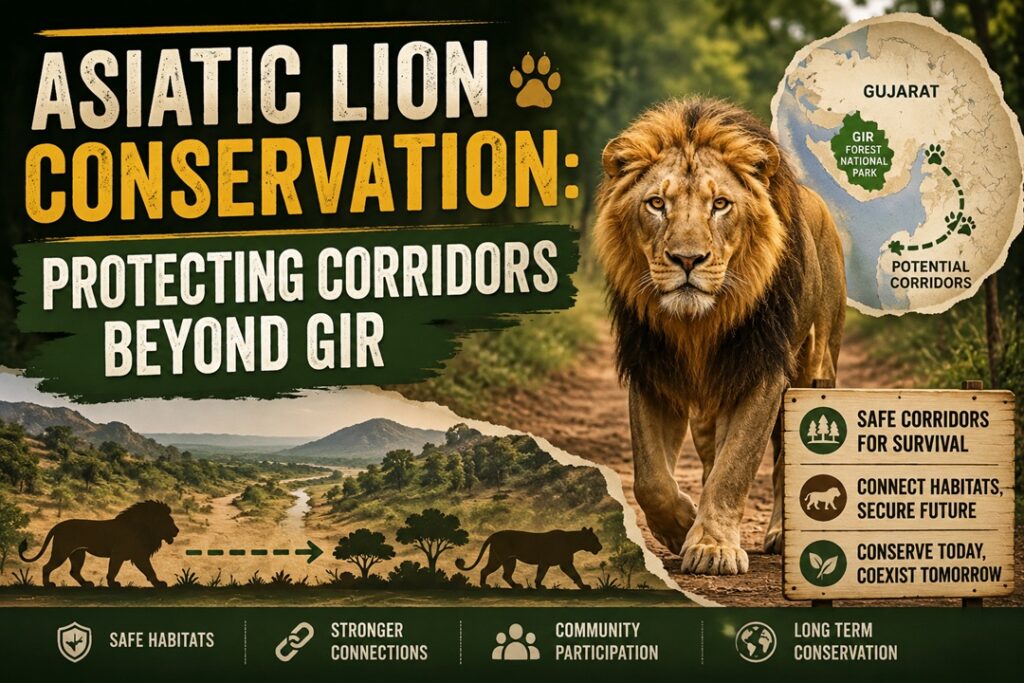
Asiatic Lion Conservation: Protecting Corridors Beyond Gir
Context
A proposal to allocate nearly 75 hectares of reserved forest for limestone extraction in the Babarkot–Jafrabad coastal belt has triggered fresh debates over wildlife conservation.
Experts caution that the mining project could interrupt a key dispersal corridor linking coastal lion habitats with the Greater Gir landscape, restricting the natural movement of Asiatic lions and affecting long-term population sustainability.
Safeguarding the Future of the Asiatic Lion
What is it?
The conservation of the Asiatic Lion (Panthera leo persica) is regarded as one of India’s most remarkable wildlife success stories. From a critically low population of nearly 100–150 lions during the 1960s, the species has recovered to almost 900 individuals today.
Despite this recovery, the entire wild population remains concentrated within the Saurashtra region of Gujarat, making habitat connectivity, satellite populations, and wildlife corridors crucial for ensuring genetic diversity and reducing extinction risks.
Important Facts & Figures
Remarkable Population Recovery
- Lion numbers increased from around 100–150 in the 1960s to 891 individuals in the 16th Lion Census (2025).
- This represents a 32.2% rise compared to the 2020 census.
Increasing Presence Outside Protected Areas
- Around 507 lions (over 56%) are now found outside officially protected forests.
- Many occupy agricultural lands, coastal habitats, and community landscapes.
Expansion of Distribution
- Lion habitat has expanded from approximately 30,000 sq. km (2020) to over 35,000 sq. km (2025).
- The species now occupies nine recognised satellite populations across Gujarat.
Global Conservation Status
- The IUCN Red List upgraded the Asiatic lion from “Critically Endangered” to “Endangered.”
- It remains the world’s only stable wild population of Asiatic lions.
Major Milestones in Asiatic Lion Conservation
Royal Protection in Junagadh
The Nawab of Junagadh prohibited lion hunting when their numbers had declined drastically during the early twentieth century.
Example: Royal intervention helped preserve the final breeding population within the Gir forests.
Creation of Gir Wildlife Sanctuary (1965)
The notification of Gir Wildlife Sanctuary marked the beginning of formal legal protection.
Example: Protected area boundaries were gradually expanded to improve habitat security and reduce human pressures.
Landscape-Based Conservation Approach
Management evolved from protecting only forest interiors to conserving the entire Greater Gir ecosystem, including grasslands, riverbeds, scrublands, and agricultural landscapes.
Example: Coastal stretches such as Babarkot and Jafrabad were recognised as important movement routes for dispersing lions.
Community Participation in Conservation
The success of lion conservation has been supported by local communities, particularly Maldhari pastoralists and farmers who have traditionally coexisted with lions.
Example: Villagers often tolerate lions moving through orchards and farmland with minimal retaliatory conflict.
Key Conservation Measures
Project Lion
A national initiative focusing on habitat improvement, prey enhancement, scientific monitoring, and strengthening satellite lion populations.
Development of Barda Wildlife Sanctuary
Barda Wildlife Sanctuary is being strengthened as an alternative habitat to support future lion dispersal and establish an additional breeding population.
Modern Monitoring & Veterinary Infrastructure
Advanced monitoring through GPS collars, satellite telemetry, and the Hi-Tech Monitoring Centre at Sasan Gir, supported by the National Wildlife Referral Centre, Junagadh, has improved conservation management.
Role of Vanya Prani Mitras
Locally recruited wildlife volunteers and trained trackers assist forest officials in monitoring lions and reducing human–wildlife conflicts.
Emerging Challenges
Risk from Disease Outbreaks
With nearly the entire population concentrated in one region, infectious diseases pose a significant threat.
Example: The 2018 Canine Distemper Virus (CDV) outbreak claimed more than 20 lions, followed by recurring cases of babesiosis.
Loss of Wildlife Corridors
Mining, industrial expansion, and infrastructure projects threaten the connectivity between lion habitats.
Example: Proposed limestone mining in the Babarkot–Jafrabad corridor could isolate coastal lion populations.
Human-Induced Threats
As lions increasingly occupy human-dominated landscapes, accidental deaths have become more common.
Example: Open wells, railway accidents, and unsafe urban infrastructure continue to endanger dispersing lions.
Slow Progress in Establishing a Second Wild Population
Efforts to create an independent lion population outside Gujarat have progressed slowly.
Example: The planned relocation of lions to Kuno National Park has faced prolonged delays despite judicial directions.
The Way Ahead
Protect Ecological Corridors
Provide legal protection to critical dispersal routes such as the Babarkot coastal corridor by declaring them ecologically sensitive areas.
Strengthen Alternative Habitats
Accelerate the development of geographically separate lion populations in Barda Wildlife Sanctuary and Kuno National Park to reduce extinction risks.
Improve Wildlife Health Monitoring
Expand disease surveillance, strengthen veterinary infrastructure, and undertake vaccination programmes for domestic animals in surrounding villages.
Reduce Human–Wildlife Conflict
Secure open wells, improve railway safety measures, and ensure timely compensation for livestock and crop losses to maintain community support for conservation.
Conclusion
The recovery of the Asiatic lion over the past six decades demonstrates the success of sustained conservation efforts, scientific management, and community participation. However, ensuring the species’ long-term survival now depends on protecting habitat corridors, reducing development pressures, establishing additional free-ranging populations, and strengthening disease surveillance to build a resilient future for India’s iconic big cat.
Source : The Hindu