
Supreme Court Strengthens 10-km Mining Safeguards Around Wetland Reserves
Context
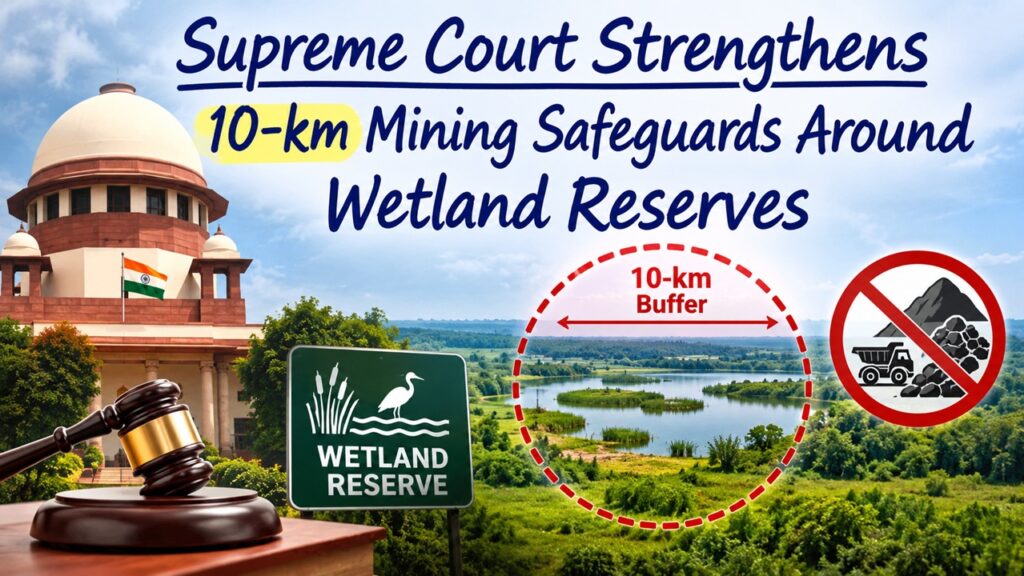
The Supreme Court has clarified that its 2024 direction requiring prior clearance for mining within a 10-km radius of the Asan Wetland Conservation Reserve will be applicable across India to all notified wetland and community conservation reserves, ensuring uniform environmental protection.
Supreme Court Expands Mining Safeguards Around Wetland Reserves
What Has the Supreme Court Directed?
The Supreme Court has ruled that mining activities within a 10-km radius of any notified wetland or community conservation reserve must obtain prior approval from the Standing Committee of the National Board for Wildlife (NBWL) and/or the Ministry of Environment, Forest and Climate Change (MoEFCC).
The judicial directive effectively creates a protective buffer around ecologically important wetlands, particularly Ramsar sites, where existing domestic regulations do not uniformly prescribe statutory buffer zones.
India’s Wetland Conservation Landscape
- Ramsar Network: India now has 101 Ramsar sites, giving it one of the largest Ramsar networks in Asia.
- Latest Addition: On August 3, 2026, Glaw Lake in Arunachal Pradesh was designated India’s 101st Ramsar site and the first Ramsar site in the state.
- Rapid Growth: India’s Ramsar network has expanded significantly, rising from 98 sites earlier in 2026 to cross the 100-site threshold.
- Global Commitment: India became a party to the Ramsar Convention in 1982, undertaking to maintain the ecological character of wetlands of international importance.
Evolution of India’s Wetland Regulations
Wetlands Rules, 2010
The Wetlands (Conservation and Management) Rules, 2010 provided a relatively centralized framework for wetland protection.
Major provisions included:
- Specified Restricted Activities: Activities such as reclamation of wetlands, establishment of new industries and disposal of solid waste were restricted.
- Control Over Impact Areas: Developmental and commercial activities within a wetland’s zone of influence required regulatory approval.
- Environmental Assessment: Certain projects affecting wetland ecosystems were subject to Environmental Impact Assessment (EIA).
- Central Regulatory Mechanism: The Central Wetlands Regulatory Authority played a major role in implementing conservation standards.
Shift Under the 2017 Rules
The 2010 framework was subsequently replaced by the Wetlands (Conservation and Management) Rules, 2017.
The newer framework:
- Shifted greater responsibility to State Wetland Authorities.
- Reduced the role of centralized regulation.
- Removed the earlier detailed list of nationally prohibited activities.
- Created concerns regarding the absence of uniform statutory buffer restrictions around wetlands.
Important Judicial Directions on Wetland Protection
Uniform 10-km Safeguard
The Supreme Court has extended the earlier Asan Wetland-related protection by requiring prior clearance for mining within 10 km of notified wetland and community conservation reserves.
Principle of Equal Protection
The Court emphasized that similar ecological entities should receive comparable regulatory safeguards irrespective of their location in different States.
Scientific Assessment of Transboundary Ecosystems
The authorities have also been directed to undertake scientific examination where wetland ecosystems extend across State boundaries, ensuring that ecological protection does not stop merely because an ecosystem crosses an administrative boundary.
How Mining Threatens Wetland Ecosystems
Alteration of Water Flow and Sedimentation
Mining operations can increase runoff and sediment deposition, altering natural drainage systems and reducing the ecological quality of wetlands.
Example: Sand and gravel extraction near river confluences can increase silt accumulation and damage feeding areas used by migratory birds.
Habitat Fragmentation and Wildlife Disturbance
Heavy machinery, blasting and increased human activity can disturb aquatic organisms, waterbirds and other wetland-dependent species.
Example: Mining activities near high-altitude wetlands may disturb important wintering and roosting sites of migratory birds.
Pollution and Increased Turbidity
Mining and quarrying can release suspended particles, chemicals and heavy metals into nearby water systems.
Example: Poorly regulated quarrying in wetland catchments can increase turbidity and introduce toxic contaminants into aquatic habitats.
Weaknesses in Existing Buffer Regulation
The transition from the 2010 framework to the 2017 Rules resulted in greater decentralization and the removal of certain explicit restrictions, creating regulatory uncertainty regarding activities surrounding wetlands.
Strengthening the Protection Framework
Establish Legally Recognized Ecological Buffers
Important Ramsar wetlands should be provided with clearly defined Eco-Sensitive Zones (ESZs) or equivalent statutory buffers under the Environment (Protection) Act, 1986.
Improve State-Level Monitoring
State Wetland Authorities should receive adequate scientific expertise, technological resources and enforcement powers to monitor land-use changes around wetlands.
Clarify Prohibited and Regulated Activities
A stronger national framework should clearly identify activities such as mining, quarrying and industrial development that require strict regulation around sensitive wetland ecosystems.
Adopt Continuous Environmental Surveillance
Periodic environmental audits, remote-sensing assessments and satellite-based monitoring can help identify illegal mining, encroachment and ecological degradation at an early stage.
Conclusion
The Supreme Court’s decision strengthens the protection available to India’s wetlands by extending the 10-km prior-approval requirement for mining beyond the Asan Wetland Conservation Reserve to comparable notified wetland and community conservation reserves nationwide.
The judgment helps bridge regulatory gaps in India’s wetland protection framework while reinforcing the country’s obligations under the Ramsar Convention. Going forward, effective conservation will require a combination of judicial oversight, stronger statutory buffers, scientific monitoring and responsible regulation of economic activities around fragile aquatic ecosystems.
Source : The Hindu