
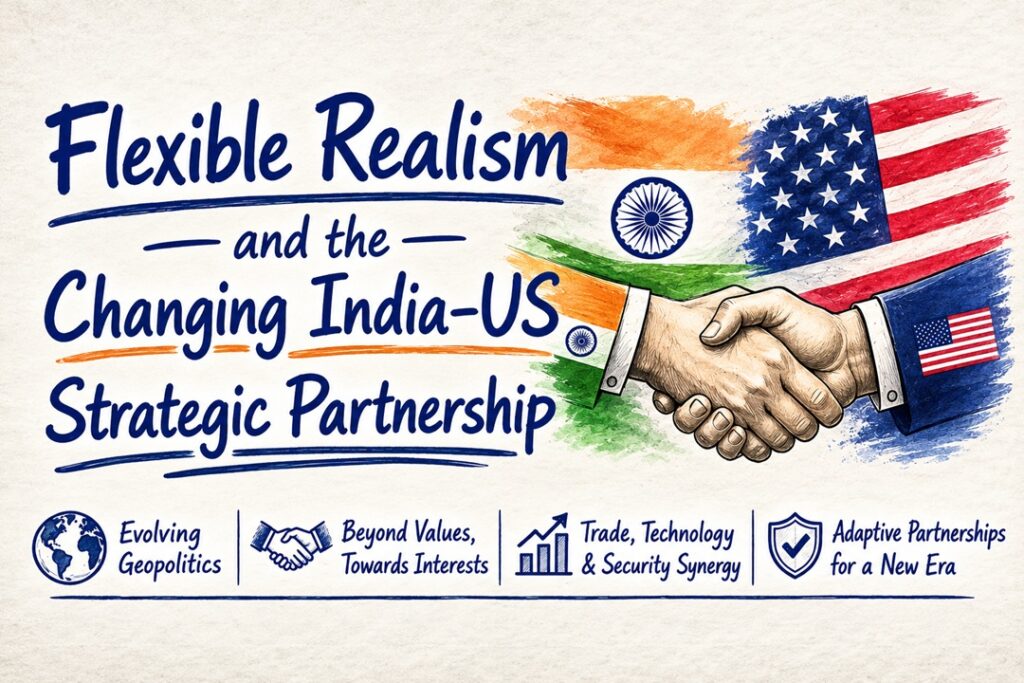
Flexible Realism and the Changing India–US Strategic Partnership
Context
Recent tariff measures adopted by the United States, including those affecting India, point beyond conventional trade friction. They reflect a wider evolution in American foreign policy, where economic interests, national security, technological strength, and strategic advantage are increasingly integrated into statecraft.
Understanding Flexible Realism
Flexible realism refers to a foreign-policy framework in which national interests take precedence over ideological commitments or traditional alliance structures.
It combines economic instruments, technological capabilities, military strength, and diplomatic partnerships to maximise strategic gains. Countries are assessed largely on the basis of their practical contribution to national objectives rather than simply their political or ideological compatibility.
Core Pillars of the Approach
- National Interest First – Foreign-policy decisions are primarily shaped by economic resilience, national security, and domestic strategic priorities.
- Benefit-Based Partnerships – Partnerships are evaluated according to their concrete economic, military, and geopolitical returns.
- Unified Statecraft – Tariffs, industrial policy, technology controls, trade arrangements, and defence strategies are increasingly coordinated toward common national goals.
- Greater Burden Sharing – Major powers increasingly expect their partners to develop stronger indigenous defence capabilities and assume greater responsibility for regional security.
Distinctive Features of Flexible Realism
- Reduced Ideological Outreach – Greater reluctance to promote democracy, human rights, or regime change as universal foreign-policy objectives.
- Practical Diplomacy – Engagement is maintained with countries based on strategic and economic utility rather than their domestic political systems.
- Respect for Political Diversity – Greater caution in imposing political or social preferences on other states.
- Selective Strategic Prioritisation – Resources are concentrated on objectives considered achievable and directly relevant to national interests.
- Interest-Driven Multilateralism – National security, economic growth, technological leadership, and geopolitical influence receive greater emphasis than abstract commitments to a rules-based order.
Evolution of India–US Relations
1. Post-Cold War Foundation
Following the Cold War, India and the United States gradually moved closer through democratic affinity, expanding trade, and growing economic interaction.
2. China and the Indo-Pacific
The emergence of China as a major strategic power accelerated bilateral cooperation. Initiatives such as the Quad, expanding defence exercises, and greater Indo-Pacific coordination became important pillars of the relationship.
3. Era of Strategic Pragmatism
The relationship is increasingly moving towards reciprocity, capability building, technology cooperation, and measurable strategic gains, reflecting elements of flexible realism.
4. Future Strategic Complementarity
The next phase could focus on joint production, technology partnerships, resilient supply chains, defence integration, and co-development of critical capabilities.
From Strategic Alignment to Strategic Complementarity
The India–US relationship is gradually shifting from strategic convergence to strategic complementarity.
Strategic convergence refers to cooperation driven primarily by common geopolitical concerns, particularly the challenge posed by China.
Strategic complementarity, in contrast, implies that both countries cooperate because their respective capabilities and interests reinforce each other.
For India, this could mean leveraging American capital, technology, and markets while contributing its own manufacturing capacity, strategic geography, skilled workforce, and regional influence.
Why China Continues to Shape India’s Strategic Choices
- Border Security – Continuing territorial disputes make China a permanent factor in India’s defence planning.
- Indo-Pacific Rivalry – China’s expanding influence affects India’s regional strategic calculations.
- Economic Dependence – India remains dependent on Chinese supply chains for several components, industrial inputs, and manufactured goods.
- Indian Ocean Security – China’s expanding maritime capabilities have implications for India’s surrounding maritime space.
- Advanced Technology Competition – Competition in areas such as semiconductors, artificial intelligence, telecommunications, and strategic technologies is becoming increasingly important.
- Asian Power Balance – China’s growing economic and military weight continues to influence the broader balance of power in Asia.
Implications for India
Economic Dimension
US tariffs could increase pressure on Indian exporters and constrain access to the American market.
At the same time, trade pressures can encourage export diversification, domestic manufacturing, supply-chain resilience, and greater global competitiveness.
Security Dimension
A more transactional US foreign policy could mean that strategic partnership alone may not guarantee favourable economic treatment.
India’s role in Indo-Pacific security, maritime stability, and resilient supply chains could therefore become increasingly significant.
Technology Dimension
US technology restrictions could create difficulties in accessing certain advanced technologies.
However, India’s importance could simultaneously increase in areas such as semiconductors, artificial intelligence, defence manufacturing, critical minerals, and emerging technologies.
Geopolitical Dimension
India must deepen cooperation with Washington without compromising its strategic autonomy.
Simultaneously strengthening relations with the European Union, Japan, ASEAN, and the Global South can help India avoid excessive dependence on any single strategic partner.
Major Challenges for India
- Managing China–US Rivalry – India must ensure that its foreign policy is not excessively shaped by competition between Washington and Beijing.
- Trade Vulnerability – A transactional US approach could create uncertainty for Indian exports and market access.
- Technology Dependence – India needs to ensure that technological cooperation does not create excessive external dependence.
- Capability Deficit – Faster development of indigenous defence manufacturing, R&D, semiconductors, and advanced technologies remains essential.
- Preserving Strategic Autonomy – India must expand cooperation with the US while avoiding dependence on exclusive strategic blocs.
Way Forward
India’s strategic importance should not depend solely on its usefulness in balancing or containing another power.
Instead, India’s global influence should rest on its own economic scale, technological capabilities, defence preparedness, manufacturing strength, resilient supply chains, and diplomatic outreach.
A sustainable India–US partnership should therefore be based on mutual complementarity rather than strategic dependence, allowing India to cooperate closely with Washington while retaining the flexibility to pursue independent partnerships across the global system.
Source : The Hindu