
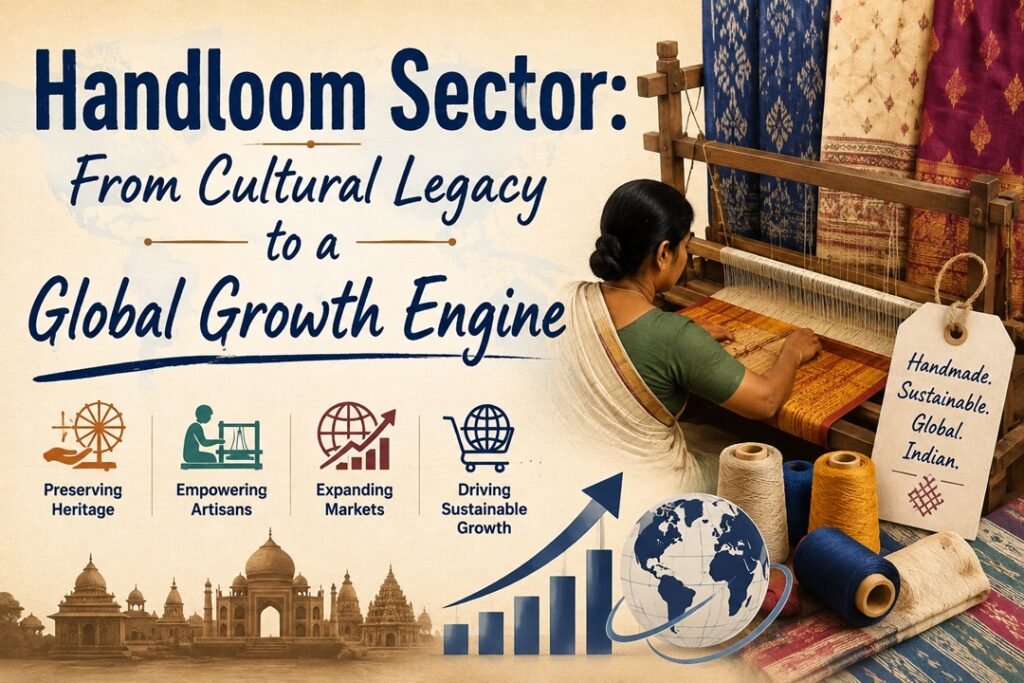
Handloom Sector: From Cultural Legacy to a Global Growth Engine
Context
On August 7, 2026, marking the 12th National Handloom Day, Union Minister of Textiles Giriraj Singh highlighted the strategic importance of India’s handloom sector in achieving the vision of Viksit Bharat@2047.
Why Handloom Matters for Viksit Bharat@2047?
India’s handloom industry is more than a traditional occupation. It represents a combination of cultural heritage, rural livelihoods, women-led economic participation and environmentally sustainable production.
With global demand shifting towards sustainable, authentic and ethically produced fashion, Indian handlooms have the potential to evolve from a cottage-based activity into a globally competitive creative industry.
India’s Rich Weaving Legacy
Ancient Roots
The history of Indian textiles dates back to the Indus Valley Civilisation, where cotton cultivation and weaving were already practised.
India’s Historic Global Textile Presence
Indian textiles once enjoyed a dominant position in international trade, particularly during the 18th century.
Important traditional weaving traditions include:
- Bengal Muslin – Famous for its exceptional fineness; historically, a 25-metre length could pass through a ring.
- Banarasi Silk – Known for intricate designs and rich craftsmanship.
- Kanchipuram Weaves – Renowned for traditional silk weaving.
- Pochampally Ikat – Distinguished by its unique resist-dyeing technique.
These traditions demonstrate how India’s cultural heritage can generate contemporary economic value.
Present Status and Government Support
India’s handloom sector supports more than 35 lakh weavers and allied workers, with women constituting nearly 72% of the workforce.
Major Interventions in Recent Years
Government initiatives over the past decade have focused on improving productivity, skills, quality and market access.
Key achievements include:
- More than 1.24 lakh improved looms distributed.
- Skill development provided to around 97,000 artisans across 797 handloom clusters.
- Quality and authenticity promoted through:
- Geographical Indication (GI) tags
- Handloom Mark
- India Handmade certification
- Urban Haats
- Design Resource Centres
National Programme for Wider Artisan Coverage
The proposed National Handloom & Handicraft Programme seeks to expand support across:
- 1,800 handloom and handicraft clusters.
- More than 500 districts.
- Around 65 lakh weavers and artisans.
The broader objective is to develop a globally recognisable “Handmade in India” identity and integrate Indian artisans with expanding domestic and international markets.
Technology Meets Traditional Craft: Handloom 4.0
Technology is increasingly being used to improve the working conditions and commercial potential of artisans without replacing the human element of weaving.
Ergonomic Loom Technology
India has a history of adapting weaving technology to improve efficiency, including innovations such as Mahatma Gandhi’s Ambar Charkha.
Contemporary regional innovations include:
- Assam’s Maina Loom.
- Sivasagar’s Chitranjan Handloom.
The Centre of Excellence for Handloom Technology, in collaboration with IITs, is working on lighter and stronger loom designs that reduce physical strain and improve accessibility, including for persons with disabilities.
Digital Transformation of Weaving
Handloom 4.0 introduces AI-enabled and digital monitoring technologies for:
- Quality management.
- Loom maintenance.
- Productivity assessment.
- Operational monitoring.
The technology is currently being piloted across 100 looms.
VisioNXT and Market Intelligence
VisioNXT uses digital technologies to help artisans and the textile ecosystem with:
- Fashion and trend forecasting.
- Design identification.
- Product authentication.
- Anti-counterfeit mechanisms.
- Connections with international markets.
How Handloom Can Accelerate Inclusive Growth
1. Strengthening Rural and Women-Led Livelihoods
As India’s largest cottage industry, handloom provides livelihoods to more than 35 lakh workers. With women accounting for nearly 72% of the workforce, the sector can play a major role in strengthening household incomes and grassroots economic independence.
2. Building India’s Sustainable Fashion Advantage
Handloom production generally requires less energy and has a comparatively low carbon footprint. Its handcrafted nature and use of natural fibres align with growing international demand for sustainable and responsible fashion.
This provides an opportunity to position Brand India within the global sustainable-luxury market.
3. Converting Heritage into Economic Value
Traditional products such as Bengal Muslin, Banarasi Silk, Kanchipuram textiles and Pochampally Ikat preserve centuries-old knowledge while creating opportunities for modern employment, tourism, exports and cultural diplomacy.
4. Modernising Artisans Without Replacing Craftsmanship
AI-enabled monitoring, improved loom designs and digital market platforms can increase productivity while retaining the distinctive human skill that makes handloom products unique.
Key Obstacles to Handloom Expansion
Rising and Unstable Input Costs
Volatility in the prices and availability of natural fibres such as cotton, silk and wool can significantly affect the profitability of small-scale weavers.
For instance, fluctuations in raw silk prices can increase working-capital pressures on independent weaving units.
Competition from Mechanised Production
Powerloom products can imitate traditional handwoven designs at lower prices, creating unfair competition for genuine artisans.
Traditional GI-tagged designs may also be reproduced through mechanised processes and marketed in ways that confuse consumers.
Dependence on Intermediaries
Long supply chains and inadequate direct access to consumers often leave artisans dependent on middlemen.
As a result, weavers may receive only a small share of the final retail value of their products.
Occupational Stress and Ageing Workforce
Traditional heavy looms can cause fatigue, joint problems and posture-related difficulties.
Such occupational challenges can discourage younger members of artisan families from continuing the weaving profession.
Strategic Priorities Ahead
Expand Cluster-Based Development
Implement the National Handloom and Handicraft Programme effectively to strengthen 1,800 clusters across more than 500 districts and extend support to around 65 lakh artisans.
Scale Digital and AI-Based Market Access
Expand Handloom 4.0 and VisioNXT to enable:
- Global trend forecasting.
- Product authentication.
- Digital branding.
- Direct consumer connections.
- Access to international e-commerce markets.
Promote Accessible and Ergonomic Looms
Accelerate the deployment of lightweight and ergonomically designed looms developed through IIT-led Centres of Excellence and regional innovations.
This can enhance productivity, reduce occupational stress and increase participation among persons with disabilities.
Improve Artisan Earnings
Weavers’ Service Centres and Indian Institutes of Handloom Technology (IIHTs) should provide integrated support covering design, technology, skills, branding and market access.
The long-term objective should be to help artisans move towards premium and luxury markets and achieve aspirational incomes of around ₹50,000 per month.
Conclusion
India’s handloom sector represents the intersection of heritage, employment, women-led development and sustainable production.
The combination of traditional craftsmanship with AI-enabled monitoring, ergonomic technologies, digital authentication and direct global market access can transform handloom from a livelihood activity into a high-value creative industry.
Empowering weavers as entrepreneurs rather than merely producers can help establish handloom as a powerful symbol of Brand India and an important contributor to the Viksit Bharat@2047 vision.
Source : The Hindu