
Youth Unemployment and the Economic Strain on Households
Context
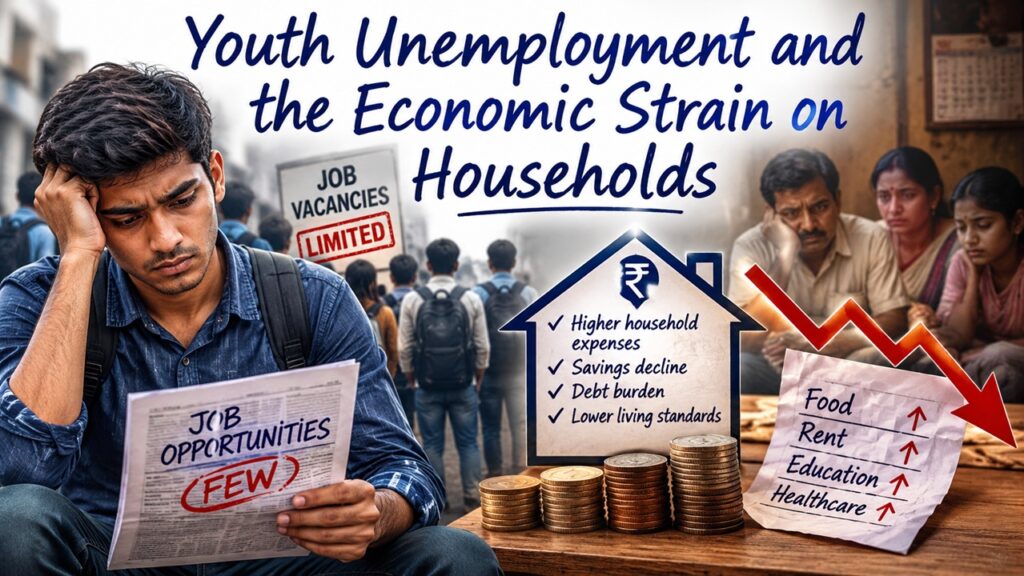
An economist’s assessment of the Periodic Labour Force Survey (PLFS) 2025 highlights that prolonged youth unemployment imposes a significant financial and social cost on Indian households. The findings challenge the perception of joblessness as only an individual employment problem and underline its wider impact on family welfare and economic mobility.
Understanding the Household Impact of Youth Joblessness
- Family-Level Economic Burden: Youth unemployment affects not only job seekers but also families that invest heavily in higher education with expectations of improved income and social mobility.
- Delayed Workforce Entry: When educated young people remain outside formal employment for extended periods, household savings and consumption are affected, while graduates may be compelled to accept low-skilled or insecure work.
Major Findings from the Data
- Elevated Unemployment Among Graduates: The unemployment rate for youth aged 18–29 is around 14.8%, rising to 29.4% among tertiary-educated youth, including diploma holders, graduates and postgraduates.
- Large NEET Population: Around 40.1% of tertiary-educated youth are not in employment, education or training (NEET). Among female graduate NEETs, nearly 74.7% remain outside the labour force.
- Lower Household Spending: Families supporting an unemployed graduate spend approximately ₹1,087 less per month on overall consumption and ₹710 less per household member than comparable households without unemployed youth.
- Fewer Income Earners: Households with unemployed graduates have an average of 1.5 earning members compared with 2.0 in other households. About 14.4% have no active earner, while 39.5% depend on a single earner.
- Extended Job-Search Periods: Nearly 58% of unemployed graduates have been seeking employment for more than a year, while 28.9% have been searching for over two years.
Why Graduate Unemployment Remains Persistent
- Mismatch Between Aspirations and Opportunities: Higher education often raises expectations for stable, well-paid employment, making graduates reluctant to enter informal or low-paying occupations.
- Slow and Uncertain Recruitment: Examination delays, paper leaks, litigation and lengthy public-sector selection processes can keep candidates in prolonged preparation cycles.
- Education–Industry Disconnect: University programmes do not always provide the practical and technical competencies demanded by rapidly expanding digital, manufacturing and service industries.
- Limited Formal Employment: Although services and gig work are expanding, the supply of secure private-sector jobs with regular wages, social protection and career progression remains inadequate compared with the growing graduate workforce.
- Gender-Specific Constraints: Safety concerns, inadequate childcare facilities, mobility restrictions and a shortage of suitable local employment opportunities discourage many educated women from joining the formal workforce.
Economic and Social Consequences for Families
- Declining Savings and Rising Financial Pressure: Education expenses, coaching costs and prolonged job searches can consume household savings and increase dependence on borrowing.
- Reduced Household Welfare: Single-earner families may cut expenditure on nutrition, healthcare and the education of younger family members to support unemployed graduates.
- Underemployment and Long-Term Wage Losses: Financial pressure can force qualified youth into jobs below their skill levels, potentially affecting their future earnings and career progression.
- Restricted Social Mobility: When education fails to translate into productive employment, families may struggle to achieve the upward economic mobility they had anticipated.
- Mental and Social Strain: Long-term unemployment can contribute to anxiety, reduced self-confidence, dependency and social stigma.
Policy Measures to Ease the Burden
- Improve Recruitment Efficiency: Establish predictable recruitment calendars, strengthen examination security and ensure time-bound completion of selection and appointment procedures.
- Align Higher Education with Labour Demand: Update university curricula and expand apprenticeships, industry-linked training, internships and professional certifications.
- Promote Formal Private Employment: Strengthen employment-linked incentives and encourage MSMEs to recruit and retain first-time graduates.
- Support Young Job Seekers: Introduce targeted employment-transition assistance, including need-based stipends and digital support for candidates from financially vulnerable households.
- Strengthen Women’s Workforce Participation: Expand safe public transport, affordable working-women accommodation, childcare support and flexible employment arrangements.
Conclusion
Youth unemployment is not merely a lost opportunity for individuals; it also places a substantial burden on the families that support them. Faster recruitment, industry-oriented education, expansion of formal jobs and targeted household support are crucial to convert India’s young workforce into a genuine demographic dividend.
Source : The Hindu