
Artificial Intelligence in Indian Agriculture: Building an Inclusive and Climate-Resilient Farming System
Context
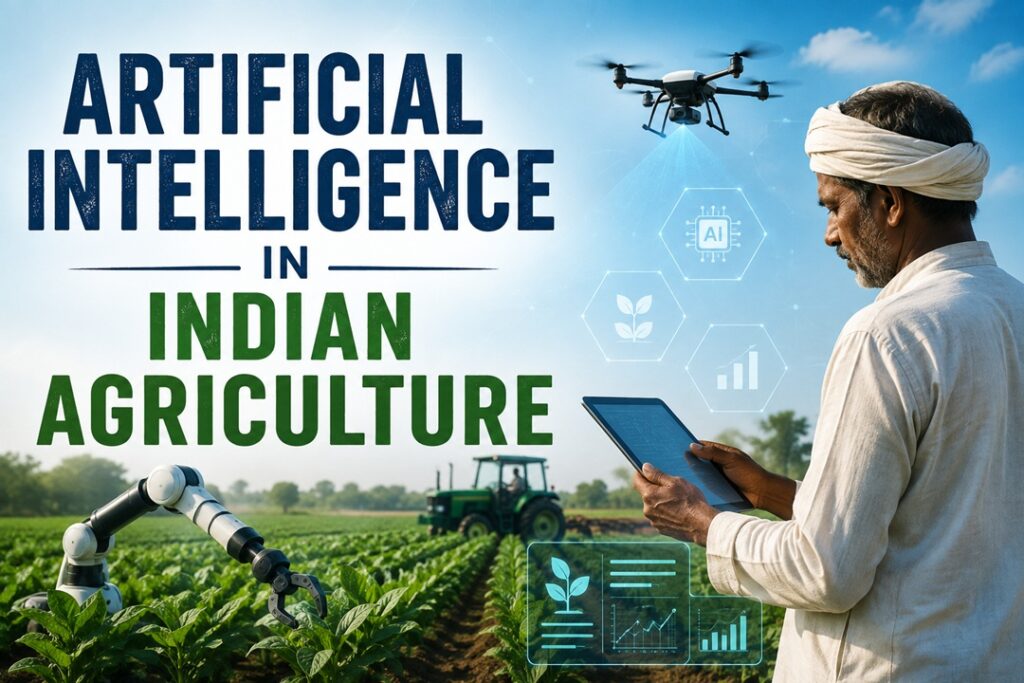
Artificial Intelligence (AI) is emerging as a promising tool for Indian agriculture, particularly as farmers face climate uncertainty, fragmented landholdings, rising input costs, resource pressures and volatile markets. However, its benefits will depend on whether technology remains affordable, locally relevant and accessible to small and marginal farmers.
How Can AI Transform Indian Agriculture?
- Climate Risk Management – AI can combine weather forecasts, satellite imagery and soil information to generate location-specific advisories.
- This can support decisions related to sowing, irrigation and harvesting.
- Precision Input Management – AI-driven tools can determine the appropriate use of water, fertilisers and pesticides.
- This can lower input expenditure while improving resource efficiency.
- Early Crop Stress Detection – AI-powered remote sensing can identify signs of pest attacks, diseases and crop stress at an early stage.
- Timely intervention can minimise production losses.
- Smarter Agricultural Markets – AI can process information on prices, demand, supply and market conditions.
- Farmers can use such insights to decide what to grow, when to sell and where to market their produce.
- Livestock and Fisheries Applications – AI can assist with disease monitoring, productivity assessment and early diagnosis in livestock.
- Similar technologies can support fisheries monitoring and improve productivity.
What Could Limit the Benefits of Agricultural AI?
- Digital Inequality – Large and financially stronger farmers may adopt advanced technologies more rapidly than small and marginal cultivators.
- This may deepen existing gaps in productivity, market access and farm earnings.
- Control Over Agricultural Data – Data generated through land records, crop surveys, satellites, insurance and digital marketplaces has considerable economic value.
- Excessive private control could create information asymmetry and allow concentration of economic benefits.
- Fragmented Farm Structure – Many AI solutions are initially designed around large-scale commercial farming.
- They must be redesigned for India’s small holdings, diverse crops and varied agro-climatic conditions.
- Weak Physical Foundations – AI cannot compensate for inadequate irrigation, storage, rural connectivity, affordable credit, roads and market access.
- Digital advice has limited impact when farmers lack the means to implement it.
- Productivity-Income Disconnect – Higher yields may not necessarily result in greater farmer incomes.
- Benefits can be reduced by technology costs, falling prices, platform charges and weak bargaining power.
- Regional Accuracy Concerns – Agricultural conditions vary widely across India.
- AI models developed for one region may not produce reliable recommendations elsewhere, making local validation and continuous monitoring essential.
Building a Farmer-Centric AI Ecosystem
- Shared Digital Infrastructure – Develop interoperable datasets, common technical standards, open interfaces and affordable computing facilities.
- This can enable startups, universities, FPOs and State governments to develop solutions without excessive dependence on dominant platforms.
- Stronger Farmer Data Governance – Farmers should have clear rights over the collection, access and use of their agricultural information.
- Data use should involve meaningful consent, transparency and safeguards against exploitative monetisation.
- Collective Technology Adoption – FPOs and cooperatives can aggregate farmer demand and facilitate access to AI services.
- Collective adoption can lower costs and strengthen farmers’ negotiating position.
- Human-AI Collaboration – AI-generated recommendations should be complemented by agricultural extension personnel.
- Local expertise remains essential because farming decisions are influenced by local conditions, experience, available resources and individual risk preferences.
- Measure Real-World Impact – AI initiatives should be assessed through outcomes such as:
- Higher farm incomes
- Lower input expenditure
- Reduced crop losses
- Improved price realisation
- Lower water consumption
- Greater climate resilience
- Reduced income fluctuations
Way Forward
- Develop AI-enabled agricultural systems as open and interoperable public digital infrastructure.
- Establish robust rules for farmer consent, data ownership, privacy and responsible data sharing.
- Make AI services affordable and accessible to small and marginal farmers.
- Use FPOs, cooperatives, Panchayats and extension networks as institutional channels for technology adoption.
- Develop models tailored to Indian crops, agro-climatic regions and regional languages.
- Encourage outcome-based funding linked to improvements in farm incomes, resilience and resource efficiency.
- Integrate AI deployment with investments in irrigation, storage, credit, insurance, connectivity and agricultural markets.
Conclusion
AI can help shift Indian agriculture towards more predictive, precise and climate-responsive decision-making. Yet technology by itself cannot overcome structural weaknesses in farming. India must therefore pursue an inclusive, farmer-centred AI ecosystem in which digital innovation complements physical infrastructure, local knowledge and public institutions. The ultimate test should be whether AI delivers sustainable improvements in farmers’ incomes, resilience and resource efficiency.
Source : Down To Earth