
ASUSE 2025: Mapping India’s Unincorporated Economy at the District Level
Context
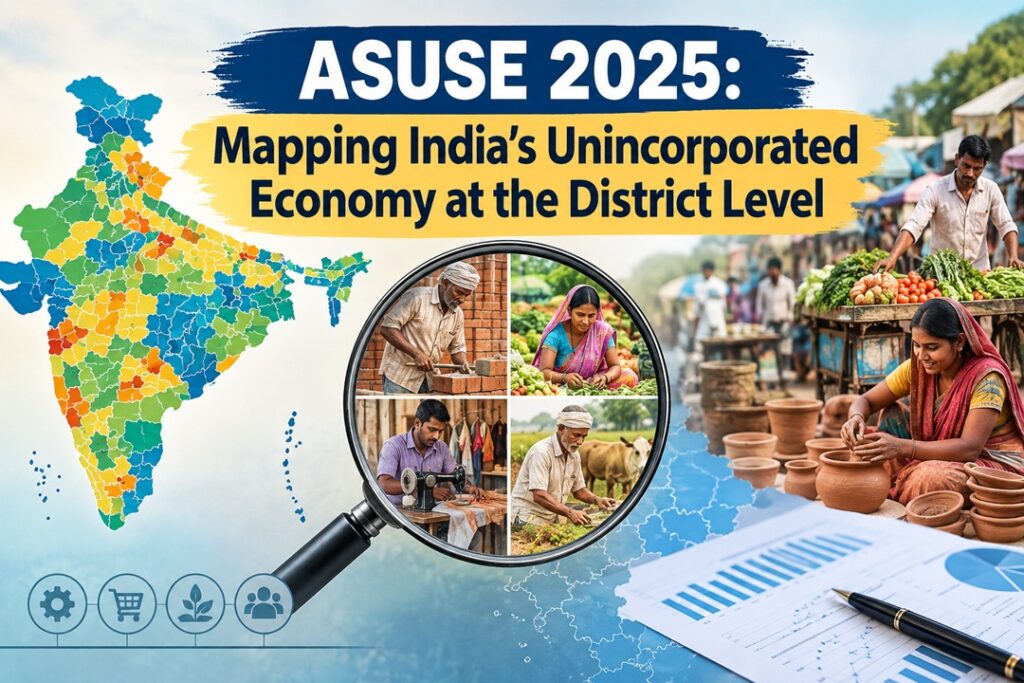
The National Statistics Office (NSO), under MoSPI, has released India’s first comprehensive district-level estimates of the unincorporated non-agricultural sector, based on the Annual Survey of Unincorporated Sector Enterprises (ASUSE) 2025. Covering 757 districts, the exercise provides a more granular picture of India’s informal and small-scale economic activity.
The unincorporated sector includes enterprises operating outside the corporate framework across manufacturing, trade and other services. It encompasses proprietorships, partnerships, cooperatives and trusts/societies and accounts for a substantial share of non-farm employment.
Key Findings
1. Economic Activity is Geographically Concentrated
The data reveals significant differences in the distribution of unincorporated enterprises across districts.
- The top 10 districts account for about 10% of establishments, workers and GVA generated by the sector.
- The top 50 districts, spread across 12 states, contribute nearly one-third of establishments, employment and GVA.
- Around one-third of districts have more than 1 lakh establishments, while nearly 9% have fewer than 10,000.
- Only 16 districts have more than 5 lakh unincorporated establishments, with several concentrated in West Bengal, Maharashtra and Gujarat.
This concentration indicates that informal economic activity is closely associated with major urban centres, industrial clusters and commercial regions.
2. Wide Differences in Labour Productivity
District-level GVA data highlights substantial variation in productivity.
- The national average GVA per worker is ₹1,56,539.
- 280 districts record productivity above this benchmark.
- In 331 districts, GVA per worker lies between ₹1 lakh and ₹1.5 lakh.
Such differences can reflect variations in infrastructure, access to finance, technology adoption, skills, market connectivity and the scale of enterprises.
3. Women’s Participation Shows Regional Variation
The survey also provides important spatial evidence on women’s role in the unincorporated economy.
- In 237 districts, women constitute at least one-third of the workforce.
- In 25 districts, women account for more than half of workers.
- Mizoram stands out, with women-owned proprietary enterprises accounting for at least half of establishments in every district.
- Telangana, Manipur, Meghalaya and Mizoram emerge as important regions for female ownership and participation.
These patterns demonstrate that women’s economic participation is not uniform and that successful regional models can provide lessons for expanding women-led enterprises elsewhere.
4. Major State-Level Economic Hubs
Several districts account for a significant proportion of their respective state-level establishments:
| State | Leading District | Share of State Establishments |
|---|---|---|
| West Bengal | North 24 Parganas | 15.99% |
| Telangana | Rangareddy | 23.53% |
| Gujarat | Surat | 19.43% |
| Punjab | Ludhiana | 14.74% |
| Karnataka | Bengaluru Urban | 12.83% |
| Kerala | Thiruvananthapuram | 12.38% |
| Rajasthan | Jaipur | 11.70% |
| Maharashtra | Pune | 9.14% |
| Bihar | Patna | 8.23% |
| Tamil Nadu | Chennai | 7.13% |
| Uttar Pradesh | Prayagraj | 5.77% |
The figures illustrate how economic activity can be heavily concentrated within particular districts even inside economically diverse states.
Methodology and Limitations
ASUSE 2025 adopted a multi-stage stratified sampling approach. Census villages and relevant urban sampling blocks served as initial sampling units, followed by individual enterprises as the ultimate units of survey.
The survey covered 757 of 770 sampled districts across States and Union Territories. Information was collected through Computer Assisted Personal Interviewing (CAPI) using handheld devices and monthly oral-recall enquiries.
There are, however, important limitations:
- Separate district estimates could not be produced for Delhi because of its sampling structure.
- Chandigarh and Lakshadweep, each having a single district, have district figures corresponding to their UT-level estimates.
- Estimates for smaller districts may have higher Relative Standard Errors (RSEs), requiring caution when making comparisons or identifying trends.
Therefore, district-level estimates should be interpreted as statistical indicators rather than precise measures of every individual enterprise.
Policy Significance
Moving Beyond State-Level Averages
The dataset can help policymakers identify district-specific economic strengths and weaknesses that may remain hidden in state-level statistics. District administrations can use it to identify enterprise clusters, productivity gaps and areas requiring targeted intervention.
Improving Access to Finance
District-level productivity information can help financial institutions better direct credit towards areas with weaker enterprise performance. Schemes such as PM MUDRA Yojana and PM SVANidhi can potentially be calibrated according to local economic conditions.
Accelerating Formalisation
Many small proprietary enterprises face difficulties accessing institutional finance and formal social-security mechanisms. Linking suitable enterprises with platforms such as the Udyam Assist Platform can support their transition towards greater formalisation.
Supporting Women Entrepreneurs
The geographical concentration of women-owned enterprises provides an opportunity to design place-specific interventions. Successful experiences in the Northeast and Telangana can inform strategies for expanding women’s ownership and participation in other districts.
Way Forward
- Develop district-level enterprise development plans based on productivity, employment and sectoral characteristics.
- Improve access to affordable institutional credit, digital infrastructure and markets for low-productivity districts.
- Strengthen skill development and technology adoption among micro and small enterprises.
- Use district data to improve the targeting of formalisation, social-security and entrepreneurship programmes.
- Regularly update district-level statistics to monitor whether regional disparities are narrowing.
Conclusion
ASUSE 2025 marks an important shift towards more decentralised economic measurement in India. By revealing variations in enterprise concentration, productivity and women’s participation across districts, it can enable more targeted policies for strengthening the country’s vast unincorporated economy.
Source : PIB