
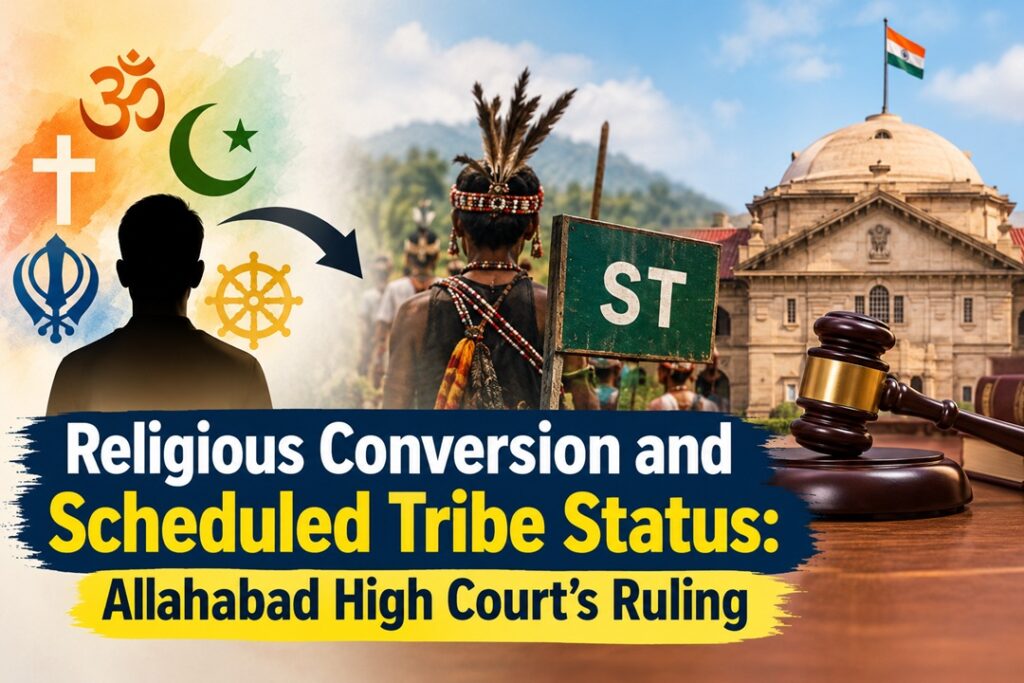
Religious Conversion and Scheduled Tribe Status: Allahabad High Court’s Ruling
Context
The Allahabad High Court clarified that conversion to another religion does not, by itself, terminate a person’s Scheduled Tribe (ST) status. However, where ST status is disputed, the person’s continuing connection with the recognised tribal community can be examined on the basis of evidence.
The case is significant because it separates religious identity from tribal identity, while also highlighting the need to protect tribal land and prevent misuse of ST safeguards.
Background of the Case
The dispute concerned three agricultural land transactions in Sonbhadra, Uttar Pradesh, carried out in 2011, 2017 and 2018.
The petitioner, who purchased the land, claimed ST status by birth as a member of the Bhuiyan tribe. Her status was subsequently questioned after official records indicated that she had married a Muslim man and converted to Islam.
The Deputy Collector declared the transactions invalid under Section 157-B of the U.P. Zamindari Abolition and Land Reforms Act, 1950, which restricts the transfer of protected tribal land to persons who are not members of the Scheduled Tribes.
The petitioner challenged the decision before the High Court.
Court’s Key Observations
The High Court made an important distinction between conversion and loss of tribal status:
- Conversion is not an automatic disqualification: The Constitution (Scheduled Tribes) Order, 1950 does not prescribe a general religion-based exclusion from ST status.
- Tribal identity and religious identity are distinct: A change of religion does not necessarily mean that a person has ceased to belong to their tribal community.
- Status depends on facts and evidence: Where continuation of ST status is contested, the person’s relationship with the tribal community can be assessed through relevant evidence.
- No rigid cultural test: A person is not necessarily required to follow every tribal custom continuously throughout life to retain tribal identity.
- Single documents are insufficient: Merely recording a person as belonging to another religion cannot, by itself, conclusively determine their tribal status.
The Court referred to State of Kerala v. Chandramohanan (2004) and Chinthada Anand v. State of Andhra Pradesh (2026) while examining the issue.
However, in the present case, the petitioner could not establish a sufficient continuing connection with the Bhuiyan community. The Court therefore upheld the cancellation of the disputed land transactions.
Why is the Judgment Significant?
1. Tribal identity is not synonymous with religion
The ruling emphasises that ST recognition is primarily connected with membership of a notified tribal community, rather than adherence to a particular religion.
2. Difference from the Scheduled Caste framework
The constitutional framework for Scheduled Tribes does not impose the same general religion-based restriction found in the legal framework governing Scheduled Caste status.
3. Importance for tribal land protection
ST status is linked not only to affirmative action but also to protective legislation. Restrictions on tribal land transfers seek to prevent alienation, exploitation and dispossession of tribal communities.
4. Need for an evidence-based approach
The judgment highlights the difficulty of determining whether a person continues to have a genuine tribal affiliation after significant changes in religion, marriage or social circumstances.
Constitutional Safeguards for Scheduled Tribes
Article 342 – Identification of Scheduled Tribes
The President specifies the tribes and tribal communities recognised as STs for each State or Union Territory. Parliament has the power to subsequently modify these lists.
Thus, recognition is fundamentally linked to membership of a notified community, rather than religion.
Articles 15(4) and 15(5) – Educational Advancement
These provisions enable special measures for the advancement of SCs and STs, including provisions relating to admission to educational institutions within the constitutional framework.
Article 16 – Public Employment
Article 16 provides the constitutional framework for reservation and other measures concerning representation of disadvantaged groups in public employment, including STs through relevant constitutional provisions and laws.
Article 46 – Protection from Exploitation
It directs the State to promote the educational and economic interests of weaker sections, particularly SCs and STs, and protect them from social injustice and exploitation.
Article 244 and the Fifth Schedule
These provide a special administrative framework for Scheduled Areas and Scheduled Tribes, including Tribes Advisory Councils and special responsibilities of Governors.
Sixth Schedule
It provides autonomous governance arrangements in specified tribal areas of Assam, Meghalaya, Tripura and Mizoram, helping protect tribal customs, culture and community institutions.
Article 338A – National Commission for Scheduled Tribes
The NCST monitors constitutional safeguards, investigates complaints and advises governments on matters concerning the welfare and development of STs.
Article 275(1) – Grants
It provides for grants-in-aid from the Consolidated Fund of India for ST welfare and the administration of Scheduled Areas.
Major Legal and Policy Safeguards
Protection of Tribal Land
State-specific laws restrict the transfer of tribal land to non-tribals. In the Allahabad High Court case, Section 157-B of the U.P. Act, 1950 was central to determining the legality of the land transactions.
Forest Rights Act, 2006
The Act recognises individual and community forest rights of eligible forest-dwelling STs and other traditional forest dwellers. The Gram Sabha has a central role in the recognition of these rights.
PESA Act, 1996
The Panchayats (Extension to Scheduled Areas) Act strengthens tribal self-governance in Scheduled Areas and empowers Gram Sabhas to protect tribal customs, traditions, cultural identity and community resources.
Key Challenges
- Determining continuing tribal affiliation: Religious conversion may change religious identity without necessarily severing social and cultural links with the tribe.
- Rigid identity tests: Requiring complete adherence to every traditional practice may overlook changes within tribal societies.
- Possibility of fraudulent claims: Since ST status carries constitutional protections and benefits, effective verification remains necessary.
- Diversity among tribes: Tribes differ significantly in their customs, social institutions and cultural practices, making a single uniform test difficult to apply.
Way Forward
- Establish clear, evidence-based criteria for assessing continuing tribal affiliation.
- Treat religious conversion as one relevant circumstance rather than an automatic ground for exclusion.
- Consider multiple indicators, including community recognition, social participation, cultural links and documentary evidence.
- Avoid making a single document or religious identity determinative of tribal status.
- Strengthen verification mechanisms while ensuring that genuine ST claimants are not denied their rights.
- Enforce tribal land-protection laws effectively to prevent alienation and exploitation.
Conclusion
The judgment reinforces the legal distinction between religious conversion and tribal identity. A balanced approach should protect genuine tribal rights and resources while ensuring that ST safeguards are not misused.
Source : The Hindu