
Weaponisation of Space: Emerging Threats to the Global Orbital Commons
Context
The United States has publicly acknowledged deploying offensive on-orbit space-control capabilities, highlighting the growing shift of outer space from a support domain for military operations towards a potential arena of direct conflict.
Understanding the Weaponisation of Space
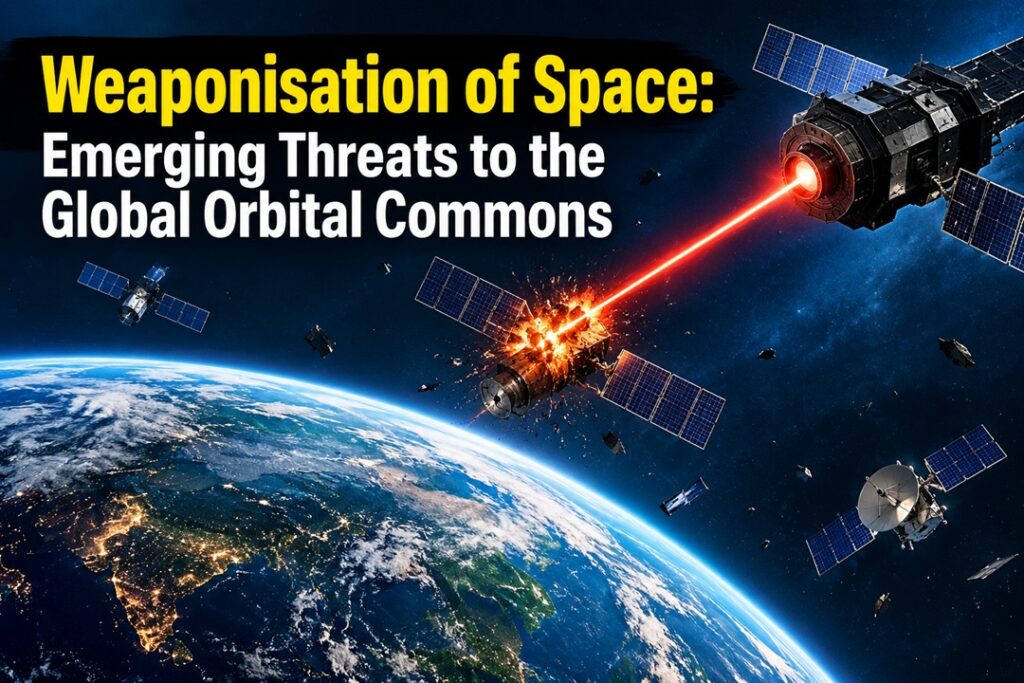
Weaponisation of space involves placing or developing systems designed to attack, disrupt, disable or destroy satellites and other space-based assets. It differs from militarisation of space, where satellites and space technologies are used for communication, navigation, surveillance and other military-support functions without necessarily being weapons themselves.
International Legal Framework
The Outer Space Treaty, 1967 remains the principal foundation of international space law. Its Article IV prohibits placing nuclear weapons and other weapons of mass destruction in orbit or stationing them in outer space. However, it does not expressly prohibit conventional orbital weapons, electronic warfare systems, kinetic interceptors or directed-energy weapons.
Other relevant frameworks include:
- UN Charter: Its principles, including the right of self-defence and peaceful settlement of disputes, extend to activities in outer space.
- Partial Test Ban Treaty, 1963: Prohibits nuclear explosions in the atmosphere, outer space and underwater.
- Moon Agreement, 1979: Restricts military activities on the Moon and other celestial bodies, although its acceptance among major space powers remains limited.
Growing Counter-Space Capabilities
The development of counter-space technologies has expanded beyond traditional anti-satellite missiles:
- Direct-Ascent ASAT Weapons: Ground-launched interceptors can physically destroy satellites in orbit. The United States, Russia, China and India have demonstrated such capabilities through different tests, including China’s 2007 destruction of Fengyun-1C and India’s 2019 Mission Shakti.
- Co-Orbital Systems: Manoeuvrable spacecraft can approach, inspect, shadow, interfere with or potentially disable another satellite. Such rendezvous and proximity operations have raised concerns about the military use of apparently non-aggressive spacecraft.
- Directed-Energy Weapons: Lasers and other energy-based systems can potentially dazzle, blind or damage satellite sensors without producing large quantities of physical debris.
- Electronic Warfare: Space-based jammers and spoofing systems can interfere with satellite communications, navigation signals and military command networks without physically destroying the targeted satellite.
- Space-Based Missile Defence: The growing interest in orbital interception systems could further blur the distinction between defensive missile architectures and offensive space-control capabilities.
Major Concerns
1. Orbital Debris and Kessler Syndrome
Destructive attacks on satellites can generate thousands of fragments travelling at extremely high velocities. These fragments may collide with other spacecraft, creating additional debris and potentially triggering a cascading chain of collisions known as Kessler Syndrome.
2. Risk of Escalation
A cyberattack, technical failure or unusual satellite manoeuvre may be difficult to distinguish from deliberate hostile action. Such ambiguity increases the possibility of miscalculation and escalation from an incident in space to a broader geopolitical conflict.
3. Threat to Civilian Services
Modern economies rely heavily on space infrastructure. Navigation, telecommunications, weather forecasting, aviation, financial transactions and emergency-response systems can all depend on satellites. Consequently, attacks on military satellites may also produce significant civilian consequences.
4. Dual-Use Technologies
Satellite servicing, refuelling, inspection and debris-removal technologies have legitimate peaceful applications but can potentially be adapted for hostile proximity operations. This creates difficulties in distinguishing civilian space activity from preparations for counter-space operations.
5. Gaps in International Governance
Existing treaties were largely developed before the emergence of sophisticated conventional counter-space weapons. The absence of comprehensive and binding restrictions on several categories of space weapons creates uncertainty over acceptable behaviour and increases the possibility of an arms race.
Way Forward
- Update international space law: Develop clearer and legally binding restrictions covering destructive ASAT weapons, co-orbital systems and other counter-space capabilities.
- Prevent debris-generating tests: Build international agreement around avoiding destructive ASAT testing that produces long-lived orbital debris.
- Promote responsible behaviour: Establish norms concerning close-proximity operations, manoeuvre notifications and safe operating distances.
- Strengthen Space Situational Awareness: Improve international data-sharing and tracking of orbital objects to reduce collision risks and distinguish routine activity from potentially hostile manoeuvres.
- Increase resilience: Develop distributed satellite architectures, including LEO constellations, so that disruption of an individual spacecraft does not cripple an entire service.
- Strengthen multilateral dialogue: Use UN-led mechanisms to build confidence-building measures and gradually develop stronger rules for military activities in outer space.
Conclusion
The growing deployment of counter-space capabilities demonstrates that outer space is becoming increasingly contested. Preventing an uncontrolled arms race requires stronger international rules, greater transparency and resilient space infrastructure. Protecting the orbital environment is not only a security imperative but also essential for preserving the civilian services on which modern societies depend.
Source : NDTV