
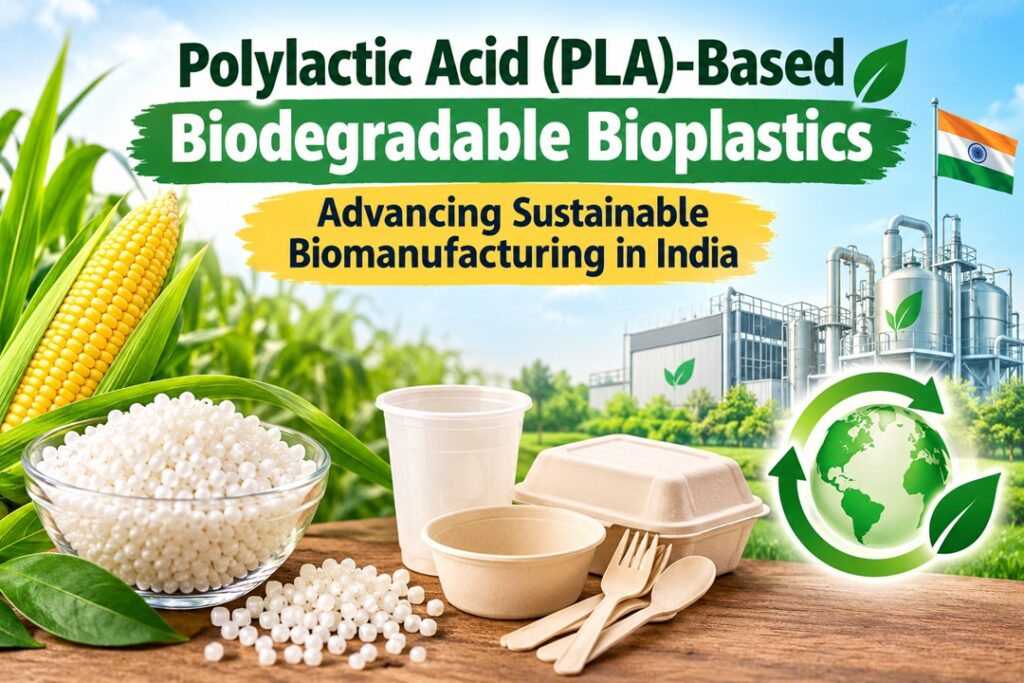
Polylactic Acid (PLA)-Based Biodegradable Bioplastics: Advancing Sustainable Biomanufacturing in India
Context
The Union Government has formally initiated the commercial development of Polylactic Acid (PLA)-based biodegradable bioplastics under the BioE3 (Biotechnology for Economy, Environment & Employment) Policy, aimed at strengthening India’s domestic bio-based manufacturing ecosystem.
Polylactic Acid (PLA) is a plant-derived, compostable thermoplastic that can provide an alternative to petroleum-based plastics in several applications.
Polylactic Acid (PLA): What is it?
PLA is a bio-based aliphatic polyester produced by converting plant-derived sugars into lactic acid through fermentation. The lactic acid is then polymerised to manufacture PLA.
Feedstocks can include:
- Sugarcane and sugarcane juice
- Molasses
- Corn starch
- Cassava
- Other agricultural biomass
Thus, PLA production can link India’s agricultural resources with the emerging bioeconomy and create a waste-to-wealth pathway.
Key Features of the Initiative
1. Agricultural feedstocks as raw material
The initiative seeks to utilise sugarcane, molasses and agricultural biomass for producing lactic acid and subsequently PLA. This can provide additional value streams for agricultural produce and residues beyond conventional applications such as ethanol production.
2. Pilot-scale production
A 100-tonne-per-annum (TPA) pilot facility at Kumbhi, Uttar Pradesh, is proposed to demonstrate the technology at scale. It will help assess production economics, refine manufacturing processes and develop PLA grades suited to different industrial requirements.
3. Compostable alternative to conventional plastics
Under appropriate industrial composting conditions, PLA can break down into carbon dioxide, water and biomass. This offers an alternative to plastics that remain persistent in the environment, although effective waste segregation and suitable composting infrastructure remain important for achieving these benefits.
4. Diverse applications
Depending on its formulation and grade, PLA can provide properties such as rigidity, tensile strength and transparency. Potential applications include:
- Food and consumer packaging
- Agricultural films
- Textiles
- Medical applications such as sutures
5. Potential climate benefits
Since PLA is produced from renewable biological feedstocks rather than fossil resources, its lifecycle greenhouse-gas emissions can be significantly lower than those of some conventional petroleum-based plastics. Estimates associated with the initiative indicate reductions of up to 60–70% in certain comparisons.
Significance for India
Promoting a bio-based economy: The initiative supports the BioE3 framework by moving biotechnology beyond research into commercially viable manufacturing.
Reducing fossil-plastic dependence: Indigenous PLA production can expand the availability of alternatives to petroleum-derived plastics, including those used in disposable and packaging applications.
Supporting circular resource use: Using sugarcane residues and agricultural biomass can generate additional economic value from biological resources and contribute to a waste-to-wealth model.
Supporting plastic-waste management: Greater availability of suitable biodegradable and compostable materials can complement India’s efforts to reduce plastic pollution under the Plastic Waste Management framework.
Strengthening the bioeconomy: Domestic production can contribute to India’s broader ambition of developing a large-scale bioeconomy while creating opportunities across agriculture, biotechnology, manufacturing and waste management.
Way Forward
India should focus on improving the cost competitiveness and scalability of PLA production, developing clear standards for compostable plastics, expanding industrial composting and waste-segregation infrastructure, and preventing biodegradable alternatives from becoming a substitute for waste reduction and reuse. Greater investment in R&D can also help develop PLA grades suited to Indian climatic and industrial conditions.
Conclusion
PLA-based bioplastics represent an important application of biotechnology to environmental and industrial challenges. By combining agricultural feedstocks, domestic manufacturing capabilities and sustainable material innovation, the initiative can help India move towards a more resource-efficient and bio-based production system.
Source : PIB