
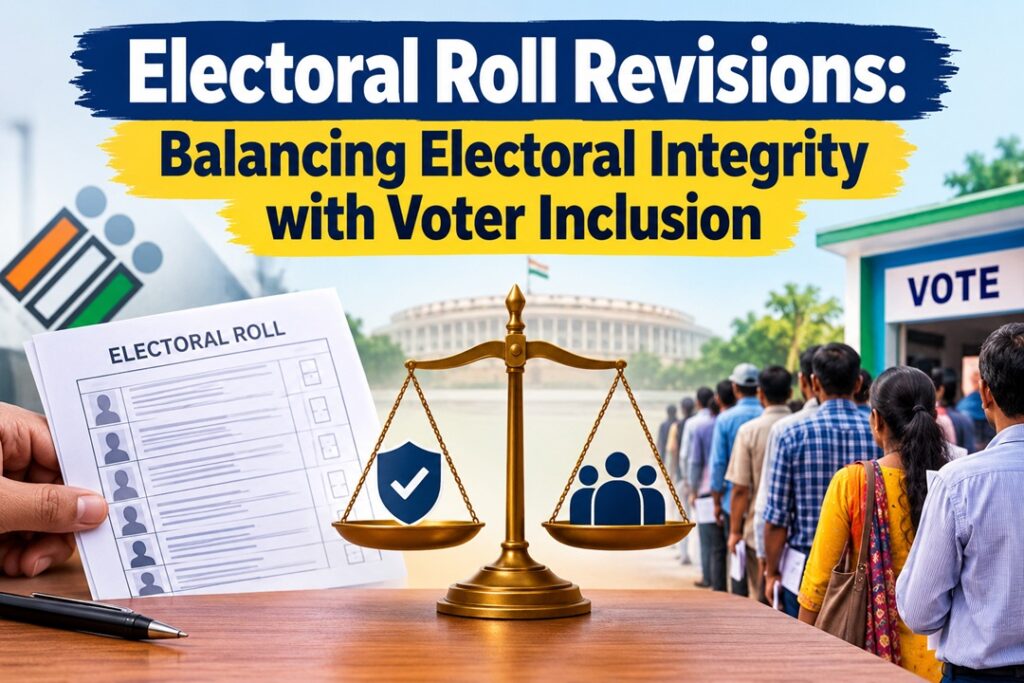
Electoral Roll Revisions: Balancing Electoral Integrity with Voter Inclusion
Context
The ongoing Special Intensive Revision (SIR) of electoral rolls has triggered concerns over large-scale voter deletions and the possibility of excluding genuine citizens, particularly migrants and other vulnerable groups, from the democratic process.
Strengthening the Electoral Roll
The Special Intensive Revision is an Election Commission of India exercise aimed at creating accurate electoral rolls through detailed verification and house-to-house enumeration. It seeks to remove names of deceased persons, duplicates, shifted electors and other ineligible entries. The exercise derives statutory support from Section 21 of the Representation of the People Act, 1950 and the Registration of Electors Rules, 1960, alongside the ECI’s constitutional authority under Article 324.
However, the scale of reported deletions has raised questions about whether the process is adequately distinguishing between ineligible and legitimate voters. Estimates indicate that around 13 crore entries have already been removed, with the figure potentially reaching nearly 14 crore as further phases continue. In some constituencies, the number of deletions has also appeared unusually high compared with previous electoral participation.
Concerns Over Vulnerable Communities
The impact of electoral exclusions is not evenly distributed. Migrant workers, women, Dalits, Adivasis, religious minorities, De-notified and Nomadic Tribes and economically disadvantaged citizens may face greater difficulties in proving their electoral eligibility.
Internal migration is a particularly important challenge. A worker who moves temporarily or seasonally for employment may be removed from the previous constituency without being promptly enrolled at the new place of residence. Such gaps can effectively leave a citizen without representation.
Documentation and Verification Challenges
The requirement to establish links with older electoral records or produce historical documents can disadvantage citizens who lack reliable paperwork. Poor households, informal-sector workers and mobile populations may have limited access to documents dating back several decades.
There are also concerns regarding errors in field verification, including living persons being incorrectly classified as deceased or shifted. At the same time, dependence on automated databases and software-based matching can amplify errors when local officials have limited ability to correct or reverse wrongful deletions.
Accuracy versus Universal Franchise
Cleaning electoral rolls is necessary for maintaining the principle of one person, one vote. Duplicate or fictitious entries can undermine electoral integrity and must be addressed.
However, electoral accuracy cannot come at the cost of excluding genuine voters. The right to participate in elections is central to India’s system of universal adult suffrage. A wrongful deletion is therefore more consequential than an ordinary administrative error because it directly affects a citizen’s political voice.
The challenge becomes greater when electoral databases are increasingly used as reference points for accessing public services. An erroneous deletion may therefore deepen the exclusion of already vulnerable citizens from both political participation and public institutions.
Institutional and Democratic Concerns
The comparison with earlier intensive revisions also raises questions about the degree of local participation in the verification process. Earlier exercises relied more heavily on community-level scrutiny, whereas contemporary systems increasingly combine centralized databases, legacy mapping and automated processes.
The Election Commission must therefore ensure that technology remains a tool for verification rather than becoming an unquestionable basis for exclusion. Similarly, overburdened Booth Level Officers require adequate resources, training and time to conduct meaningful field verification.
Way Forward
- Ensure due process before deletion: Every proposed deletion should be accompanied by adequate notice, an opportunity for the elector to respond and an accessible appeal mechanism.
- Strengthen local verification: Draft deletion lists should be publicly displayed and scrutinized through Gram Sabhas, ward-level institutions and participation of recognized political-party representatives.
- Protect migrant voters: Electoral systems should facilitate seamless transfer of registration when citizens move within the country for employment or other legitimate reasons.
- Audit technology-driven exclusions: Independent statistical and technical audits should identify unusual deletion patterns and enable rapid restoration of wrongly removed names.
- Improve institutional capacity: BLOs and Electoral Registration Officers should receive sufficient manpower, training and technological support for accurate verification.
- Strengthen judicial and independent oversight: Large-scale exclusion exercises should remain subject to transparent review and effective legal remedies.
Conclusion
Electoral roll revision is essential for credible elections, but the pursuit of cleaner rolls must not undermine universal adult suffrage. The legitimacy of SIR will ultimately depend on whether it can remove ineligible entries while protecting every genuine voter from arbitrary exclusion. A transparent, participatory and rights-based verification process is therefore essential to preserve both electoral integrity and democratic inclusion.
Source : Front Line