
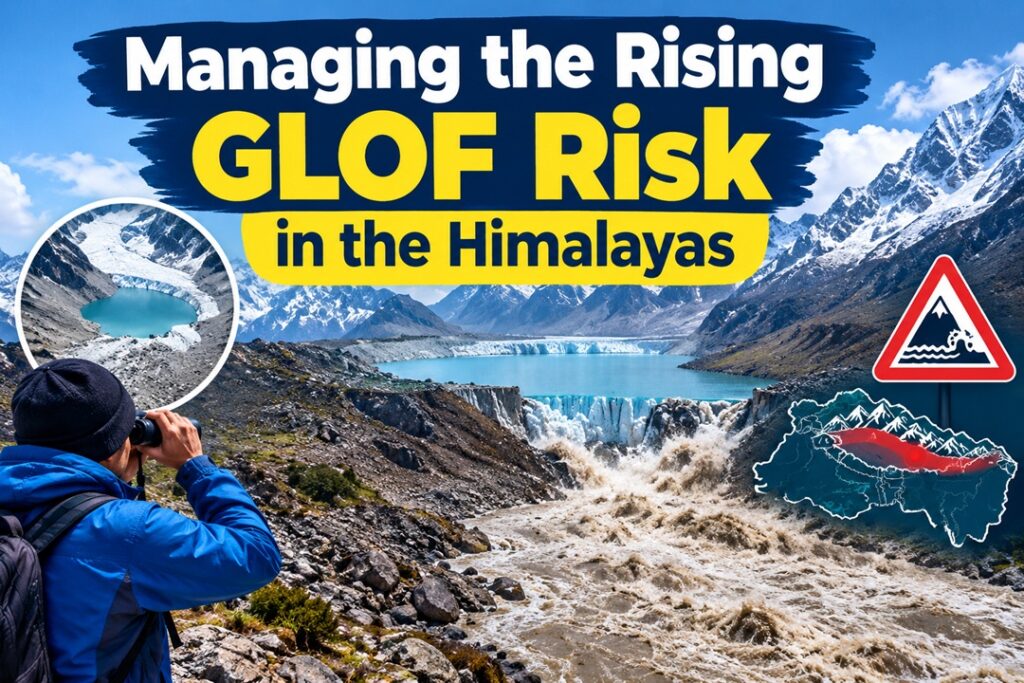
Managing the Rising GLOF Risk in the Himalayas
Context
Three years after the 2023 Sikkim Glacial Lake Outburst Flood (GLOF), India has expanded surveillance of glacial lakes and initiated risk-mitigation measures. However, weaknesses in last-mile warnings, community preparedness and climate-resilient infrastructure continue to expose Himalayan communities to severe cascading hazards.
Glacial Lake Outburst Floods and the Emerging Himalayan Risk
A Glacial Lake Outburst Flood (GLOF) occurs when a glacial lake suddenly releases a large quantity of water, often following the failure of a moraine dam. Landslides, avalanches, ice falls and earthquakes can destabilise such lakes and trigger rapid downstream flooding.
The risk is increasing as climate change accelerates glacier retreat, causing many glacial lakes to expand and accumulate larger volumes of water. The steep and geologically fragile Himalayan terrain, combined with seismic activity, can further amplify the consequences. A single GLOF may evolve into debris flows, landslides and flash floods, affecting areas far beyond the original lake.
Human activities have also increased exposure. Roads, hydropower projects, settlements and tourism facilities are frequently concentrated along river valleys, which are particularly vulnerable to sudden flood surges. Consequently, a GLOF can simultaneously disrupt lives, agriculture, tourism, energy generation and transport networks.
Lessons from the 2023 Sikkim Disaster
The 2023 Sikkim GLOF demonstrated the scale and cascading nature of the threat. The disaster affected nearly 80,000 people across about 100 villages, while officially recording 55 deaths, 74 missing persons and more than 7,000 displaced people.
Major infrastructure, including roads, bridges, buildings, farmland and hydropower facilities, suffered extensive damage. The Teesta III hydropower project at Chungthang was severely impacted. Overall losses were estimated at around ₹1,480 crore, covering infrastructure, agriculture, tourism and social sectors.
The event showed that a high-altitude glacial hazard can rapidly become a regional disaster when vulnerable infrastructure and settlements lie downstream.
Why the Himalayan Region Remains Vulnerable
The Hindu Kush Himalaya (HKH), spanning eight countries, contains numerous glacial lakes and is among the world’s important GLOF-prone regions. Vulnerability is heightened by difficult terrain, poverty, dependence on agriculture, expanding populations and limited disaster-management capacity.
In India, states such as Sikkim, Arunachal Pradesh, Himachal Pradesh and Uttarakhand face significant exposure. The concentration of settlements and infrastructure in narrow valleys means that even a relatively localised GLOF can produce extensive downstream impacts.
India’s Expanding Monitoring and Mitigation Efforts
India has strengthened its scientific assessment of glacial lakes through agencies such as the Central Water Commission (CWC) and the National Remote Sensing Centre (NRSC).
The NRSC’s 2023 inventory identified around 28,043 glacial lakes larger than 0.25 hectares. By June 2025, the CWC was monitoring 2,485 glacial lakes and 358 waterbodies across Indian Himalayan river basins.
The Union government’s National Glacial Lake Outburst Flood Risk Mitigation Project (NGRMP), with an allocation of ₹150 crore, covers Arunachal Pradesh, Himachal Pradesh, Sikkim and Uttarakhand. Its measures include real-time monitoring, early-warning mechanisms, controlled drainage of vulnerable lakes, automatic weather stations, strengthening of lake boundaries and development of GLOF-resilient infrastructure.
Persistent Gaps in GLOF Management
Despite these initiatives, significant challenges remain:
- Insufficient last-mile warnings: Monitoring a lake is not enough unless alerts reach downstream populations quickly and reliably.
- Difficult terrain: Remote high-altitude locations make installation, maintenance and communication difficult.
- Weak community preparedness: Communities require evacuation routes, drills and locally understandable warning protocols.
- Infrastructure exposure: Roads, bridges, dams and settlements located in river valleys can magnify disaster losses.
- Development pressures: Unplanned hydropower, tourism and road construction may increase vulnerability when ecological carrying capacity and hazard assessments are ignored.
- Data limitations: Long-term information on lake behaviour, historical GLOFs and changing hazard patterns remains inadequate in several areas.
- Transboundary risks: Himalayan rivers cross national boundaries, making information-sharing and coordinated warnings essential.
Way Forward
India needs to shift from a predominantly hazard-monitoring approach towards anticipatory and community-centred risk management.
Real-time sensors, satellite observations, automatic weather stations, remote sensing, AI-based modelling and predictive analytics should be integrated into a comprehensive GLOF early-warning network. Equally important is ensuring that warnings reach vulnerable communities through dependable communication channels.
At the local level, every high-risk settlement should have village-specific evacuation plans, clearly identified safe zones, regular mock drills and trained response teams. Risk-sensitive land-use planning should prevent or restrict critical infrastructure and dense construction in highly exposed zones.
Infrastructure planning in the Himalayas must incorporate GLOF and cascading-hazard assessments from the design stage itself. Roads, bridges, dams and hydropower facilities should be constructed and retrofitted according to scientifically assessed risk rather than merely historical flood patterns.
A unified national database on glacial lakes, GLOF events, losses and changing risk profiles can strengthen evidence-based planning. Better coordination among the CWC, NRSC, NDMA, State Disaster Management Authorities and district administrations is also necessary.
Since Himalayan river systems are transboundary, India should further promote regional cooperation on hydrological data, glacial-lake monitoring and emergency warnings among Himalayan countries.
Conclusion
GLOFs illustrate how climate change, fragile mountain ecosystems and infrastructure exposure can interact to produce cascading disasters. India has made progress in mapping and monitoring glacial lakes, but effective risk reduction ultimately depends on connecting scientific knowledge with early warnings, resilient infrastructure and prepared communities. Building such a system is essential for protecting Himalayan lives, livelihoods and development gains.
Source : Down To Earth