
Crowd Crushes in India: Causes, Challenges and Preventive Measures
Context
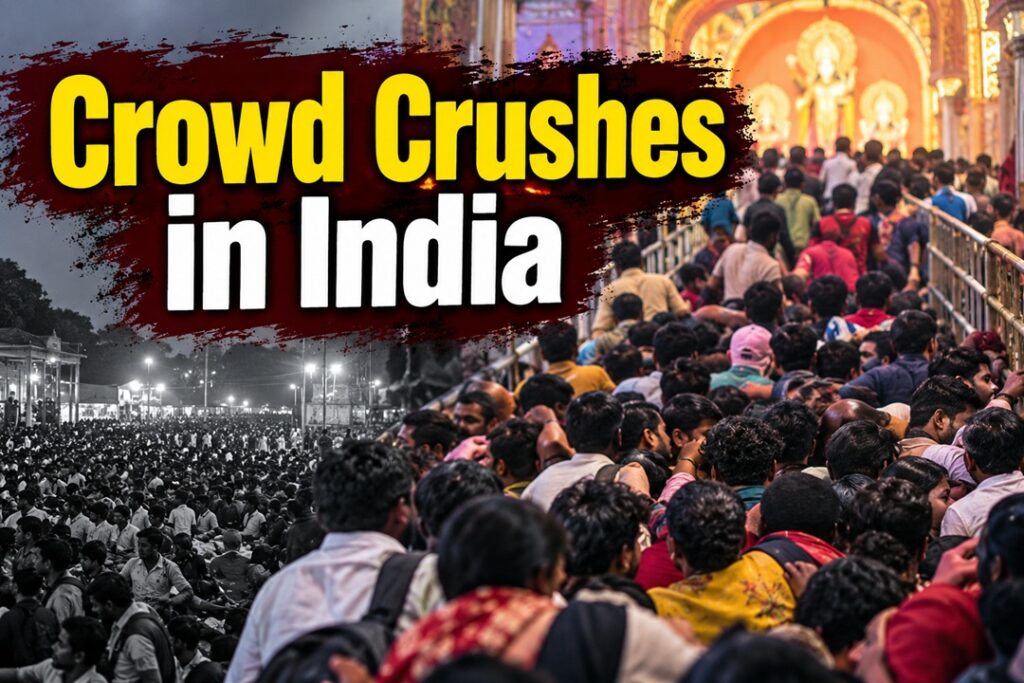
The deadly crowd crush at the Chorbagan Sarbojanin Durga Puja pandal in north Kolkata in October 2026, which reportedly claimed at least 19 lives and injured 25 people, has renewed concerns over crowd safety at mass gatherings. Heavy rainfall and panic-inducing public announcements reportedly contributed to the tragedy, highlighting the need for scientific crowd management, effective emergency communication and stronger enforcement of safety standards.
Understanding Crowd Crushes in India
A crowd crush occurs when excessive human density and physical pressure prevent individuals from moving freely, potentially leading to suffocation, injuries and fatalities. Although commonly described as a stampede, the term crowd crush more accurately highlights the role of overcrowding, restricted movement and collective pressure.
According to data compiled by the National Crime Records Bureau (NCRB), more than 3,000 people died in stampedes across India between 2001 and 2022.
Religious festivals, pilgrimages, temple gatherings and public celebrations are particularly vulnerable because of fluctuating attendance, narrow access routes and limited emergency infrastructure.
Key Statistics and Trends
- Historical fatalities: More than 3,000 deaths were recorded in stampede incidents between 2001 and 2022, according to the cited NCRB data.
- Dangerous crowd density: Densities approaching 4–6 persons per square metre can severely restrict movement and generate dangerous crowd pressure, although the risk depends on the layout and movement of the crowd.
- Vulnerable groups: Women, children and older persons face heightened risks because they may have less ability to withstand compressive forces or escape rapidly.
- Religious gatherings: Pilgrimage centres and religious festivals account for a substantial share of major crowd disasters in India, according to disaster-management assessments.
Major Crowd Crush Incidents in India
- Kolkata Durga Puja Pandal, 2026: At least 19 people reportedly died amid heavy rainfall, overcrowding and panic at the venue.
- Sheetla Mata Temple, Bihar, 2026: Nine devotees reportedly lost their lives amid overcrowding during the Chaitra Navratri gathering.
- Mansa Devi Temple, Haridwar, 2025: Six pilgrims reportedly died in a crowd-related incident on the temple approach route.
- Hathras Satsang, Uttar Pradesh, 2024: A crowd disaster during a religious congregation killed 121 people, predominantly women and children.
- Vaishno Devi Shrine, Jammu and Kashmir, 2022: Twelve pilgrims died in a crowd surge near the shrine on New Year’s Day.
These incidents demonstrate that crowd disasters can occur across different settings, from temporary festival venues to established pilgrimage centres.
Major Causes of Crowd Crushes
1. Overcrowding and Capacity Mismatch
Allowing attendance beyond a venue’s safe holding capacity increases pressure on entry points and evacuation routes. Weak registration systems and poor monitoring of actual footfall make it difficult to regulate the number of visitors.
For example, the Hathras gathering in 2024 reportedly attracted a crowd far exceeding the authorised attendance.
2. Narrow Access Routes and Poor Venue Design
Shared entry and exit routes, narrow passages, steep approaches and inadequate emergency exits create bottlenecks. When opposing streams of people meet, movement can become obstructed and pressure can rapidly escalate.
Encroachments, temporary stalls and poorly positioned barricades further reduce the space available for evacuation.
3. Panic, Rumours and Sudden External Events
Heavy rainfall, electrical disturbances, falling structures or unverified rumours can trigger sudden movement. In densely packed crowds, even a localised disturbance may generate pressure that spreads to people far removed from the original trigger.
The absence of clear information can intensify fear and encourage people to move simultaneously towards perceived safety.
4. Ineffective Public Communication
Unclear or abrupt announcements may unintentionally direct large numbers of people towards the same entrance or exit. Inadequate coordination between loudspeaker operators, police and event organisers can worsen confusion during an emergency.
Communication must therefore provide calm, specific instructions rather than merely announce danger.
5. Administrative and Enforcement Failures
Inadequate risk assessments, insufficient personnel, weak enforcement of capacity limits and delayed emergency responses increase the likelihood of fatalities.
Treating crowd surges exclusively as law-and-order problems can also be counterproductive. Forceful attempts to push people backwards may intensify pressure when the crowd is already densely packed.
Challenges in Crowd Disaster Management
- Unpredictable attendance: Open-access festivals and urban celebrations attract visitors throughout the day, making real-time crowd estimation difficult.
- Geographical constraints: Historic temple towns and hilltop shrines often have narrow roads, steep approaches and limited space for expanding evacuation infrastructure.
- Fragmented institutional responsibility: Police, municipal authorities, disaster-management agencies, private organisers and religious trusts may operate without a unified command structure.
- Limited technical capacity: Many venues lack real-time density monitoring, evacuation modelling and systematic assessment of entry and exit flow.
- Weather and infrastructure risks: Rainfall, slippery surfaces, temporary structures, electrical hazards and inadequate shelter can create additional pressure during emergencies.
- Weak accountability: Safety plans may exist on paper but remain ineffective when inspections, permissions and capacity restrictions are not rigorously enforced.
Way Forward
1. Introduce Scientific Capacity Management
Authorities should establish maximum occupancy limits based on usable space, exit capacity and evacuation time. Timed entry, digital registration and staggered access can help regulate visitor flows at high-footfall events.
These measures should be supplemented with free or accessible alternatives for people who cannot use digital systems.
2. Redesign Entry, Exit and Evacuation Routes
Venues should have clearly separated entry and exit corridors wherever feasible, multiple emergency escape routes and strategically placed holding areas. Barricades should guide movement without creating enclosed spaces where people can become trapped.
Independent safety audits should be mandatory before large gatherings receive permission.
3. Deploy Real-Time Crowd Monitoring
CCTV analytics, overhead cameras, sensors and drones, where appropriate, can help estimate crowd density and identify congestion. Warning thresholds should trigger immediate measures such as pausing entry, redirecting visitors and opening designated relief routes.
Technology must support trained personnel rather than replace on-ground assessment and decision-making.
4. Establish Unified Emergency Command Systems
A designated incident commander should coordinate police, fire services, medical teams, municipal authorities and event organisers. Clearly assigned responsibilities and reliable communication channels can reduce delays during emergencies.
Regular joint drills should test evacuation plans under realistic conditions.
5. Strengthen Crisis Communication
Public announcements should be calm, consistent and action-oriented. Organisers must communicate safe routes, temporary entry restrictions and shelter arrangements in local languages.
Authorities should also establish mechanisms to verify and counter rumours quickly through trusted official channels.
6. Protect Vulnerable Visitors
Dedicated assistance points, accessible evacuation routes, trained volunteers and priority medical support should be provided for children, older persons and persons with disabilities.
Temporary shelters, drinking water and first-aid facilities can help prevent dangerous surges when visitors seek protection from adverse weather.
7. Ensure Accountability and Compliance
Permissions should be linked to verified safety arrangements, including crowd-capacity assessments, emergency access, trained marshals and medical preparedness. Post-incident investigations should identify systemic failures and lead to corrective action rather than focusing solely on individual negligence.
The National Disaster Management Authority’s crowd-management guidance should inform the planning, inspection and execution of large public gatherings.
Conclusion
Crowd crushes are often preventable disasters arising from excessive density, inadequate infrastructure, poor communication and failures in coordination. India’s experience with religious gatherings and public festivals demonstrates the need to shift from reactive emergency response towards preventive risk management. Scientific capacity limits, safer venue design, real-time monitoring and accountable administration can help ensure that cultural and religious celebrations remain safe, inclusive and accessible.
Source : NDTV